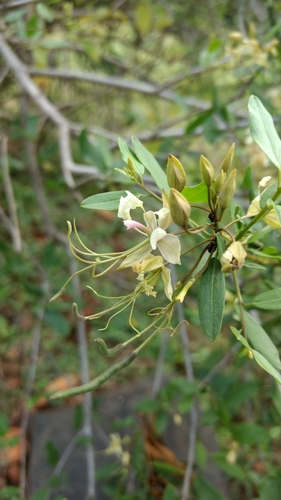
Boscia coriacea
Pax
Qalqalq, Mnafisi
iNaturalist· cc-by
(c) Rafael Medina, some rights reserved (CC BY)
Description
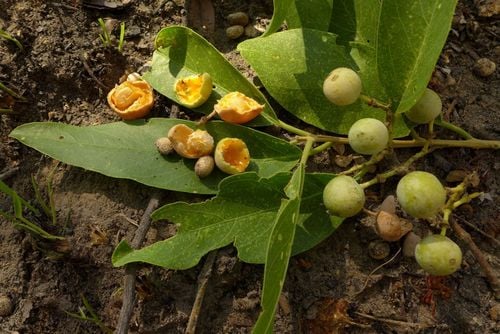
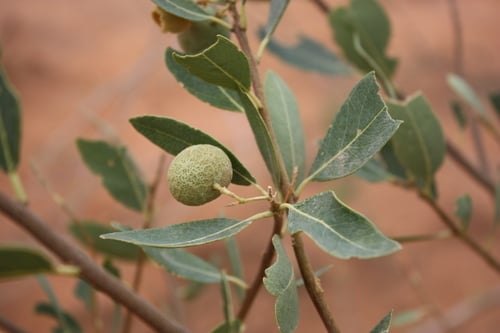
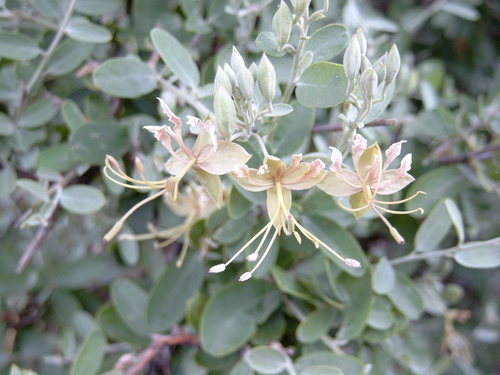
An evergreen shrub. It usually has several stems and many branches. It can grow 1-6 m tall. The bark is smooth and dark grey. The leaves are light green and leathery. They are narrowly oval with a sharp point. The flowers are creamy green. They are in dense groups 3 cm wide. The fruit are light green. They have a fleshy coat. The seeds are enclosed in a white skin.
Edible Uses
The ripe fruit is sucked for its sweet taste. The fruit is eaten after long boiling, with the outer coat pounded away before cooking. The seeds are boiled briefly to remove the outer skin, then the cotyledons are boiled with several water changes before eating. Twigs are used as flavouring.
Traditional Uses
The fruit is eaten after long boiling. The fruit are pounded to remove the outer coat. The seeds are boiled briefly to remove the outer skin then the cotyledons (seed leaves) are boiled changing the water several times before eating. The ripe fruit is sucked for its sweet taste.
Known Hazards
The fruit and seeds require extensive preparation (boiling and water changes) before consumption.
Distribution
It is a tropical plant. It grows in drier areas. It is usually on salty or sandy soils. It can grow between 150-1,500 m above sea level. It can grow in arid places.
Where It Grows
Africa, East Africa, Ethiopia, Kenya, New Zealand, Somalia, South Sudan, Sudan, Tanzania, Uganda,
Cultivation
Plants can be grown from seeds sown directly in the field where they are to grow.
Other Information
The fruit are eaten especially by children.
Nutrition
| Part | Moisture | kJ | kcal | Protein | Vit A | Vit C | Iron | Zinc |
|---|---|---|---|---|---|---|---|---|
| Fruit | 1994 | — | 7.5 | — | — | — | — | — |
Synonyms
Also Known As
Aytneba, Dhuorich Zoorich, Geri, Homura, Hurhurota, Isivu, Karkarota, Mdudu, Muthiu, Qalaaqal, Qarqarota, Sericho, Sorich, Sorichin, Sorichon
References (14)
- Addis, G., Asfaw, Z & Woldu, Z., 2013, Ethnobotany of Wild and Semi-wild Edible Plants of Konso Ethnic Community, South Ethiopia. Ethnobotany Research and Applications. 11:121-141
- East African Herbarum records, 1981,
- INFOODSUpdatedFGU-list.xls
- Lulekal, E., et al, 2011, Wild edible plants in Ethiopia: a review on their potential to combat food insecurity. Afrika Focus - Vol. 24, No 2. pp 71-121
- Maundu, P. et al, 1999, Traditional Food Plants of Kenya. National Museum of Kenya. p 77
Show all 14 references Hide references
- Morgan, W. T. W., 1981, Ethnobotany of the Turkana: Use of plants by a Pastoral People and Their Livestock in Kenya. Economic Botany 35(1):96-130
- Mutie, F. G., 2020, Conservation of Wild Food Plants and Their Potential for Combatting Food Insecurity in Kenya as Exemplified by the Drylands of Kitui County. Plants 2020, 9, 1017
- Mutie, F. M., et al, 2023, Important Medicinal and Food Taxa (Orders and Families) in Kenya, Based on Three Quantitative Approaches. Plants 2023, 12, 1145
- Ngugi, G., 2000, Case Study from Kenya on Indigenous Wild Vegetables. Paper 4 Workshop in Kenya 1999. p 33
- Peters, C. R., O'Brien, E. M., and Drummond, R.B., 1992, Edible Wild plants of Sub-saharan Africa. Kew. p 75
- Royal Botanic Gardens, Kew (1999). Survey of Economic Plants for Arid and Semi-Arid Lands (SEPASAL) database. Published on the Internet; http://www.rbgkew.org.uk/ceb/sepasal/internet [Accessed 5th April 2011]
- Teklehaymanot, T., 2017, An ethnobotanical survey of medicinal and edible plants of Yalo Woreda in Afar regional state, Ethiopia. Journal of Ethnobiology and Ethnomedicine 13:40
- Termote, C., et al, 2014, Assessing the potential of wild foods to reduce the cost of a nutritionally adequate diet: An example from eastern Baringo District, Kenya. Food and Nutrition Bulletin, vol. 35, no. 4
- World Checklist of Useful Plant Species 2020. Royal Botanic Gardens, Kew