Canna indica
L.
Indian shot, Queensland arrowroot, Edible canna
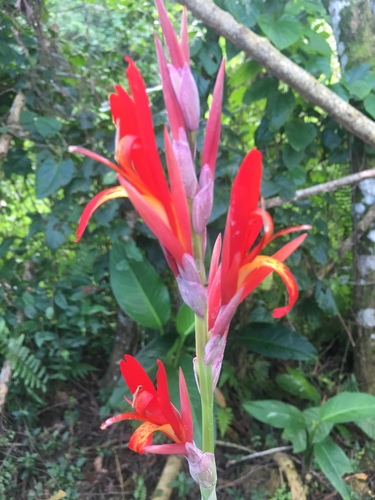
iNaturalist· cc-by-nc
(c) orlandomontes, some rights reserved (CC BY-NC), uploaded by orlandomontes
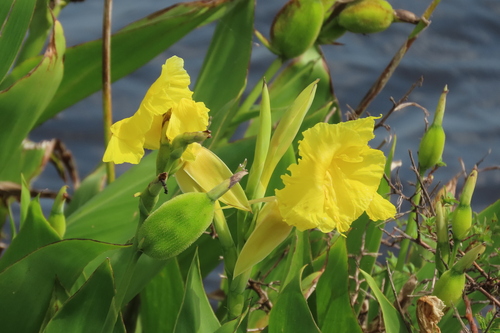
iNaturalist· cc-by
(c) Christoph Moning, some rights reserved (CC BY)
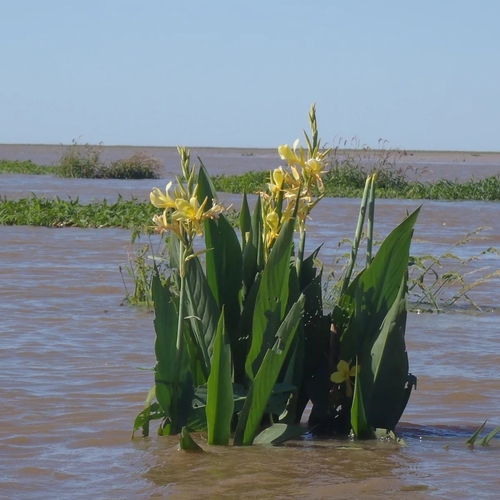
iNaturalist· cc-by-nc
(c) omar_urbina, some rights reserved (CC BY-NC)
Summary
Source: WikipediaCanna indica, commonly known as Indian shot, African arrowroot, edible canna, purple arrowroot, Sierra Leone arrowroot, is a plant species in the family Cannaceae. It is native to the Americas and naturalized elsewhere. The edible rhizomes are a source of starch.
Description
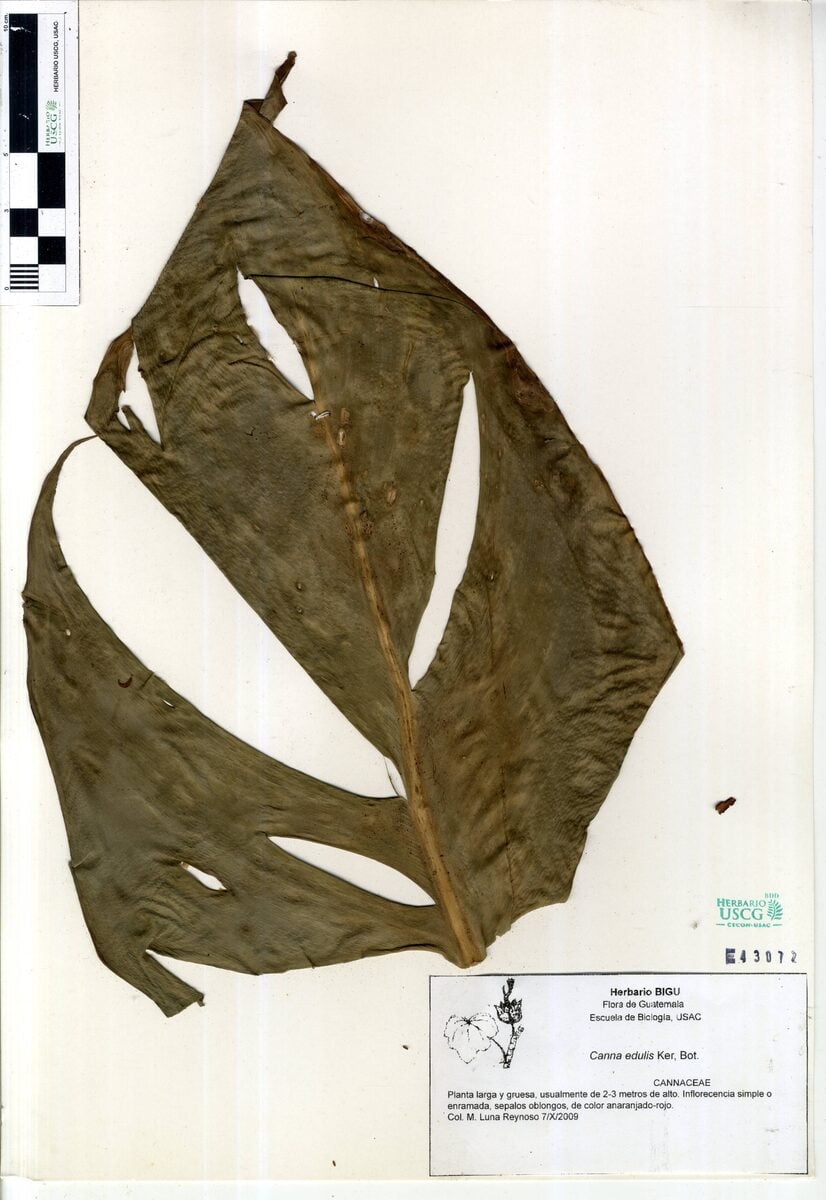
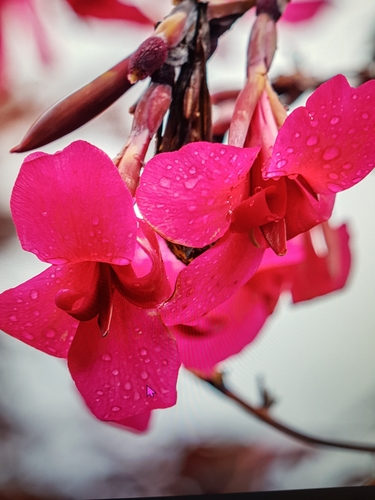
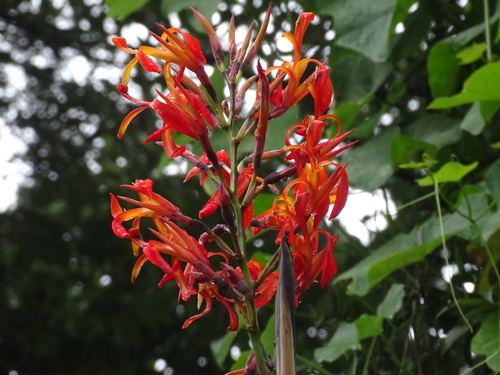
A broad leafed plant with purple leaf sheaths. It is about 1.5 to 2.5 m high. It grows as a perennial. The stems are in clusters. The leaves are large and smooth. They are dark green but can be reddish in some varieties. The leaf base forms a sheath around the stem. The flowers are red and produced at the top of the plant. The petals are small and red and 4-10 mm wide. The fruit is a 3 celled capsule with black seeds. Underground it has a much branched root or rhizome with fattened sections covered with leaf scars. These are often light red on the outside and yellowish white inside. A clump of 15-20 suckers often develops. These starchy tubers are from 6 cm across to 15 cm long. The shape varies. The seeds are black and hard. They are 5-7 mm across.
Edible Uses
The root is eaten cooked and is the source of 'canna starch', used as an arrowroot. It is prepared by rasping the root to a pulp, then washing and straining to remove the fibres. Very young tubers are eaten cooked — they are sweet but fibrous. Roots contain around 25% starch. There is one report of an edible fruit, but this is considered dubious as the fruit is a dry capsule containing very hard seeds.
Traditional Uses
The rhizomes are a source of starch. The rhizomes are eaten after cooking. They are boiled or baked. The leaves and rhizomes are used for animals. Starch can be extracted from the roots. This is achieved by rasping the tubers, then washing the starch out and straining out the fibres. The large starch grains are very digestible. The starch is used to make transparent noodles. The young shoots can be eaten as a green vegetable. Immature seeds are cooked.
Medicinal Uses
The plant is used in the treatment of women's complaints. A decoction of the root with fermented rice is used to treat gonorrhoea and amenorrhoea. The plant is also considered demulcent, diaphoretic, and diuretic.
Distribution
A tropical plant. It is grown and used in some of the coastal areas of the tropics and subtropics. It will grow from sea level up to 1600 m. In the Andes it grows between 1,000 and 2,500 m altitude. It needs a heavy fertile soil. It cannot stand strong winds. It does best with an evenly distributed rainfall. It cannot stand waterlogging. It grows in wetlands. It can stand some shade. It needs to be in a frost free location. It has some salt tolerance. It does best where both days and nights are warm. It grows in hardiness zones 8-12. In Sichuan and Yunnan.
Where It Grows
Africa, American Samoa, Andes, Antilles, Argentina, Asia, Australia, Bahamas, Belize, Bolivia, Brazil, Cambodia, Cameroon, Central Africa, Central America, Chile, China, Colombia, Congo DR, Costa Rica, Côte d'Ivoire, Cuba, Dominican Republic, East Africa, East Timor, Ecuador, El Salvador, Eswatini, Europe, Fiji, France, Gabon, Germany, Ghana, Grenada, Guam, Guatemala, Guiana, Guyana, Haiti, Honduras, India, Indochina, Indonesia, Iraq, Ivory Coast, Jamaica, Kiribati, Kurdistan, Laos, Madagascar, Malawi, Malaysia, Marquesas, Mexico*, Middle East, Myanmar, Nauru, Nepal, Nicaragua, Niger, Nigeria, North America, Northeastern India, Pacific, Pakistan, Panama, Papua New Guinea, PNG, Paraguay, Peru, Philippines, Rotuma, Sahel, Samoa, Sao Tome and Principe, SE Asia, Senegal, Sierra Leone, Slovenia, South Africa, Southern Africa, South America, Sri Lanka, St Helena, Suriname, Swaziland, Taiwan, Thailand, Timor-Leste, Tonga, Trinidad, Turkey, Türkiye, Tuvalu, Uganda, United Arab Emirates, UAE, Uruguay, USA, Vanuatu, Venezuela, Vietnam, West Africa, West Indies*,
Cultivation
They can be grown from seed. It is more easy to grow them by dividing the plant. The crowns should not be planted too deeply. The end section of the rhizome is planted. Well developed tubers with one or two undamaged buds should be used. A spacing of 1 m x 1 m is suitable. Tubers are planted about 15 cm deep and need to be kept weed free during early growth. About 2.5 tons of tubers are required to plant a hectare. The tubers are dug from between 6 and 19 months. The tubers can be stored if cool and dry. For starch manufacture they need to be processed immediately.
Propagation
Pre-soak seeds for 24 hours in warm water, then sow in February or March in a warm greenhouse at 20°C, planting 2–5cm deep in individual pots. Scarifying the seed can speed germination, particularly if the seed has not swollen after soaking. Germination usually occurs in 3–9 weeks. Grow plants on in a greenhouse for at least their first winter, then plant out in late spring or early summer after the last expected frosts. The root clump can be divided as the plant comes into growth in spring; each portion must have at least one growing point. Pot up divisions and grow on in the greenhouse until well established before planting out in summer. Root cuttings are also an option.
Other Uses
The plant yields a fibre — possibly from the stem — that serves as a jute substitute. A fibre obtained from the leaves is used to make paper: leaves are harvested in late summer after flowering, scraped to remove the outer skin, soaked in water for 2 hours, cooked for 24 hours with lye, and then beaten in a blender to produce a light tan-brown paper. A purple dye is obtained from the seed. Smoke from the burning leaves is said to be insecticidal.
Production
Harvesting occurs after about 8 months. Parts of the underground root are harvested as needed. High yields of tops and rhizomes are possible. Up to 38 tons of rhizomes and 50 tons of tops have been achieved.
Other Information
It is a commercially cultivated vegetable. It is a starchy root crop of some importance in some coastal areas mainly on the Papuan side of Papua New Guinea.
Notes
There are about 10 Canna species. They grow in the tropics and subtropics. They originally came from tropical America.
Nutrition
| Part | Moisture | kJ | kcal | Protein | Vit A | Vit C | Iron | Zinc |
|---|---|---|---|---|---|---|---|---|
| Root | 88.8 | 142 | 34 | 1.7 | — | 5.6 | — | — |
| Fruit | — | — | — | — | — | — | — | — |
Synonyms
Also Known As
Achera, Achira, Acira, Adalut, African arrowroot, Ambaradeda, Araruta bastarda, Ar-do, Atsera, Australian arrowroot, Balisier, Balisier, Berg, Biru manso, Biru manso, Bungah tasbih, Buthsarana, Caite, Capacho, Chisgua, Cucurds, Dingiza, Dinioka, Dong rieng, Essbare canna, Fanamanu, Ganyong, Gasau, Gontha, Gruya, Imbirg, Kalvazhai, Kana, Kattaye, Kuentas-kuentasan, Mei ren jiao, Meru, Moz fahal, Pann-u, Pipirigallo, Pisang sebiak, Platanillo, Purple arrowroot, Saka siri canna, Sakhu chin, Sembu, Sugu, Te riti, Tous-les-mois, Zembu
References (104)
- Queensland arrowroot references (Canna indica syn. C. edulis)
- ALCORN, (As Canna lutea)
- Altschul, S.V.R., 1973, Drugs and Foods from Little-known Plants. Notes in Harvard University Herbaria. Harvard Univ. Press. Massachusetts. no. 461
- Ambasta S.P. (Ed.), 2000, The Useful Plants of India. CSIR India. p 101 (Also as Canna edulis)
- Arinathan, V., et al, 2007, Wild edibles used by Palliyars of the western Ghats, Tamil Nadu. Indian Journal of Traditional Knowledge. 6(1) pp 163-168
Show all 104 references Hide references
- Aryal, K., Moe, A.T., Hein, P.P., Bay, Y.H.S., Htay, T., Aung, H.W., Shakya, B., Xuefei, Y., Shaoliang, Y. ,2020, Wild and non- cultivated edible plants and their contribution to local livelihoods in Putao, Myanmar. ICIMOD.
- Bernholt, H. et al, 2009, Plant species richness and diversity in urban and peri-urban gardens of Niamey, Niger. Agroforestry Systems 77:159-179
- Bodkin, F., 1991, Encyclopedia Botanica. Cornstalk publishing, p 210
- Borrell, O.W., 1989, An Annotated Checklist of the Flora of Kairiru Island, New Guinea. Marcellin College, Victoria Australia. p 18 (As Canna edulis)
- Bot. Reg. 9: t. 775. 1823 (As Canna edulis)
- Brickell, C. (Ed.), 1999, The Royal Horticultural Society A-Z Encyclopedia of Garden Plants. Convent Garden Books. p 225
- Brouk, B., 1975, Plants Consumed by Man. Academic Press, London. p 227 (As Canna edulis)
- Burkill, H. M., 1985, The useful plants of west tropical Africa, Vol. 1. Kew.
- Burkill, I.H., 1966, A Dictionary of the Economic Products of the Malay Peninsula. Ministry of Agriculture and Cooperatives, Kuala Lumpur, Malaysia. Vol 1 (A-H) p 440 (As Canna edulis), p 441 (As Canna orientalis)
- Castillo, R. O., 1995, Plant Genetic Resources in the Andes: Impact, Conservation, and Management. Crop Science 35:355-360
- Cundall, P., (ed.), 2004, Gardening Australia: flora: the gardener's bible. ABC Books. p 324
- de Polle, E., Plantas Silvestres Comestible de Guatemala. 1(1) Universidad de San Carlos de Guatemala. (As Canna edulis)
- Diaz-Betancourt, M., et al, 1999, Weeds as a future source for human consumption. Rev. Biol. Trop. 47(3):329-338
- Dividich, J., Le, 1977, Feeding Value of Canna edulis Roots for Pigs. J. Ag. univ. Puerto Rico. (56): 3 p 267- (As Canna edulis)
- Engel, D.H., & Phummai, S., 2000, A Field Guide to Tropical Plants of Asia. Timber Press. p 125
- Facciola, S., 1998, Cornucopia 2: a Source Book of Edible Plants. Kampong Publications, p 71 (As Canna coccinea), (Also as Canna edulis)
- Franklin, J., Keppel, G., & Whistler, W., 2008, The vegetation and flora of Lakeba, Nayau and Aiwa Islands, Central Lau Group, Fiji. Micronesica 40(1/2): 169–225, 2008
- French, B.R., 1986, Food Plants of Papua New Guinea, A Compendium. Asia Pacific Science Foundation p 20 (As Canna edulis)
- French, B.R., 2010, Food Plants of Solomon Islands. A Compendium. Food Plants International Inc. p 35 (As Canna edulis)
- Flora of Australia Volume 49, Oceanic Islands 1, Australian Government Publishing Service, Canberra. (1994) p 501
- Gade, D.W., 1966, Achira, the edible canna, its cultivation and use in the Peruvian Andes. Econ. Bot. 20(4), 407-415. (As Canna edulis)
- Gard. dict. ed. 8: Canna no. 4. 1768 (As Canna lutea)
- Goode, P., 1989, Edible Plants of Uganda. FAO p 26 (As Canna edulis)
- Hardwick, G., 2001, Economically Useful Plants for Northern Australia: Master Species List. Crusader eBooks. (As Canna edulis) Hedrick, U.P., 1919, (Ed.), Sturtevant's edible plants of the world. p 149, p 132 (As Canna achiras, Canna coccinea and Canna edulis)
- Hermandez Bermejo, J.E., and Leon, J. (Eds.), 1994, Neglected Crops. 1492 from a different perspective. FAO Plant Production and Protection Series No 26. FAO, Rome. p18 (As Canna edulis)
- Heywood, V.H., Brummitt, R.K., Culham, A., and Seberg, O., 2007, Flowering Plant Families of the World. Royal Botanical Gardens, Kew. p 356 (As Canna achiras)
- Hibbert, M., 2002, The Aussie Plant Finder 2002, Florilegium. p 59
- Hu, Shiu-ying, 2005, Food Plants of China. The Chinese University Press. p 329 (As Canna edulis)
- IRVINE, (As Canna bidentata)
- Jardin, C., 1970, List of Foods Used In Africa, FAO Nutrition Information Document Series No 2.p 12 (Also as Canna bidentata)
- Joyal, E., 1987, Ethnobotanical Field Notes from Ecuador: Camp, Prieto, Jorgensen, and Giler. Economic Botany 41(2): 163-189 (As Canna edulis)
- Karim, F. M. & Dakheel, A, J., 2006, Salt-tolerant plants of the United Arab Emirates. 2006. International Center for Biosaline Agriculture, Dubai, UAE.
- Kay, D.E., 1973, Root Crops. T.P.I. Crop & Product Digest No 2, London, p 120 (As Canna edulis)
- Kays, S. J., and Dias, J. C. S., 1995, Common Names of Commercially Cultivated Vegetables of the World in 15 languages. Economic Botany, Vol. 49, No. 2, pp. 115-152
- Keller J. 2001, 2005, Canna, based on Mansfeld's Encyclopedia of Agricultural and Horticultural Crops' (P. Hanelt & IPK (eds.) 2001, Springer [Version 6.18] at IPK Gatersleben 2002. < http://mansfeld.ipk-gatersleben.de/Mansfeld/taxonomy/search_names-mf.htm >.
- Kinupp, V. F., 2007, Plantas alimenticias nao-convencionais da regiao metropolitana de Porto Alegre, RS, Brazil p 72
- Kiple, K.F. & Ornelas, K.C., (eds), 2000, The Cambridge World History of Food. CUP p 1713 (As Canna edulis)
- Larios, et al., 2013, Plant management and biodiversity conservation in Náhuatl homegardens of the Tehuacán Valley, Mexico. Journal of Ethnobiology and Ethnomedicine 2013 9:74.
- Lazarides, M. & Hince, B., 1993, Handbook of Economic Plants of Australia, CSIRO. p 46 (Also as Canna edulis)
- Lembaga Biologi Nasional, 1977, Ubi-Ubian, Balai Pustaka, Jakarta. p 30 (As Canna edulis)
- Leon, J., 1968, Fundamentos Botanicos de Los Cultivos Tropicales p (As Canna edulis)
- Lim, T. K., 2015, Edible Medicinal and Non Medicinal Plants. Volume 9, Modified Stems, Roots, Bulbs. Springer p 22
- Liu, Yi-tao, & Long, Chun-Lin, 2002, Studies on Edible Flowers Consumed by Ethnic Groups in Yunnan. Acta Botanica Yunnanica. 24(1):41-56 (As Canna edulis)
- Low, T., 1991, Wild Herbs of Australia and New Zealand. Angus & Robertson. p 103 (Drawing) (Also as Canna edulis)
- Llamas, K.A., 2003, Tropical Flowering Plants. Timber Press. p 168
- Maas-van de Kramer, H., & Maas P. J. M., 2008, The Cannaceae of the World. Blumea 53:247-318
- Macmillan, H.F. (Revised Barlow, H.S., et al) 1991, Tropical Planting and Gardening. Sixth edition. Malayan Nature Society. Kuala Lumpur. p 337 (As Canna edulis)
- McClatchey, W., Thaman, R., & Vodonaivalu, S., 2000, A Preliminary Checklist of the Flora of Rotuma with Rotuman Names. Pacific Science (2000) Vol. 54, No. 4: 345-363
- Medhi, P. & Borthakur, S. K., 2012, Phytoresources from North Cachur Hills of Assam -3: Edible plants sold at Hflong market. Indian Journal of Natural Products and Resources. 3(1) pp 84-109
- Miguel, E., et al, 1989, A checklist of the cultivated plants of Cuba. Kulturpflanze 37. 1989, 211-357 (As Canna edulis)
- Morley, B.D., & Toelken, H.R., (Eds), 1983, Flowering Plants in Australia. Rigby. p 353, 354 (As Canna edulis)
- Morton, J.K., 1961, West African Lilies and Orchids. Longmans. p 52
- Ochse, J.J., Dijkman, M.J.,Soule, M.J.& Wehlburg, C.,1961, Tropical and Subtropical Agriculture. p (As Canna edulis)
- Ochse, J.J. et al, 1931, Vegetables of the Dutch East Indies. Asher reprint. p 93 (As Canna edulis)
- Parham, B. E. V., 1972, Plants of Samoa. New Zealand Department of Scientific and Industrial Research. Information Series. No. 85 p 22, 77
- Peduruhewa, P. S., et al, 2021, Potential of Underutilized Wild Edible Plants as the Food for the Future – A Review. Journal of Food Security, Vol. 9, No. 4, 136-147
- Peekel, P.G., 1984, (Translation E.E.Henty), Flora of the Bismarck Archipelago for Naturalists, Division of Botany, Lae, PNG. p 111, 110
- Penafield Anchundia, D. D., 2017, Traditional food consumption and its nutritional contribution in Guasaganda, Central Ecuador. PhD Ghent University p 71
- Peters, C. R., O'Brien, E. M., and Drummond, R.B., 1992, Edible Wild plants of Sub-saharan Africa. Kew. p 14 (As Canna indica)
- Piedra-Malagón, E. M. et al, 2022, Edible native plants of the Gulf of Mexico Province. Biodiversity Data Journal 10: e80565 p 16
- Plants for a Future database, The Field, Penpol, Lostwithiel, Cornwall, PL22 0NG, UK. http://www.scs.leeds.ac.uk/pfaf/ (Also as Canna edulis)
- Plants of Haiti Smithsonian Institute http://botany.si.edu
- Polini, G., et al, Useful and edible plants of Paraguay Region of Chaco. p 52
- PROSEA (Plant Resources of South East Asia) handbook, Volume 9, 1996, Non seed starch.
- Purseglove, J.W., 1972, Tropical Crops. Monocotyledons. Longmans p 92 (Also as Canna edulis)
- Recher, P, 2001, Fruit Spirit Botanical Gardens Plant Index. www.nrg.com.au/~recher/ seedlist.html p 1 (As Canna edulis)
- Roa, J. A. G. & Boada, D. S. G., 2018, Fundación para el Fortalecimiento de la Fruticultura y Plantas Alimenticias no Convencionales en Colombia.
- Romanowski, N., 2007, Edible Water Gardens. Hyland House. p 83 (As Canna edulis), (Also as Canna lanuginosa)
- Sarvalingam, A., et al, 2014, Wild edible plant resources used by the Irulas of the Maruthamalai Hills, Southern Western Ghats, Coimbatore, Tamil Nadu. Indian Journal of Natural Products and Resources 5(2):198-201
- Scarpa, G. F., 2009, Wild food plants used by the indigenous peoples of South American Gran Chaco: A general synopsis and intercultural comparison. Journal of Applied Botany and Food Quality 83:90-101
- Seidemann J., 2005, World Spice Plants. Economic Usage, Botany, Taxonomy. Springer. p 78
- Smith, A.C., 1979, Flora Vitiensis Nova, Lawaii, Kuai, Hawaii, Volume 1 p 216
- Smith, N., Mori, S.A., et al, 2004, Flowering Plants of the Neotropics. Princeton. p 424 (Drawing), Plate 56 (Photo) p 425 (Also as Canna edulis)
- Smith, P.M., 1979, Queensland arrowroot, in Simmonds, N.W., (ed), Crop Plant Evolution. Longmans. London. p 304 (As Canna edulis)
- Sp. pl. 1:1. 1753
- Staples, G.W. and Herbst, D.R., 2005, A tropical Garden Flora. Bishop Museum Press, Honolulu, Hawaii. p 645 (Drawing), p 646 (Also as Canna edulis)
- Stone, B. C., 1970, The Flora of Guam. A Manual for the Identification of the Vascular Plants of the Island. Micronesica. Journal of the University of Guam. p 112 (As Canna edulis)
- Sukarya, D. G., (Ed.) 2013, 3,500 Plant Species of the Botanic Gardens of Indonesia. LIPI p 1087 (Also as Canna lutea)
- Swaziland's Flora Database http://www.sntc.org.sz/flora
- Tanaka,T., 1976, Tanaka's Cyclopedia of Edible Plants of the World. Keigaku Publishing, Tokyo. (As Canna edulis)
- Tapia, M. E., The role of under-utilised plant species with regard to increased food security and improved health of poor poeople, in mountain regions. IIAP-PNUD/Peru (As Canna edulis)
- Terashima, H., et al, 1992, Ethnobotany of the Lega in the Tropical Rainforest of Eastern Zaire (Congo): Part Two, Zone de Walikale, African Study Monographs, Suppl. 19:1-60
- Terra, G.J.A., 1973, Tropical Vegetables. Communication 54e Royal Tropical Institute, Amsterdam, p 35 (Also as Canna edulis)
- Thaman, R. R, 2016, The flora of Tuvalu. Atoll Research Bulletin No. 611. Smithsonian Institute p 43
- Torre, de la, L., et al, 2008, Enciclopedia de las Plantas Útiles del Ecuador. Herbario QCA. Pontificia Universidad Católica del Ecuador. p 272
- UPHOF, (As Canna bidentata)
- Uprety, Y., et al, 2016, Traditional use and management of NTFPs in Kangchenjunga Landscape: implications for conservation and livelihoods. Journal of Ethnobiology and Ethnomedicine (2016) 12:19
- Valder, P., 1999, The Garden Plants of China. Florilegium. p 354
- van Wyk, B., 2005, Food Plants of the World. An illustrated guide. Timber press. p 114 (As Canna edulis)
- Wealth of India, 1959, Council of Scientific and Industrial Research, New Delhi. p 58 (As Canna edulis)
- Wiersema, J. H. & Leon, B., 2013, World Economic Plants. A Standard Reference CRC Press. 2nd Ed. p 139
- Williams, C.N., Chew, W.Y., and Rajaratnam, J.A., 1989, Tree and Field Crops of the Wetter Regions of the Tropics. Longman, p 217. (As Canna edulis)
- Williamson, J., 2005, Useful Plants of Malawi. 3rd. Edition. Mdadzi Book Trust. p 52 (As Canna bidentata)
- Woodward, P., 2000, Asian Herbs and Vegetables. Hyland House. p 48
- World Checklist of Useful Plant Species 2020. Royal Botanic Gardens, Kew
- Wu Delin; W. John Kress, CANNACEAE, Flora of China
- Yuncker, T.G., 1959, Plants of Tonga, Bernice P. Bishop Museum, Hawaii, Bulletin 220. p 86
- Zeven, A. C. & de West, J. M. J., 1982, Dictionary of cultivated plants and their regions of diversity. Wageningen. p 123 (As Canna speciosa)
- Zhang, Y., et al, 2014, Diversity of wetland plants used traditionally in China: a literature review. Journal of Ethnobiology and Ethnomedicine. 10:72