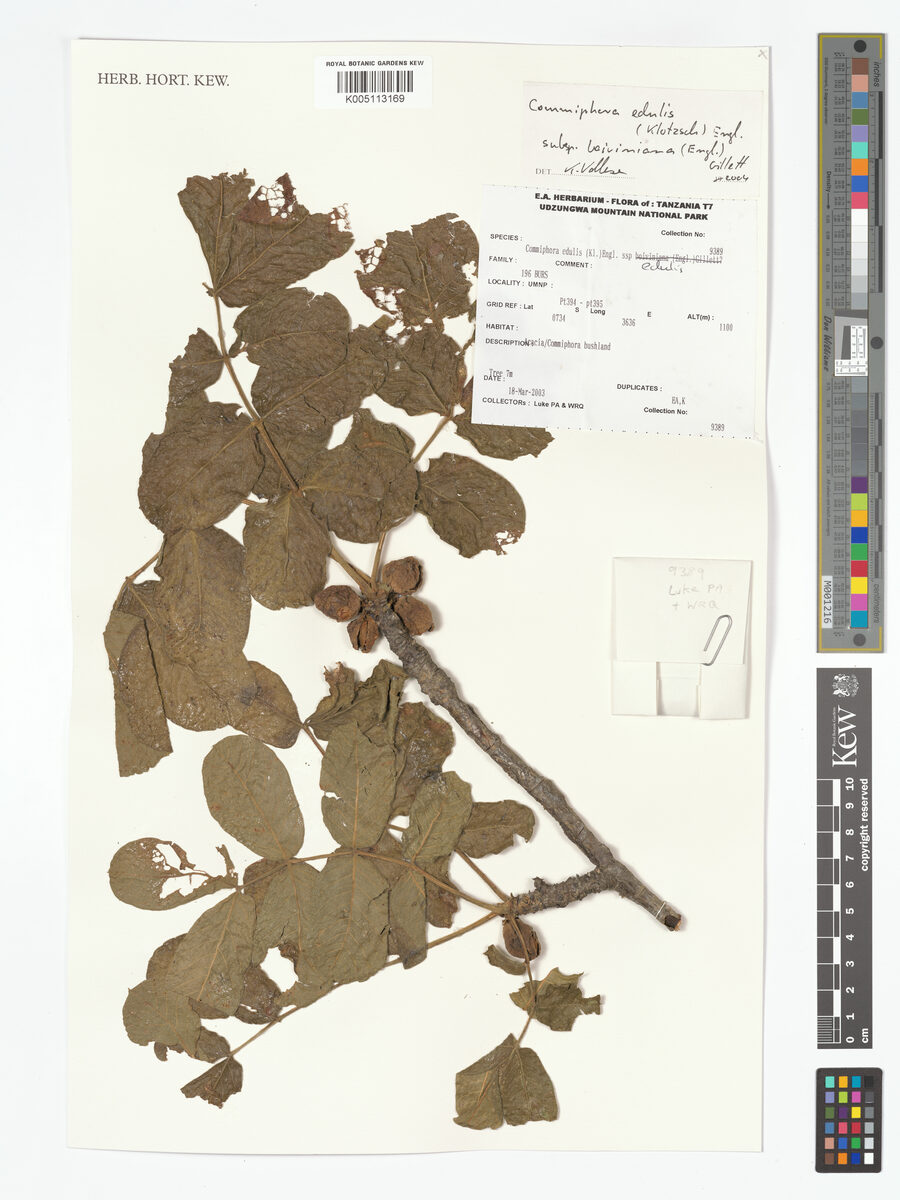
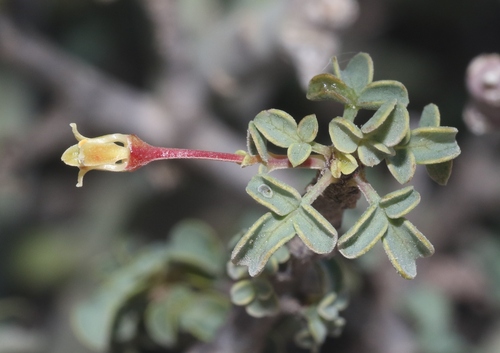
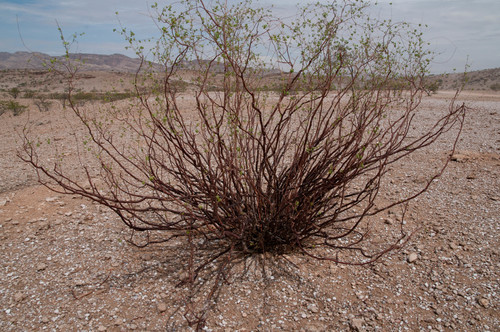
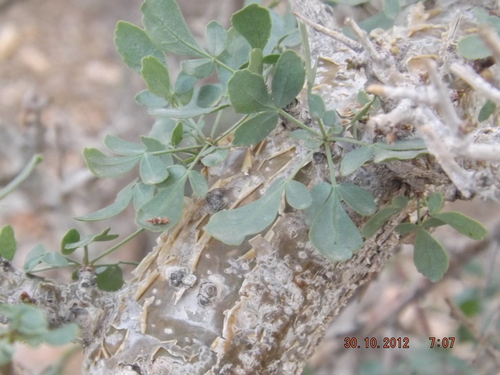
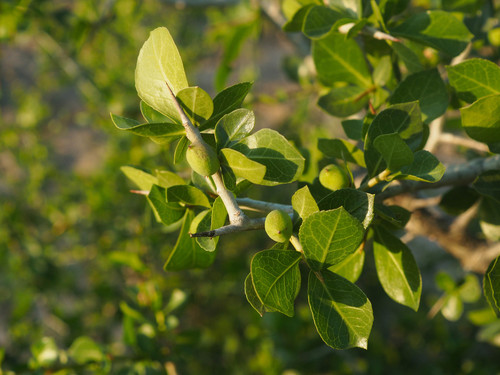
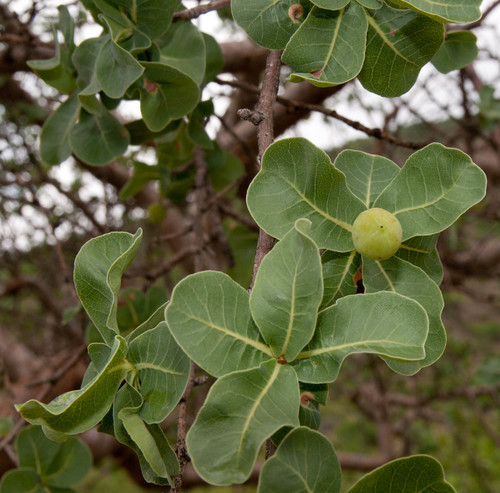
Canarium vulgare
Leenhouts
Pili nut, Java-almond
iNaturalist· cc-by-nc-sa
(c) 106611639464075912591, some rights reserved (CC BY-NC-SA), uploaded by 106611639464075912591
iNaturalist· cc-by-nc
(c) Rafidah Abdul Rahman, some rights reserved (CC BY-NC)
iNaturalist· cc-by-nc
(c) Rafidah Abdul Rahman, some rights reserved (CC BY-NC)
Summary
Source: WikipediaCanarium vulgare, known as Java almond, is a species of Canarium native to eastern Java Sea (Bawean and Kangean Islands), Lesser Sunda Islands, Sulawesi and Maluku Islands. C. vulgare is closely related to C. indicum, and they used to be one species under the name Canarium commune L., which has caused much confusion. Their main difference is that the stipule of C. vulgare is entire and caducous, while that of C. indicum is dentate and persistent.
Description
A tree which grows up to 45 m high. It can be 70 cm across the trunk. Buttresses can be 3 m high and 1.5 m wide. The small branches are about 0.5 cm across. (When cut across, this, like most Canariums has separate vascular bundles similar to that found in a root). The leafy structures (stipules) fall off early but are more on the branch than the leaf stalk. They are oblong and 1-5 cm long by 0.5-1.7 cm wide. The edges are not divided. The leaves have 4 or 5 pairs of leaflets and are without hairs. The leaflets are oblong and 5-16 cm long by 3-8 cm wide. They can be papery in texture. The base can be broadly wedge shaped. The tip tapers. There are 12-15 pairs of veins which are slightly curved. The flower clusters occur at the ends of branches. Male flower clusters can be 35 cm long with branches 20 cm long. Female flower clusters are 20 cm long with branches 10 cm long. The flowers are hairy and male flowers have almost no stalk while female flower stalks are 6-7 mm long. The fruiting stalks can be 15 cm long with about 12 fruit. The fruit are oval and slightly triangular. They are 3-5 cm long by 1.5-3 cm across. There are 1-3 seeds inside.
Edible Uses
The seed can be eaten raw or cooked and has a rich, pleasant flavour, making it a highly favoured snack. It is used as a substitute for the common almond and is somewhat sweeter in flavour. The seeds can be ground into a powder for making bread and are used in a wide variety of local dishes. The seed contains about 72% oil, 13% protein, and 7% starch. Adding a strained emulsion of crushed, well-ripened kernels to cow's milk has been found to make it significantly more digestible for babies. An edible oil is also obtained from the seed and is preferred over coconut oil by local people.
Traditional Uses
The seeds are eaten. An oily mixture made from the seeds is used as a baby food.
This uses section is brief — help expand it
Medicinal Uses
The resin is used medicinally as a balsam.
Distribution
It is a tropical plant. It does well on limestone soils.
Where It Grows
Asia, Cook Islands, East Timor, Fiji, FSM, Hawaii, Indonesia*, Malaysia, Pacific, Papua New Guinea, PNG, Pohnpei, Philippines, SE Asia, Solomon Islands, Sri Lanka, Timor-Leste, USA, Vanuatu,
Cultivation
A tree of the lowland tropics, succeeding at elevations up to 1,200 metres. Seedling trees begin to bear crops of seeds when about 6 - 8 years old. Wild forms usually have three, sometimes two kernels present in the nut, each in its own compartment. In the case of cultivated trees, however, only one kernel may be present in each nut. When this is so, the kernel is proportionately larger and the nut easier to crack. The seeds can vary considerably in shape and quality from tree to tree. Flowering and fruiting can occur throughout the year.
Propagation
The seed has a hard coat and germinates erratically. Filing away part of the seed coat — without damaging the seed — to allow moisture to penetrate more readily will encourage faster and more even germination. Treated seed generally has around 85% viability. Air-dried seed can be stored without temperature control for several months and up to 1.5 years without losing viability.
Other Uses
The tree is grown in nutmeg groves to provide shade and shelter. The oil from the seed serves as an illuminant. The resin is suitable for varnish and caulking boats, though it is not produced abundantly. The hard, even-textured shells are well suited to carving and are crafted into decorative articles. The wood is rather soft and used for making canoes; paddles have been manufactured from the buttresses. The wood is mainly used for fuel. This species is a source of kedondong timber (family Burseraceae). Kedondong heartwood is generally light brown, not sharply demarcated from the 3–5cm wide lighter sapwood band. The texture is moderately fine and even; grain is interlocked to wavy; the surface is lustrous. The wood is light in weight, moderately hard, and not very durable — susceptible to fungi, dry wood borers, and termites. It seasons slowly with slight risk of checking and distortion; once dry it is moderately stable to stable. It has a fairly high blunting effect; stellite-tipped and tungsten carbide tools are recommended. It is moderately easy to slightly difficult to plane, finishes smooth to rough, can be easy to very difficult to bore, slightly difficult to difficult to turn; nailing and screwing are good; gluing is correct. Suitable for planking, cladding, plywood, flooring, furniture, packing cases, pallets, and general carpentry.
Notes
This plant is very similar to Canarium indicum but considered separate. The names have often been confused. There are 80-95 Canarium species.
Synonyms
Also Known As
Chinese-olive, Gisau, Kenari nut-tree
References (19)
- Arora, R. K., 2014, Diversity in Underutilized Plant Species - An Asia-Pacific Perspective. Bioversity International. p 93
- Barwick, M., 2004, Tropical and Subtropical Trees. A Worldwide Encyclopedic Guide. Thames and Hudson p 89
- Bernice P. Bishop Mus. Bull. 216:31, fig. 13; Blumea 8:188. 1955
- Blench, R., 2004, Fruits and Arboriculture in the Indo-Pacific Region. Indo-Pacific Prehistory Association Bulletin 24. (Taipei Papers Volume 2) p 36
- Bradacs, G., 2008, Ethnobotanical Survey and Biological Screening of Medicinal Plants from Vanuatu. PhD thesis Frankurt University. p 101
Show all 19 references Hide references
- Coronel, R.E., 1982, Fruit Collections in the Philippines. IBPGR Newsletter p 9
- Cowie, I, 2006, A Survey of Flora and vegetation of the proposed Jaco-Tutuala-Lore National Park. Timor-Lests (East Timor) www.territorystories.nt/gov.au p 45
- French, B.R., 2010, Food Plants of Solomon Islands. A Compendium. Food Plants International Inc. p 167
- Heyne, 1927, Nutt. pl. p 873 (About use as baby food)
- Leenhouts, P.W., 1955, Canarium in the Pacific, Bernice P. Bishop Museum Bulletin 216 p 31
- Menninger, E.A., 1977, Edible Nuts of the World. Horticultural Books. Florida p 27
- Smith, A.C., 1985, Flora Vitiensis Nova: A New flora of Fiji, Hawai Botanical Gardens, USA Vol 3 p 473
- Soepadmo, E. and Wong, K. M., 1995, Tree Flora of Sabah and Sarawak. Forestry Malaysia. Volume One. p 48
- USDA, ARS, National Genetic Resources Program. Germplasm Resources Information Network - (GRIN). [Online Database] National Germplasm Resources Laboratory, Beltsville, Maryland. Available: www.ars-grin.gov/cgi-bin/npgs/html/econ.pl (10 April 2000)
- Walter, A. & Sam C., 2002, Fruits of Oceania. ACIAR Monograph No. 85. Canberra. p 131, 279
- Wickens, G.E., 1995, Edible Nuts. FAO Non-wood forest products. FAO, Rome. p 111
- Wiersema, J. H. & Leon, B., 2013, World Economic Plants. A Standard Reference CRC Press. 2nd Ed. p 138
- World Checklist of Useful Plant Species 2020. Royal Botanic Gardens, Kew
- www.pngplants.org