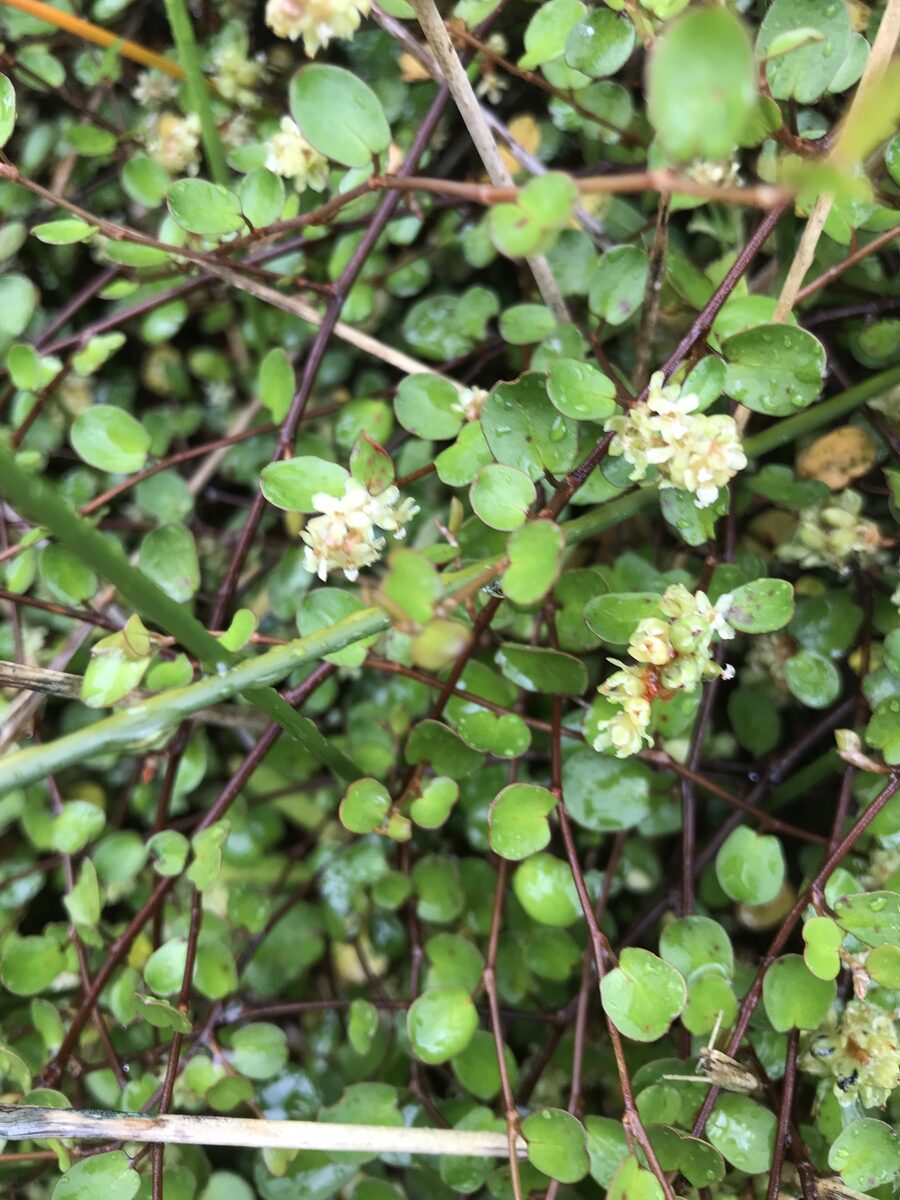
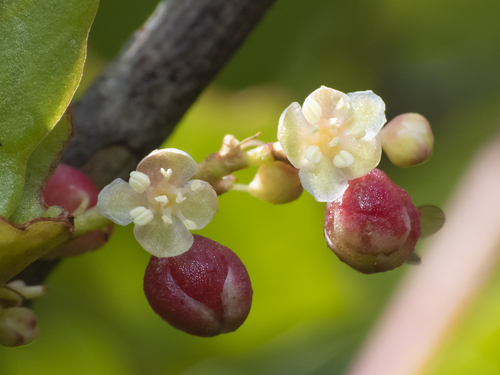
Rumex acetosella subsp. angiocarpus
(Murb.) A. Love
Sheep sorrel
gbif· cc-by-nc
Charcos Companhia
gbif· cc-by-nc
Charcos Companhia
gbif· cc-by-nc
Charcos Companhia
Summary
Source: WikipediaRumex acetosella, commonly known as red sorrel, sheep's sorrel, field sorrel and sour weed, is a species of flowering plant in the buckwheat family Polygonaceae. Native to Eurasia including the British Isles, the plant and its subspecies are common perennial weeds. It has green arrowhead-shaped leaves and red-tinted deeply ridged stems, and it sprouts from an aggressive and spreading rhizome. The flowers emerge from a tall, upright stem. Female flowers are maroon in color.
Description
An annual plant. It grows to 1 m tall and spreads 1 m wide. The stem is erect and slender. Often the stem lies over at the base. The leaves have long leaf stalks. The leaves are usually narrow and long but older leaves are shaped like an arrow. The flowers are small and white. Male and female flowers are carried on different plants. They are on long stalks. The fruit valves are 5-6 mm long.
Edible Uses
The leaves can be eaten raw or cooked, with the water changed to reduce its strong taste. The oxalic acid they contain lend them a somewhat sour taste. There are several uses of sheep sorrel in the preparation of food including a garnish, a tart flavoring agent, a salad green, and a curdling agent for milk in cheese-making. The leaves have a lemony, tangy or rhubarb-like tart flavor.
Traditional Uses
The young leaves and stems are eaten raw in salads. The leaves are boiled, mashed and eaten with butter. They can be used to make soup. The leaves can contain oxalic acid causing them to burn the throat. Large amounts of raw leaves should not therefore be eaten.
Known Hazards
The plant contains oxalic acid and derivatives, known as oxalates.
Distribution
It is a Mediterranean climate plant. It occurs naturally in Europe. It prefers a well drained acid soil. It does best in open sunny positions. It is drought and frost resistant. It is naturalised on acid soils in Australia. It grows in dry rather bare places. It grows in Western Mediterranean regions.
Where It Grows
Africa, Asia, Australia, Britain, Canada, East Africa, Eswatini, Europe, France, Germany, India, Italy, Mediterranean, Netherlands, North America, South Africa, Southern Africa, South America, Spain, Swaziland, Tasmania, USA, Venezuela, Zimbabwe,
Cultivation
It is grown by seed.
Synonyms
Also Known As
Adeas de pajaro, Agricas, Manigrells, Pa-i-vi, Vinagrella, Vinagreras, Vinagrillos
References (15)
- Acta Univ. Lund 27(5):46. 1899 (As Rumex angiocarpus)
- Blamey, M and Grey-Wilson, C., 2005, Wild flowers of the Mediterranean. A & C Black London. p 38 (As Rumex angiocarpus)
- Bodkin, F., 1991, Encyclopedia Botanica. Cornstalk publishing, p 43 (As Acetosella angiocarpa)
- Bonet, M. A. & Valles, J., 2002, Use of non-crop food vascular plants in Montseny biosphere reserve (Catalonia, Iberian Peninsula). International Journal of Food Sciences and Nutrition (2002) 53, 225–248
- Cribb, A.B. & J.W., 1976, Wild Food in Australia, Fontana. p 114 (As Acetosella angiocarpa)
Show all 15 references Hide references
- Curtis, W.M., 1993, The Student's Flora of Tasmania. Part 3 St David's Park Publishing, Tasmania, p 586 (As Rumex angiocarpus)
- Fox, F. W. & Young, M. E. N., 1982, Food from the Veld. Delta Books. p 308 (As Rumex angiocarpus)
- Gonzalez, J. A., et al, 2011, The consumption of wild and semi-domesticated edible plants in the Arribes del Duero (Salamanca-Zamora, Spain): an ananalysis of traditional knowledge. Genetic Resources and Crop Evolution 58:991-1006
- Long, C., 2005, Swaziland's Flora - siSwati names and Uses http://www.sntc.org.sz/flora/ (As Rumex acetosella subsp. angiocarpus)
- Plants for a Future database, The Field, Penpol, Lostwithiel, Cornwall, PL22 0NG, UK. http://www.scs.leeds.ac.uk/pfaf/ (As Rumex angiocarpus)
- Rivera, C., et al, 2005, The Ethnobotanical Study of Local Mediterranean Food Plants as Medicinal Resources in Southern Spain. Journal of Physiologyand Pharmacology. 56, Suppl. 1, 97-114
- Ruiters-Welcome, A. K., 2019, Food plants of southern Africa. Ph.D. thesis. Univ. of Johannesburg p 91
- Swaziland's Flora Database http://www.sntc.org.sz/flora (As Rumex angiocarpus)
- Tardio, J., et al, 2006, Ethnobotanical review of wild edible plants in Spain. Botanical J. Linnean Soc. 152 (2006), 27-71
- Tasmanian Herbarium Vascular Plants list p 45 (As Acetosella vulgaris)