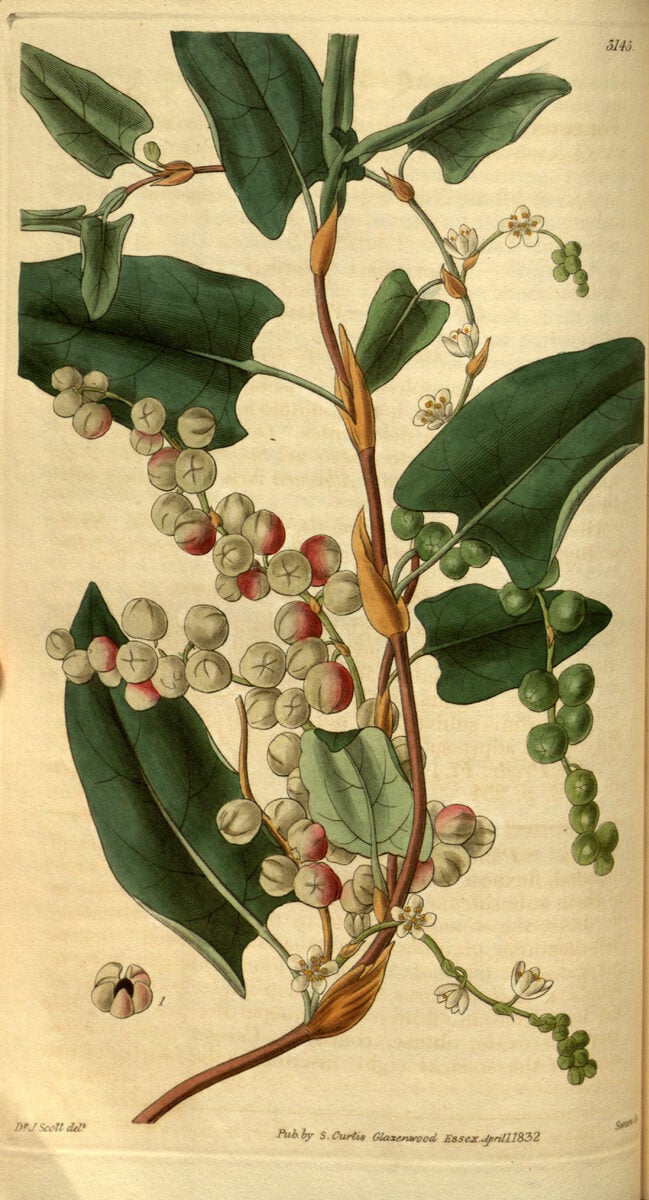
Muehlenbeckia australis - (G.Forst.)Meissn.
(G.Forst.)Meissn.
gbif· cc0
John Barnett
gbif· cc0
John Barnett
gbif· cc0
John Barnett
Description
Muehlenbeckia australis is an evergreen Climber growing to 10 m (32ft 10in). See above for USDA hardiness. It is hardy to UK zone 8. The species is dioecious (individual flowers are either male or female, but only one sex is to be found on any one plant so both male and female plants must be grown if seed is required). . Suitable for: light (sandy), medium (loamy) and heavy (clay) soils and prefers well-drained soil. Suitable pH: mildly acid, neutral and basic (mildly alkaline) soils. It can grow in semi-shade (light woodland) or no shade. It prefers moist soil.
Edible Uses
Fruit - raw or cooked. Sweet and juicy.
Distribution
New Zealand.
Where It Grows
AUSTRALASIA: Australia (New South Wales (Norfolk Island)), New Zealand (Chatham Islands Territory, North Island, South Island, Stewart Island)
Cultivation
Requires a well-drained soil in sun or semi-shade. Not very hardy in Britain. Plants tolerate temperatures down to between -5 and -10°c. A climbing plant that supports itself by twining around other plants etc. Dioecious. Male and female plants must be grown if seed is required.
Propagation
Seed - sow spring in a greenhouse. When they are large enough to handle, prick the seedlings out into individual pots and grow them on in the greenhouse for at least their first winter. Plant them out into their permanent positions in late spring or early summer, after the last expected frosts. Cuttings of half-ripe wood, 5 - 8 cm with a heel, July/August in a frame. Pot up in autumn and overwinter in a cold frame. High percentage. Plant out in late spring. Cuttings of mature wood of the current season's growth, 5 - 10cm with a heel, October/November in a cold frame. High percentage.