Canarium album
(Loureiro) DC.
Chinese white olive
iNaturalist· cc-by-nc
(c) yko, some rights reserved (CC BY-NC)
Summary
Source: WikipediaCanarium album is a species of flowering plant in the family Burseraceae. This tree is native in Cambodia, China, Laos, and Vietnam. The Catalogue of Life does not record any sub-species. Canarium album produces a fruit commonly called Chinese olive or white olive, though it has no relation to Olea; it is consumed in Vietnam (Vietnamese: trám trắng, fruit quả trám), Thailand (where it is known as samo chin (Thai: สมอจีน) or kana (Thai: กาน้า)) and in China (simplified Chinese: 橄榄; traditional Chinese: 橄欖; pinyin: gǎnlǎn). The pulp of the tree's fruit and its seeds are edible, with a strong resinous flavor when they are fresh. Culinary oil can be extracted from the seed. Preserves can be made with the fruit, both sweet like jam or pickled preserves. In China, a pickle called olive vegetable (simplified Chinese: 橄榄菜; traditional Chinese: 橄欖菜; pinyin: gǎnlǎn cài), made from a mix of Canarium album fruit and mustard greens, is commonly used as a flavoring for congee and fried rice, with Teochew people specifically being very fond of the pickle. Mostly cultivated in Thailand, cultivation has been introduced on a smaller scale to Fiji and northern Queensland in Australia. Its fruit, resin and seed are exported to Europe where they are used in the manufacture of varnish and soap.
Description
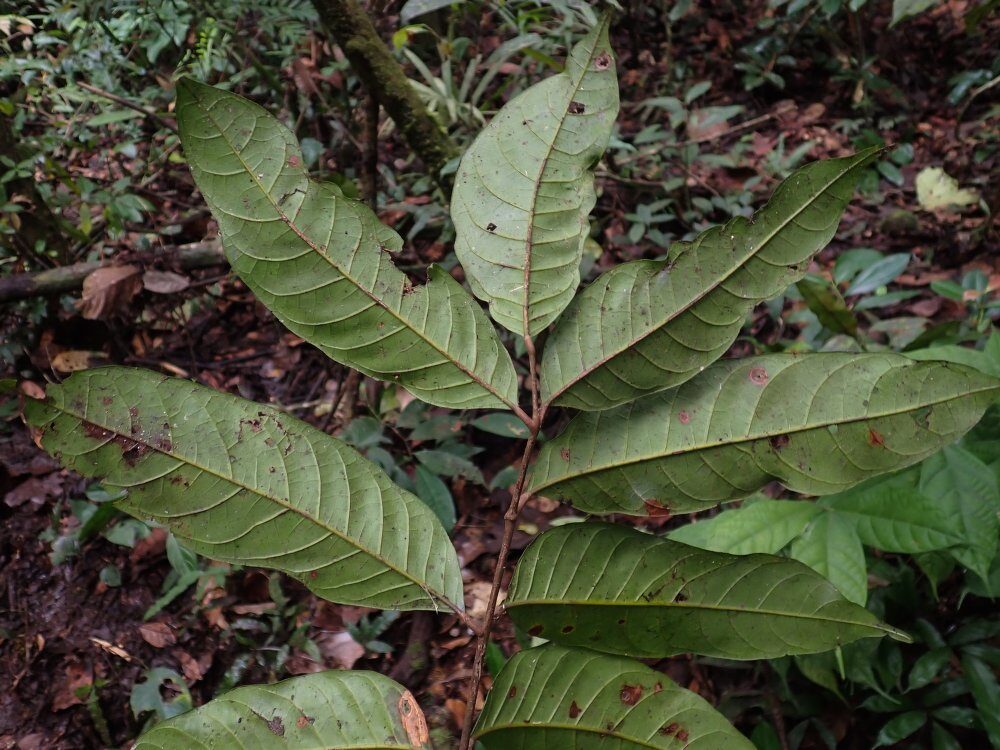
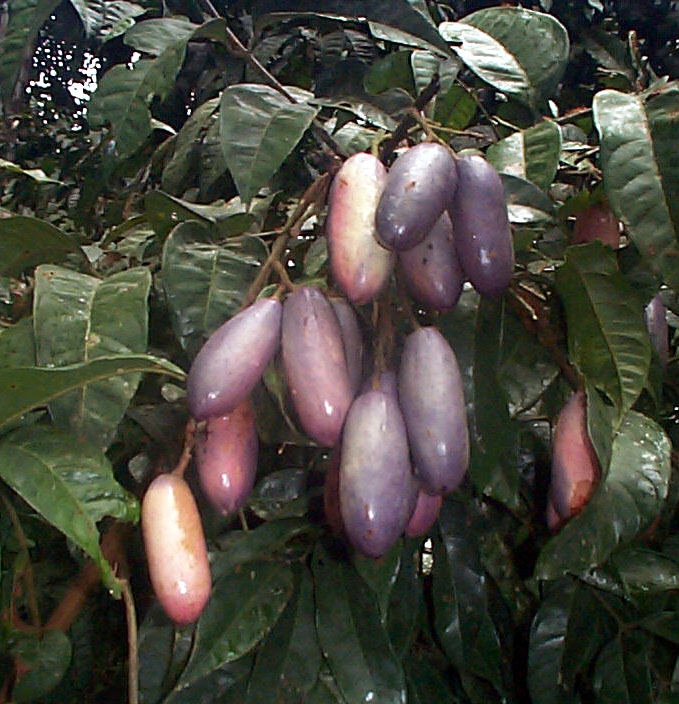
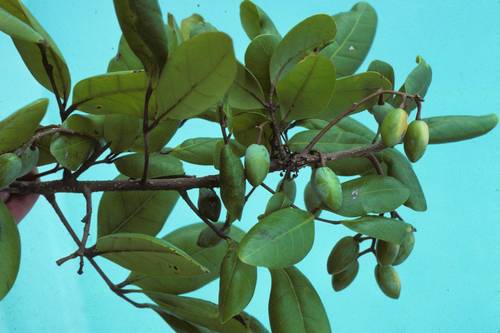
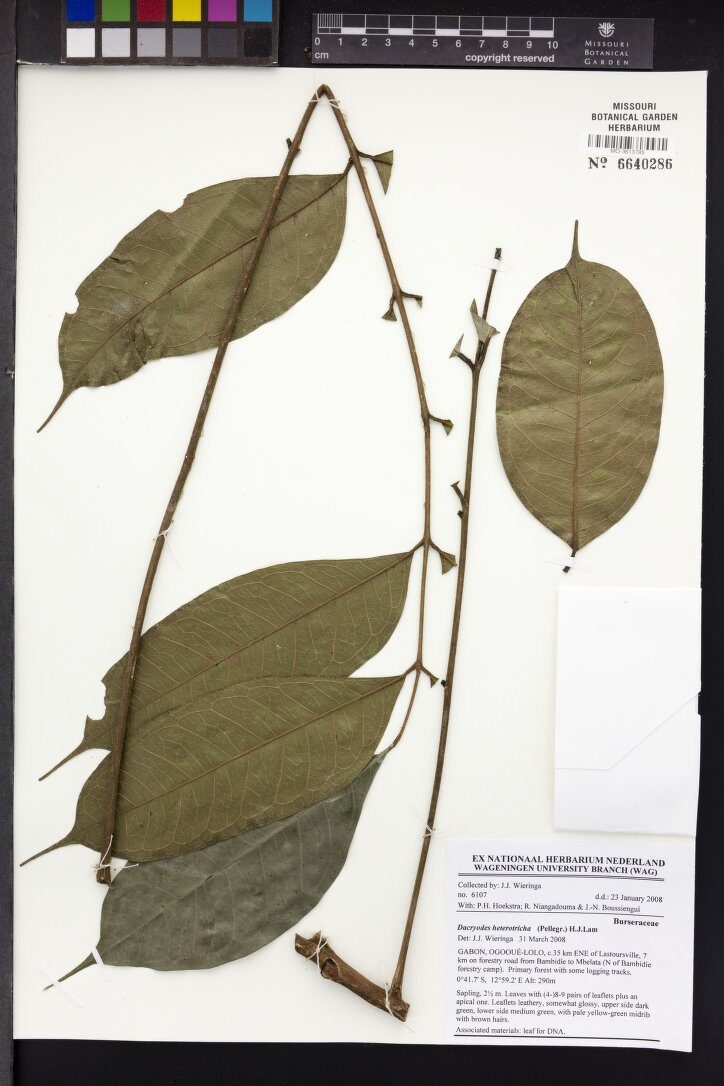
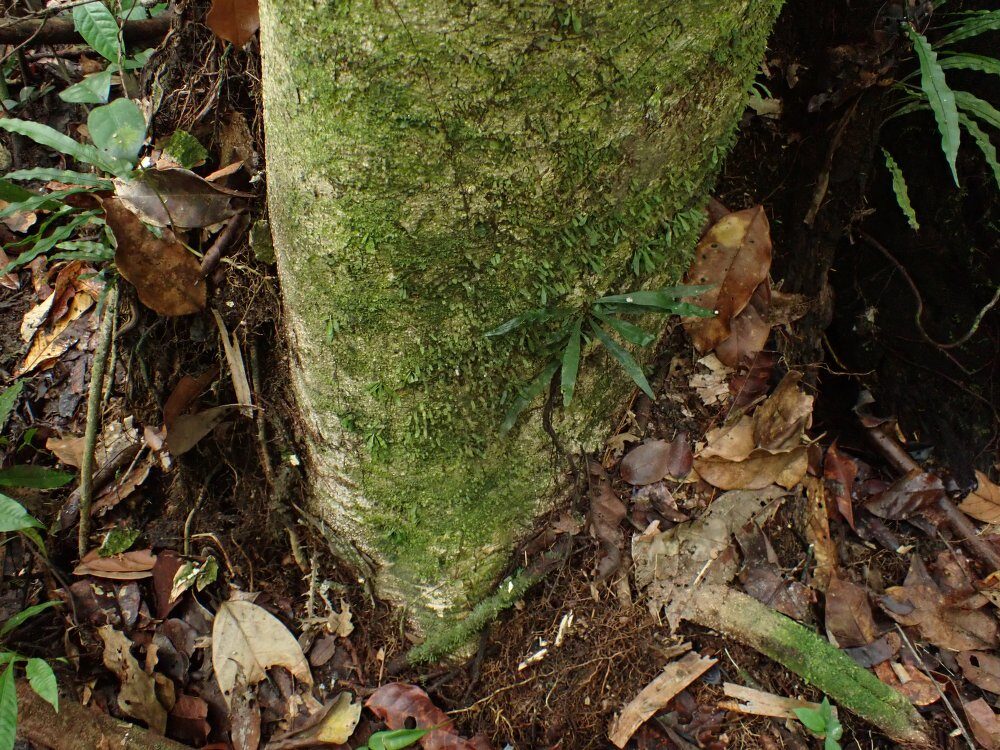
A large tree. It grows 25-30 m high. The trunk is straight and branches high up. The trunk can be 1.5 m across. The bark is white and has cracks along it. The crown of the tree is small and rounded. The leaves have about 8 pairs of leaflets with a leaflet at the end. The leaflets are 6-15 cm long by 2.5-6 cm wide. They have shiny white scales underneath. The base of the leaflets is unequal. The flower clusters have branches without a flower at the end. They flowers are small and 0.2-0.3 cm long and yellowish white. The fruit is oval and 3.4-4 cm long by 2-2.5 cm wide. They are yellowish green when mature. Young seedling trees have leaves which vary a lot in shape. Young leaves are simple with deep lobes. The flowers are white or yellow and in clusters around a stalk produced in the axils of leaves. The fruit is angled and has 3 cells. They are 3-4 cm long and 1.2-2 cm wide. They are dull yellow when ripe.
Edible Uses
The fruit can be eaten raw or cooked and is used much like olives. Fresh fruit is crisp with an initial slight bitterness that gives way to a fragrant, sour-sweet flavour. It is used in stir-fry dishes, preserved fruits, and beverages, and is also made into crack seeds.
Traditional Uses
The fruit are eaten like olives. The fruit are soaked in tubs of salt water, then dried. They are also preserved as a condiment. They are also used for wines and drinks. The seed contains an edible oil. The oil should not be too hot as seeds burn easily. The seed kernels are eaten. The fruit are edible when mature. They are also pickled.
Medicinal Uses
The fruit is used to stimulate the appetite and eliminate apprehension, and also acts as a sialagogue. In Traditional Chinese Medicine, the olive fruit is used to clear heat from the lung, relieve sore throats, promote the production of body fluid, and aid detoxification. It is applied in cases of swollen and sore throats, excessive thirst, hematemesis, bacillary dysentery, epilepsy, puffer poisoning, and alcoholism.
Distribution
It is a subtropical and tropical plant. It grows in forest in north Vietnam below 500 m altitude. It needs light to grow. In Yunnan, China it grows between 600-1300 m altitude. It grows in deep humid and fertile soil. It can grow under light shade. In Sichuan.
Where It Grows
Asia, Cambodia, China, Indochina, Indonesia, Japan, Laos, Malaysia, Pacific, Philippines, SE Asia, Taiwan, Thailand, Vietnam,
Cultivation
Plants can be grown by seeds.
Propagation
Propagated by seed.
Other Uses
In China the tree is planted ornamentally along highways, streets, and in gardens.
Production
Trees are fast growing. They flower in January and February and fruit in June and July. In southern China fruit are available in June to August.
Other Information
It is a cultivated crop. Fruit are sold in markets. It is a priority under-utilised crop for China.
Notes
There are 80-95 Canarium species.
Nutrition
| Part | Moisture | kJ | kcal | Protein | Vit A | Vit C | Iron | Zinc |
|---|---|---|---|---|---|---|---|---|
| Fruit | 80.2 | — | 72 | 1.2 | — | 5 | 2.1 | — |
| Nuts | — | — | — | — | — | — | — | — |
| Nuts - oil | — | — | — | — | — | — | — | — |
Synonyms
Also Known As
Ca-na, Cay ca-na, Chinese olive, Ch'ing-kuo, Ganlan, Larm yin, Maizhahang, Mane, Olive nut, Paak-laam, Samo cheen, Talatt, Tonkin canarium, Tram chim, Tram trang, Wu Lam, Xica, Ximo
References (34)
- Altschul, S.V.R., 1973, Drugs and Foods from Little-known Plants. Notes in Harvard University Herbaria. Harvard Univ. Press. Massachusetts. no. 1976
- Bircher, A. G. & Bircher, W. H., 2000, Encyclopedia of Fruit Trees and Edible Flowering Plants in Egypt and the Subtropics. AUC Press. p 78, p 79 (As Canarium tonkinensis)
- Burkill, I.H., 1966, A Dictionary of the Economic Products of the Malay Peninsula. Ministry of Agriculture and Cooperatives, Kuala Lumpur, Malaysia. Vol 1 (A-H) p 430
- Cengel, D. J. & Dany, C., (Eds), 2016, Integrating Forest Biodiversity Resource Management and Sustainable Community Livelihood Development in the Preah Vihear Protected Forest. International Tropical Timber Organization p 120
- Facciola, S., 1998, Cornucopia 2: a Source Book of Edible Plants. Kampong Publications, p 62
Show all 34 references Hide references
- Forest Inventory and Planning Institute, 1996, Vietnam Forest Trees. Agriculture Publishing House p 80
- Ghorbani, A., et al, 2012, Diversity of Medicinal and Food Plants as Non-timber Forest Products. Economic Botany XX (X) 2012, pp 1-14 (As Canarium tonkinensis)
- Hedrick, U.P., 1919, (Ed.), Sturtevant's edible plants of the world. p 148
- Hill, M. & Hallam, D., (eds), 1997, Na Hang Nature Reserve, Tat Ke Sector. Site description and conservation evaluation. Hanoi. p 72
- Hu, Shiu-ying, 2005, Food Plants of China. The Chinese University Press. p 505, p 506 (As Canarium tonkinensis)
- Jin, Chen et al, 1999, Ethnobotanical studies on Wild Edible Fruits in Southern Yunnan: Folk Names: Nutritional Value and Uses. Economic Botany 53(1) pp 2-14
- Kiple, K.F. & Ornelas, K.C., (eds), 2000, The Cambridge World History of Food. CUP p 1755
- Kuo, W. H. J., (Ed.) Taiwan's Ethnobotanical Database (1900-2000), http://tk.agron.ntu.edu.tw/ethnobot/DB1.htm
- Leenhouts, 1959, Blumea 9(2):402-405
- Luo, B., et al, 2019, Wild edible plants collected by Hani from terraced rice paddy agroecosystem in Honghe Prefecture, Yunnan, China. Journal of Ethnobiology and Ethnomedicine 15:56
- Macmillan, H.F. (Revised Barlow, H.S., et al) 1991, Tropical Planting and Gardening. Sixth edition. Malayan Nature Society. Kuala Lumpur. p 313
- Martin, F. W., et al, 1987, Perennial Edible Fruits of the Tropics. USDA Handbook 642 p 19
- Nomencl. bot. ed. 3, 287. 1797 (DC., Prodr. 2:80. 1825)
- Rehm, S., & Espig, G., 1991, The cultivated plants of the tropics and subtropics.
- Sam, H. V. et al, 2004, Trees of Laos and Vietnam: A Field Guide to 100 Economically or Ecologically Important Species. BLUMEA 49: 201-349
- Sang, D. T., & Mizoue, K. O. N., 2012, Use of Edible Forest Plants among Indigenous Ethnic Minorities in Cat Tien Biosphere Reserve, Vietnam. Asian Journal of Biodiversity Vol. 3 (1), p 23-49
- Soepadmo, E. and Wong, K. M., 1995, Tree Flora of Sabah and Sarawak. Forestry Malaysia. Volume One. p 48
- Solomon, C., 2001, Encyclopedia of Asian Food. New Holland. p 260
- Steenis, ed, Flora Malesiana
- Terrell, 1986, Agricultural handbook no 505,
- USDA, ARS, National Genetic Resources Program. Germplasm Resources Information Network - (GRIN). [Online Database] National Germplasm Resources Laboratory, Beltsville, Maryland. Available: www.ars-grin.gov/cgi-bin/npgs/html/econ.pl (10 April 2000)
- Valder, P., 1999, The Garden Plants of China. Florilegium. p 269
- Van Sam, H. et al, 2004, Trees of Laos and Vietnam: A Field Guide to 100 Economically or Ecologically Important Species. Blumea 29 (2004) 201-349
- Van Sam, H. et al, 2008, Uses and Conservation of Plant Species in a National Park. A case study of Ben En, Vietnam. Economic Botany 62:574-593
- Wickens, G.E., 1995, Edible Nuts. FAO Non-wood forest products. FAO, Rome. p 111
- Wiersema, J. H. & Leon, B., 2013, World Economic Plants. A Standard Reference CRC Press. 2nd Ed. p 137
- World Checklist of Useful Plant Species 2020. Royal Botanic Gardens, Kew
- Xu, You-Kai, et al, 2004, Wild Vegetable Resources and Market Survey in Xishuangbanna, Southwest China. Economic Botany. 58(4): 647-667.
- Zeven, A. C. & de West, J. M. J., 1982, Dictionary of cultivated plants and their regions of diversity. Wageningen. p 32