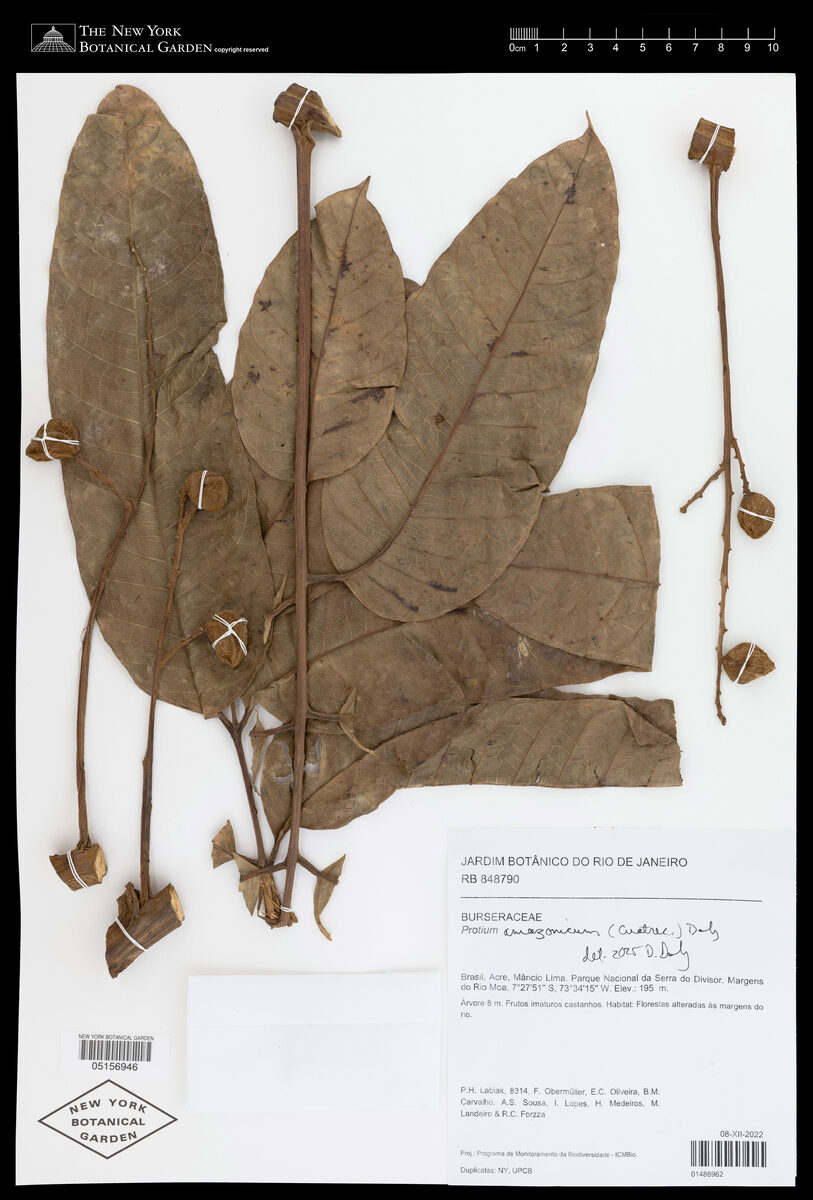
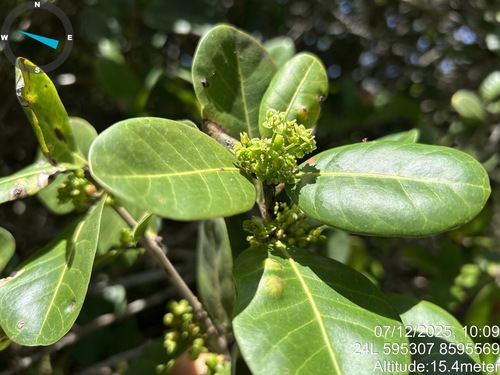
Dacryodes heterotricha
(Pell.) H. J. Lam
gbif· cc-by-nc-sa
MBG
gbif· cc-by-nc-sa
MBG
gbif· cc-by-nc-sa
MBG
Description
A tree. It can grow 25 m tall. The crown is spreading. The trunk can be 1 m across and it has buttresses 1 m tall. Plants are separately male and female. The fruit clings strongly to the seed.
Edible Uses
Fruit. The flesh of the fruits in this genus usually adheres very strongly to the seed. When placed in hot (but not boiling) water at around 60 - 85°c the fruit softens and swells and all the flesh then slides easily off the seed.
Traditional Uses
The fruit is put in hot water to remove the flesh from the seed.
This uses section is brief — help expand it
Medicinal Uses
A decoction of the leaf is taken to treat whooping cough.
Distribution
It is a tropical plant. It grows in dense forest. It grows between 100-300 m above sea level.
Where It Grows
Africa, Central Africa, Congo R, Gabon,
Cultivation
A dioecious species, both male and female forms need to be grown if fruit and seed are required.
Other Uses
The heartwood is a light brown; it is not clearly demarcated from the 7 - 15cm wide band of pale pink, yellow or grey sapwood, which often extends over half the radius of the log. The grain is straight or interlocked; texture is medium; the wood is lustrous, and ribbon-like markings and small stripes give it an attractive figure. The wood is of moderate weight, moderately hard to hard; not very durable, being susceptible to attack by fungi and dry wood borers, but resistant to termites. It seasons normally, with only a slight risk of distortion but a high risk of checking; once dry it is moderately stable in service. It saws slowly and with some difficulty, with a blunting effect on tools; the use of stellite-tipped saw teeth and tungsten carbide tools is recommended; it works fairly well with hand and machine tools, but rough patches may be produced on planing; it does not split on nailing and holds nails and screws well; peeling characteristics are good, and gluing, boring and sanding properties satisfactory; the wood paints and varnishes well. It is recommended for furniture, screens, door and window frames, stairs and other light carpentry, flooring, construction, vehicle bodies, mine props, poles and piles. It is also considered suitable for ship and boat building, tool handles, agricultural implements, joinery, vats, toys, novelties, turnery, railway sleepers, veneer, core stock, hardboard and particle board[299; 848].
Synonyms
Also Known As
Abete, Baviya, Mitsogo, Mouganga, Moumbamba, Safoukala
References (5)
- Nkeoua, G. & Boundzanga, G. C., 1999, Donnees sur les produits forestieres non ligneux en Republique du Congo. FAO. p 24
- Onana, J. M., 2008, A synoptic revision of Dacryodes (Burseraceae) in Africa, with a new species from Central Africa. KEW BULLETIN VOL. 63: 385–400
- Raponda-Walker, A & Sillans, R., 1961, Les Plantes Utiles du Gabon. Editions Paul Lechevalier, Paris. p 114 (As Pachylobus heterotricha)
- Useful Tropical Plants
- World Checklist of Useful Plant Species 2020. Royal Botanic Gardens, Kew