Camassia quamash
(Pursh) Greene
Western Camass, Quamash, Camass lily
iNaturalist· cc-by-nc
(c) Chris Shuck, some rights reserved (CC BY-NC)
iNaturalist· cc-by-nc
(c) dstathis, some rights reserved (CC BY-NC)
iNaturalist· cc-by
(c) Ed Alverson, some rights reserved (CC BY)
Summary
Source: WikipediaCamassia quamash, commonly known as camas, kwetlal, small camas, common camas, common camash or quamash, is a perennial herb. It is native to western North America in large areas of southern Canada and the northwestern United States.
Description
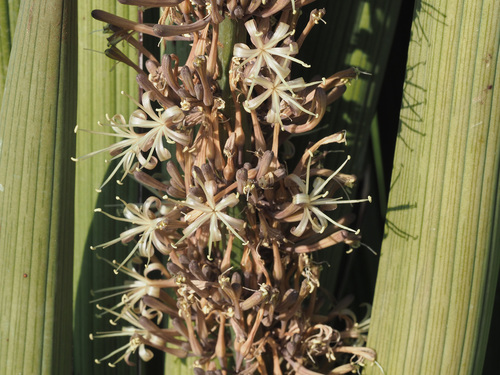
A plant with a bulb. It keeps growing from year to year. It grows 25-90 cm high and 10-15 cm wide. It has grass-like leaves. It forms large clumps. The leaves are blue-green and 50 cm long. They all grow from the base and are 5-15 mm wide. The flower spikes are blue. The flowers are 5 cm across. The flowers are star shaped. The fruit are dry capsules with shiny black seeds. The bulbs are 3-5 cm across. The bulb is edible.
Edible Uses
Edible Parts: Root Edible Uses: Bulb - raw or cooked. The bulb, which can be up to 5cm in diameter, has a mild, starchy flavour when eaten raw, but a gummy texture that reduces the enjoyment of it somewhat. When cooked, however, it develops a delicious sweet flavour somewhat like sweet chestnuts, and is a highly nutritious food. Excellent when slow baked, it can also be dried and made into a powder which can be used as a thickener in stews or mixed with cereal flours when making bread, cakes etc. The bulbs can be boiled down to make a molasses, this was used on festival occasions by various Indian tribes. The bulbs can be harvested at any time of the year, but are probably best in early summer when the seeds are ripe. One report says that the bulbs contain inulin (a starch that cannot be digested by humans) but that this breaks down when the bulb is cooked slowly to form the sugar fructose which is sweet and easily digested. Quamash bulbs were a staple food of the N. American Indians. The tribes would move to the Quamash fields in the early autumn and, whilst some people harvested the bulbs, others would dig a pit, line it with boulders then fill it with wood and set fire to it. The fire would heat the boulders and the harvested bulbs would then be placed in the pit and the whole thing covered with earth and the bulbs left to cook slowly for 2 days. The pit would then be opened and the Indians would feast on the bulbs until they could no longer fit any more in their stomachs. Whatever was left would be dried and stored for winter use.
Traditional Uses
The bulbous root is eaten raw, boiled or baked. They can be used in pies. They can be boiled down to a syrup or pounded into cakes that are sun dried for future use. Caution: This plant should not be confused with death camass (Zigadenus venenosus).
Medicinal Uses
Birthing aid Oxytoxic A decoction of the roots has been used to induce labour. An infusion of the leaves has been used to treat vaginal bleeding after birth and to help expel the placenta.
Distribution
It is a temperate plant. Plants can grow in full sun or light shade. It does best in moist but not waterlogged soil. It is resistant to frost and sensitive to drought. It suits hardiness zones 5-9.
Where It Grows
Australia, Canada, Europe, France, North America*, Slovenia, Tasmania, USA,
Cultivation
The bulbs are planted 10 cm deep and plants spaced 20-25 cm apart.
Propagation
Seed - best sown as soon as it is ripe in a cold frame. The seed can also be sown in a cold frame in spring. It usually germinates in 1 - 6 months at 15°c, but it can be erratic. Sow the seed thinly so that it does not need to be thinned and allow the seedlings to grow on undisturbed for their first year. Give an occasional liquid feed to ensure that the plants do not become nutrient deficient. When the plants are dormant in late summer, pot up the small bulbs putting 2 - 3 bulbs in each pot. Grow them on for another one or two years in a cold frame before planting them out when dormant in late summer. Offsets in late summer. The bulb has to be scored in order to produce offsets.
Other Uses
Notable Products: Nectar, pollen, edible bulb. Attracts Wildlife - flowers attract beneficial insects. Grown as an ornamental plant. Special Uses Attracts Wildlife Food Forest
Other Information
An important food of native Americans.
Notes
It is low in starch and high in sugar. There are 6 Camassia species. Also put in the family Hyacinthaceae.
Synonyms
Also Known As
Blue Quamas, Camosh, Common Camass, Navadni kamas, Paazigo, Swamp sego, Wild hyacinth
References (36)
- Beckstrom-Sternberg, Stephen M., and James A. Duke. "The Foodplant Database." http://probe.nalusda.gov:8300/cgi-bin/browse/foodplantdb.(ACEDB version 4.0 - data version July 1994) (As Quamasia quamash)
- Bircher, A. G. & Bircher, W. H., 2000, Encyclopedia of Fruit Trees and Edible Flowering Plants in Egypt and the Subtropics. AUC Press. p 76
- Bodkin, F., 1991, Encyclopedia Botanica. Cornstalk publishing, p 207
- Bremness, L., 1994, Herbs. Collins Eyewitness Handbooks. Harper Collins. p 156 (As Camassia esculenta)
- Brickell, C. (Ed.), 1999, The Royal Horticultural Society A-Z Encyclopedia of Garden Plants. Convent Garden Books. p 213
Show all 36 references Hide references
- Burnie, G.(Ed.), 2003, Annuals and Bulbs. The Gardener's Handbooks. Fog City Press. p 252
- Crawford, M., 2012, How to grow Perennial Vegetables. Green Books. p 150
- Cormack, R. G. H., 1967, Wild Flowers of Alberta. Commercial Printers Edmonton, Canada. p 32
- Couture, M. D., 1978, Recent and Contemporary Foraging Practices of the Harney Valley Paiute. Thesis, Portland State University
- Coutre, M. D., et al, 1986, Foraging Behaviour of a Contemporary Northern Great Basin Population. Journal of California and Great Bason Anthropology Vol. 8(2) pp 150-160
- Cundall, P., (ed.), 2004, Gardening Australia: flora: the gardener's bible. ABC Books. p 292
- Elias, T.S. & Dykeman P.A., 1990, Edible Wild Plants. A North American Field guide. Sterling, New York p 136
- Facciola, S., 1998, Cornucopia 2: a Source Book of Edible Plants. Kampong Publications, p 143 (Also as Camassia esculenta)
- Hibbert, M., 2002, The Aussie Plant Finder 2002, Florilegium. p 51
- http://en.hortipedia.com
- Jackes, D. A., Edible Forest Gardens
- Joyce, D., 1998, The Garden Plant Selector. Ryland, Peters and Small. p 283
- Kiple, K.F. & Ornelas, K.C., (eds), 2000, The Cambridge World History of Food. CUP p 1743 (Also as Camassia esculenta)
- Lambert,S., 2005, Guide to the Seeds of Native and Non-Native Grasses, Forbs and Shrubs of the Great Basin, Idaho BLM Technical Bulletin 2005-04 p 46
- Lim, T. K., 2015, Edible Medicinal and Non Medicinal Plants. Volume 9, Modified Stems, Roots, Bulbs. Springer p 22
- MacKinnon, A., et al, 2009, Edible & Medicinal Plants of Canada. Lone Pine. p 199
- Man. bot. San Francisco 313. 1894
- Plants for a Future database, The Field, Penpol, Lostwithiel, Cornwall, PL22 0NG, UK. http://www.scs.leeds.ac.uk/pfaf/
- Porsild, A.E., 1974, Rocky Mountain Wild Flowers. Natural History Series No. 2 National Museums of Canada. p 94
- Romanowski, N., 2007, Edible Water Gardens. Hyland House. p 94
- Saunders, C.F., 1948, Edible and Useful Wild Plants. Dover. New York. p 23 (As Camassia esculenta)
- Self, M., 1999, Phoenix Seeds Catalogue p 4
- Slocum, P.D. & Robinson, P., 1999, Water Gardening. Water Lilies and Lotuses. Timber Press. p 112
- Stubbs, R. D., 1966, An investigation of the Edible and Medicinal Plants used by the Flathead Indians. MA thesis University of Montana. p 41
- Tozer, F., 2007, The Uses of Wild Plants. Green Man Publishing. p 51
- Turner, N., 1995, Food Plants of Coastal First Peoples. Royal BC Museum Handbook p 42
- Turner, N., 1997, Food Plants of Interior First Peoples. Royal BC Museum Handbook p 66
- Turner, N., et al, 2011, "Up on the Mountain": Ethnobotanical Important of Montane Sites in Pacific Coastal North America. Journal of Ethnobiology 31(1): 4-43
- USDA, ARS, National Genetic Resources Program. Germplasm Resources Information Network - (GRIN). [Online Database] National Germplasm Resources Laboratory, Beltsville, Maryland. Available: www.ars-grin.gov/cgi-bin/npgs/html/econ.pl (10 April 2000)
- Wiersema, J. H. & Leon, B., 2013, World Economic Plants. A Standard Reference CRC Press. 2nd Ed. p 134
- World Checklist of Useful Plant Species 2020. Royal Botanic Gardens, Kew