Cascabela thevetia
(L.) Lippold
Yellow oleander, Exile tree, Lucky nut tree
iNaturalist· cc-by-nc
(c) Alan Kwok (King Lun), Ada Tai (Ah Heung) / 阿達蘭 AdAlan, some rights reserved (CC BY-NC), uploaded by Alan Kwok (King Lun), Ada Tai (Ah Heung) / 阿達蘭 AdAlan
iNaturalist· cc-by-nc
(c) E. A. Mayer, some rights reserved (CC BY-NC)
Summary
Source: WikipediaCascabela thevetia (syn. Thevetia peruviana) is a species of poisonous plant in the dogbane family Apocynaceae, native throughout Mexico and Central America and cultivated widely as an ornamental. It is a relative of Nerium oleander and thus is known by the common name yellow oleander.
Description
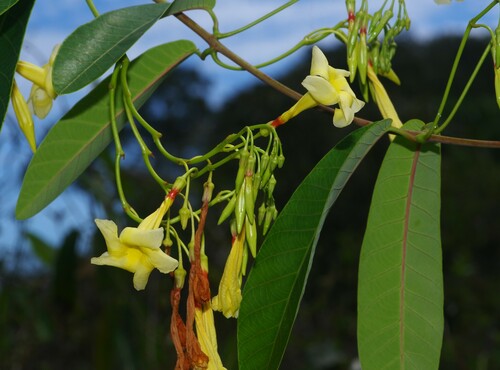
A shrub. It grows 6 m high. The leaves are narrow and shiny. They are 7-16 cm long by 1 cm wide. The flowers are yellow and 3-6 cm long. The fruit are pear shaped and 2-4 mm long by 3-5 cm wide. The seeds are 12 mm long by 14 mm wide.
Edible Uses
The fruit and flower nectar are recorded as edible, though the fruit should be eaten with extreme caution.
Traditional Uses
Caution: The bark, roots, seed kernels and sap are highly poisonous. Although the fruit is recorded as eaten this should be with extreme caution.
This uses section is brief — help expand it
Medicinal Uses
Biological pest control The plant's toxins have been tested in experiments for uses as a biological pest control. T. peruviana seed oil was used to make a 'paint' with antifungal, antibacterial and anti-termite properties.
Known Hazards
All parts of the C. thevetia plant are toxic to most vertebrates as they contain cardiac glycosides. Many cases of intentional and accidental poisoning of humans are known. The main toxins are the cardenolides thevetin A and thevetin B; others include peruvoside, neriifolin, thevetoxin and ruvoside. These cardenolides are not destroyed by drying or heating and are very similar to digoxin from Digitalis purpurea. They produce gastric upset and cardiotoxic effects. Antidotes include atropine and digoxin immune fabs (antibodies) and treatment may include oral administration of activated charcoal. Ovine polyclonal anti-digitoxin Fab fragment antibody (DigiTAb; Therapeutic Antibodies Inc.) can be used to treat T. peruviana poisoning, but in many countries the cost is prohibitively high. A few bird species are, however, known to feed on them without any ill effects. These include sunbirds, Asian koel, red-whiskered bulbul, white-browed bulbul, red-vented bulbul, brahminy myna, common myna and common grey hornbill. In South India and in Sri Lanka, swallowing the seeds of Thevetia peruviana (Kaneru කණේරු (Sinhala), Manjal arali (Tamil)) is one of the preferred methods for suicides in villages where they are grown in abundance. Extracts from C. thevetia are reported to possess antispermatogenic activity in rats. In 2023, the US Centers for Disease Control and Prevention (CDC) and Food and Drug Administration (FDA) reported on weight loss supplements which had substituted Crataegus mexicana and Aleurites moluccanus for C. thevetia, following multiple hospitalizations.
Distribution
It is a tropical plant. It grows in evergreen lowland forests and along rivers. It grows between 50-200 m above sea level. In XTBG Yunnan.
Where It Grows
Africa, Asia, Australia, Brazil, Burkina Faso, Central America, China, Côte d'Ivoire, Dominican Republic, East Africa, Ghana, India, Indonesia, Ivory Coast, Mexico*, Nepal, Nicaragua, Nigeria, North America, Pacific, Sao Tome and Principe, SE Asia, Senegal, Uganda, West Africa, West Indies,
Cultivation
Plants can be grown from seeds and cuttings.
Synonyms
Also Known As
Kaner, Landuru, Oleander kuning
References (6)
- Anywar, G., et al, 2014, Wild Plants Used as Nutraceuticals from Nebbi District, Uganda. European Journal of medicinal Plants. 4(6):641-660 (As Thevetia peruviana)
- Burkill, H. M., 1985, The useful plants of west tropical Africa, Vol. 1. Kew. (As Thevetia neriifolia)
- Checklist of NT Vascular Plant Species. January 2003.
- Omino, E. A., 2002, Flora of Tropical East Africa. Vol. 1 p 1
- Sukarya, D. G., (Ed.) 2013, 3,500 Plant Species of the Botanic Gardens of Indonesia. LIPI p 605
Show all 6 references Hide references
- World Checklist of Useful Plant Species 2020. Royal Botanic Gardens, Kew