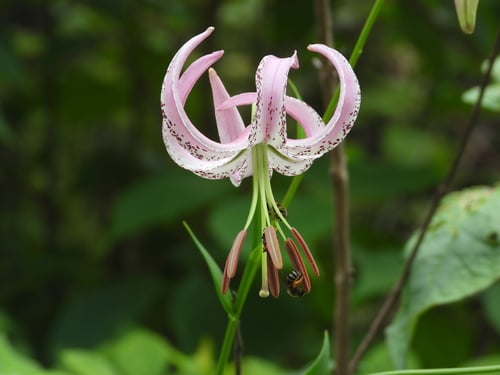
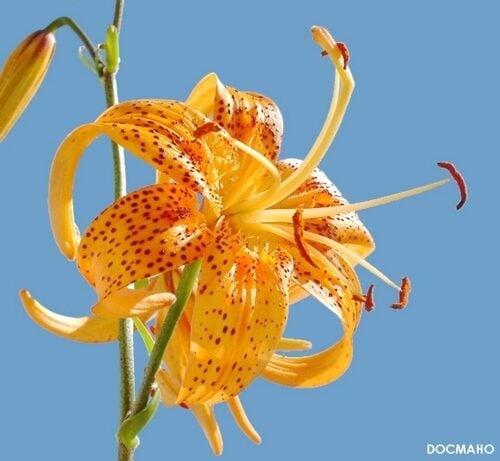
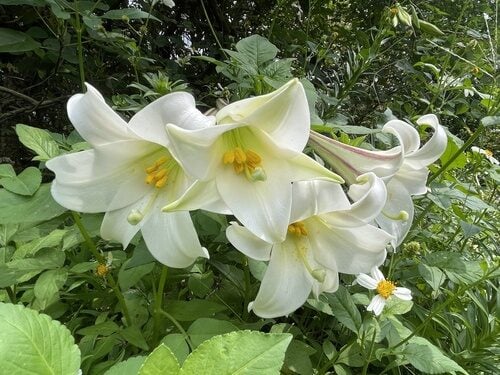
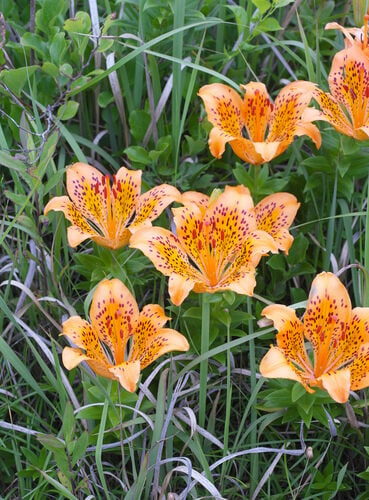
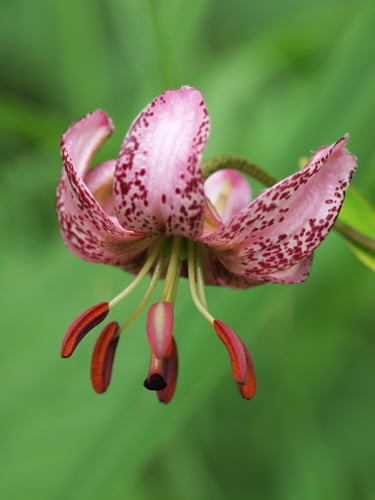
Calochortus aureus
S. Wats.
iNaturalist· cc-by-nc
(c) Steve Buckley, some rights reserved (CC BY-NC), uploaded by Steve Buckley
iNaturalist· cc-by-nc
(c) Zach Coury, some rights reserved (CC BY-NC)
iNaturalist· cc-by-nc
(c) Zach Coury, some rights reserved (CC BY-NC)
Summary
Source: WikipediaCalochortus aureus is a North American species of flowering plants in the lily family. It is native to the southwestern United States (Arizona, southern Utah, northwestern New Mexico and southwestern Colorado). Calochortus aureus is a bulb-forming perennial herb producing a single stalk up to 30 cm tall. Flowers are bright lemon-yellow with red or purple splotches on the petals.
Description
Bulb reaching 0.3 m tall and 0.2 m wide, hardy to UK zone 3. Flowers April to June. Hermaphrodite, pollinated by insects. Prefers light sandy and medium loamy, well-drained soils with mildly acid to mildly alkaline pH. Requires full sun and tolerates dry to moist soil.
Edible Uses
Edible Parts: Flowers Root Edible Uses: Bulb - raw. The bulbs are gathered in early spring and peeled before being eaten. Flowers. Edible Uses & Rating: All parts of C. aureus are technically edible, though bulbs are the most valuable food source. They can be roasted, boiled, or dried for later use. The flavor is mild and potato-like, free from bitterness or fibrous texture. Leaves and seeds have been recorded as edible, but they are less palatable and possibly irritating if eaten in quantity. Edibility rating: 4.5/5 for bulbs; 1.5/5 for leaves and seeds [2-3]. Taste, Processing & Kitchen Notes: Fresh bulbs have a crisp, smooth texture and a faintly sweet, nutty flavor. Roasting enhances sweetness, yielding a taste reminiscent of chestnut or sweet potato, while boiling gives a milder, starchy consistency similar to a small new potato. Indigenous preparations typically involved roasting bulbs in earth pits lined with hot stones or boiling them in baskets with heated rocks. Leaves and seeds, while edible, are tough and slightly acrid; boiling softens them but adds little culinary value [2-3]. Seasonality (Phenology): Flowering occurs from May to July, depending on elevation and seasonal rainfall. Seed capsules mature by late July to early September, often persisting on dry stems long after the leaves wither. Bulbs remain viable underground year-round, even during summer drought. Plants enter dormancy by mid-summer, re-emerging the following spring after winter moisture [2-3]. Safety & Cautions (Food Use): Bulbs are safe when cooked but should not be consumed raw. Leaves and seeds may contain mild irritants; caution is advised, especially for those with sensitive digestion. Avoid harvesting in national parks or protected areas, as some Calochortus species are legally protected. Harvest & Processing Workflow: Bulbs are harvested after flowering but before complete dieback, ensuring they are firm and well-formed. Dig with minimal soil disturbance using a narrow trowel. Clean, peel, and cook immediately or dry for later roasting. Traditional use involved roasting bulbs whole in earthen pits. Traditional / Indigenous Use Summary: The bulbs of C. aureus were widely eaten by Paiute, Ute, and Hopi peoples. They were roasted, boiled, or ground into flour, often used as a sweet, sustaining food. The plants also had cultural significance, sometimes used ceremonially as symbols of renewal and resilience.
Medicinal Uses
None known
Distribution
It is a temperate plant. It grows in SW USA on red clay soils in grassland between 750-2.500 m altitude.
Where It Grows
North America, USA,
Cultivation
Identification & Habit: Golden Mariposa Lily is a perennial herb emerging each spring from a rounded bulb approximately 1–2.5 cm in diameter. The plant grows 15–40 cm tall, bearing a few narrow, grass-like basal leaves and one or two on the stem. Each stem terminates in 1–3 brilliant yellow flowers, often with an orange-red spot or crescent near the base of each petal and a small, dark nectar gland surrounded by hairs. Sepals are narrower and often greener than the petals. The fruit is a three-winged capsule, typically 2–4 cm long, containing numerous flattened seeds. Requires a deep very well-drained fertile sandy soil in a sunny position and must be kept dry over winter. This is a rather difficult plant to cultivate in Britain, it is very cold hardy but is intolerant of wetness especially in the winter. It is easiest to grow in a bulb frame but is worth trying outdoors at the base of a south-facing wall, especially with shrubs that like these conditions. Bulbs can be lifted as soon as the foliage dies down in the summer and stored overwinter in a cool dry place, replanting in spring. Bulbs frequently divide after flowering, the bulblets taking 2 years to reach flowering size. Hand pollination is necessary if seed is required. Habitat & Range: This species occurs across Utah, Arizona, New Mexico, western Colorado, and southern Nevada, from 1,200 to 2,700 meters elevation. It often grows with other spring wildflowers such as Phlox hoodii, Eriogonum umbellatum, and Penstemon spp., forming part of the mid-spring desert bloom. Size & Landscape: Performance Typically 15–40 cm tall and 10–25 cm wide, C. aureus produces eye-catching blooms ideal for native xeriscapes or rock gardens. It tolerates neglect and poor soils, provided they are dry in summer. Its vibrant flowers contrast beautifully with fine-textured desert vegetation.
Propagation
Seed - sow as soon as ripe or early spring in a cold frame in a very sharply draining medium. Stratification may be helpful. Germination usually takes place within 1 - 6 months at 15°c. Leave the seedlings undisturbed for their first two years growth, but give them an occasional liquid feed to ensure they do not become nutrient deficient. It is quite difficult to get the seedlings through their first period of dormancy since it is all too easy either to dry them out completely or keep them too moist when they will rot. After their second year of growth, pot up the dormant bulbs in late summer and grow them on for at least another 2 years in the greenhouse before trying them outside. Seedlings take about 5 - 7 years to come into flower. Division of the bulbs as soon as the foliage dies down. One report says that the bulbs must be planted into their permanent positions immediately, whilst another says that they can be stored overwinter and replanted in the spring. Stem bulbils, harvested from the stems after flowering. They can be stored cool and dry then planted in pots in the cold frame in the spring.
Other Uses
Eye-catching blooms ideal for native xeriscapes or rock gardens. It tolerates neglect and poor soils. Ecology & Wildlife: The flowers attract a variety of native bees and pollinating flies, serving as a key nectar source in dry habitats during late spring. Rodents, especially ground squirrels and voles, occasionally consume bulbs, while deer may browse the foliage lightly. The plant also contributes to early-season pollinator networks in arid ecosystems. The plants also had cultural significance, sometimes used ceremonially as symbols of renewal and resilience. Special Uses
Notes
There are about 60-100 Calochortus species. There are 7-9 species in tropical America. They have also been put in the family Calochortaceae.
Synonyms
Also Known As
Golden Mariposa Lily (Calochortus aureus S. Watson)
References (4)
- Beckstrom-Sternberg, Stephen M., and James A. Duke. "The Foodplant Database." http://probe.nalusda.gov:8300/cgi-bin/browse/foodplantdb.(ACEDB version 4.0 - data version July 1994)
- Bircher, A. G. & Bircher, W. H., 2000, Encyclopedia of Fruit Trees and Edible Flowering Plants in Egypt and the Subtropics. AUC Press. p 74
- Elmore, F. H., 1944, Ethnobotany of the Navajo. University of New Mexico Press. p 105
- Kermath, B. M., et al, 2014, Food Plants in the Americas: A survey of the domesticated, cultivated and wild plants used for Human food in North, Central and South America and the Caribbean. On line draft. p 163