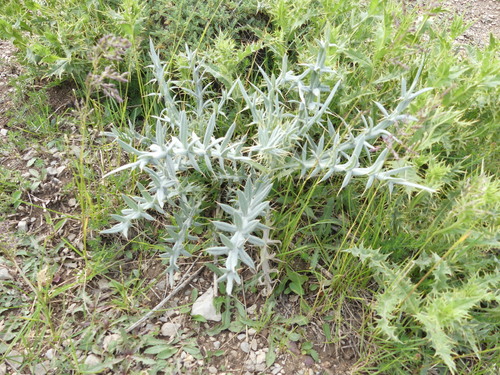
Helichrysum panduratum
O. Hoffm.
Everlasting
iNaturalist· cc0
no rights reserved, uploaded by Erwin Sieben
iNaturalist· cc-by-nc
(c) Marinda, some rights reserved (CC BY-NC)
iNaturalist· cc-by-nc-nd
(c) Brendan Cole, some rights reserved (CC BY-NC-ND), uploaded by Brendan Cole
Description
A small shrub or scrambling herb. The leaves are 7 cm long by 4 cm wide. They get smaller up the stem. They are broad at the base and clasp the stem. They have dense woolly hairs underneath. The flowers are yellow with whtie bracts.
Edible Uses
The leaves are used to make tea drinks.
Traditional Uses
The leaves are used for tea drinks.
This uses section is brief — help expand it
Medicinal Uses
The leaves are used traditionally for tea drinks.
Distribution
It is a tropical plant. It can grow in arid places. It grows along the edges of forests and in woodland.
Where It Grows
Africa, Angola, Central Africa, Congo, East Africa, Eswatini, Gabon, Kenya, Malawi, Mozambique, South Africa, Southern Africa, Swaziland, Tanzania, Uganda, Zambia, Zimbabwe,
References (7)
- Fowler, D. G., 2007, Zambian Plants: Their Vernacular Names and Uses. Kew. p 12
- Fox, F. W. & Young, M. E. N., 1982, Food from the Veld. Delta Books. p 123
- Long, C., 2005, Swaziland's Flora - siSwati names and Uses http://www.sntc.org.sz/flora/
- Royal Botanic Gardens, Kew (1999). Survey of Economic Plants for Arid and Semi-Arid Lands (SEPASAL) database. Published on the Internet; http://www.rbgkew.org.uk/ceb/sepasal/internet [Accessed 11th April 2011]
- Ruiters-Welcome, A. K., 2019, Food plants of southern Africa. Ph.D. thesis. Univ. of Johannesburg p 35
Show all 7 references Hide references
- Welcome, A. K. & Van Wyk, B.-E., 2019, An inventory and analysis of the food plants of southern Africa. South African Journal of Botany 122 (2019) 136–179
- World Checklist of Useful Plant Species 2020. Royal Botanic Gardens, Kew