Grewia olukondae
Schinz
Rough-leaved raisin, Soft-leaved donkey-berry
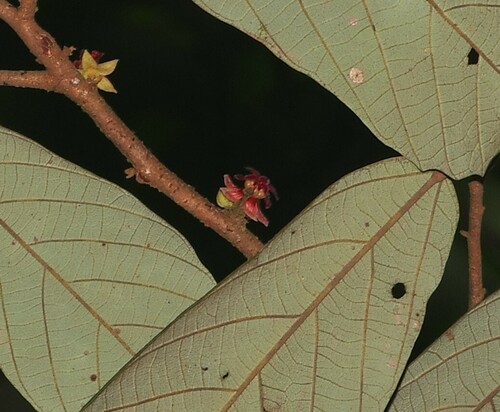
iNaturalist· cc-by-nc
(c) Troos van der Merwe, some rights reserved (CC BY-NC)
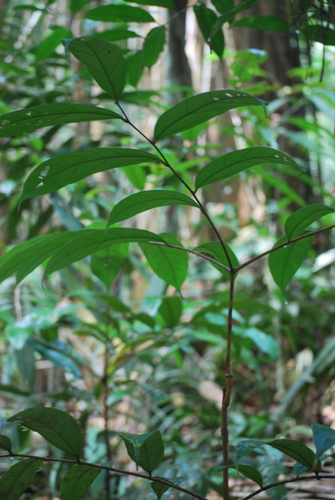
iNaturalist· cc-by-nc
(c) Troos van der Merwe, some rights reserved (CC BY-NC)
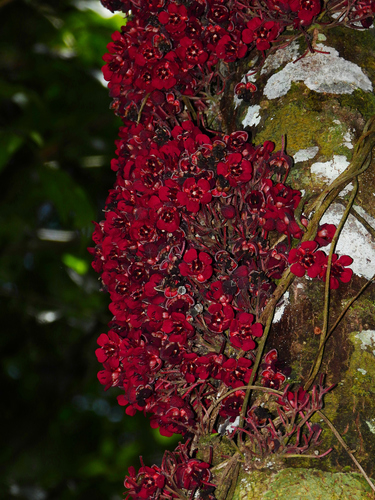
iNaturalist· cc-by-nc
(c) Troos van der Merwe, some rights reserved (CC BY-NC)
Description
A shrub. It grows 2 m tall. The larger branches are often square. It is usually dense and scrambling. The leaves are alternate and oval. They are 7 cm long by 7.5 cm wide. They have irregular teeth along the edge. The leaves are hairy on both sides. The flowers are yellow and star shaped. The petals curve backwards. The fruit is an orange-brown berry. It is hard and has 2 seeds.
Edible Uses
The fruit is eaten as a snack, and the leaves are also edible.
Traditional Uses
The fruit is eaten as a snack.
This uses section is brief — help expand it
Distribution
It is a tropical plant. It grows along river banks. It can be on termite mounds in open woodland.
Where It Grows
Africa, Asia, Botswana, East Africa, Eswatini, India, Mozambique, Namibia, South Africa, Southern Africa, Swaziland, Zambia, Zimbabwe,
Notes
These were in the Sparrmanniaceae and the Tiliaceae.
Synonyms
Also Known As
Omukopakopa
References (4)
- Long, C., 2005, Swaziland's Flora - siSwati names and Uses http://www.sntc.org.sz/flora/
- Pickering, H., & Roe, E., 2009, Wild Flowers of the Victoria Falls Area. Helen Pickering, London. p 110
- Ruiters-Welcome, A. K., 2019, Food plants of southern Africa. Ph.D. thesis. Univ. of Johannesburg p 76
- Welcome, A. K. & Van Wyk, B.-E., 2019, An inventory and analysis of the food plants of southern Africa. South African Journal of Botany 122 (2019) 136–179