Plantago lanceolata
L.
Narrow-leaf plantain, Buckhorn plantain
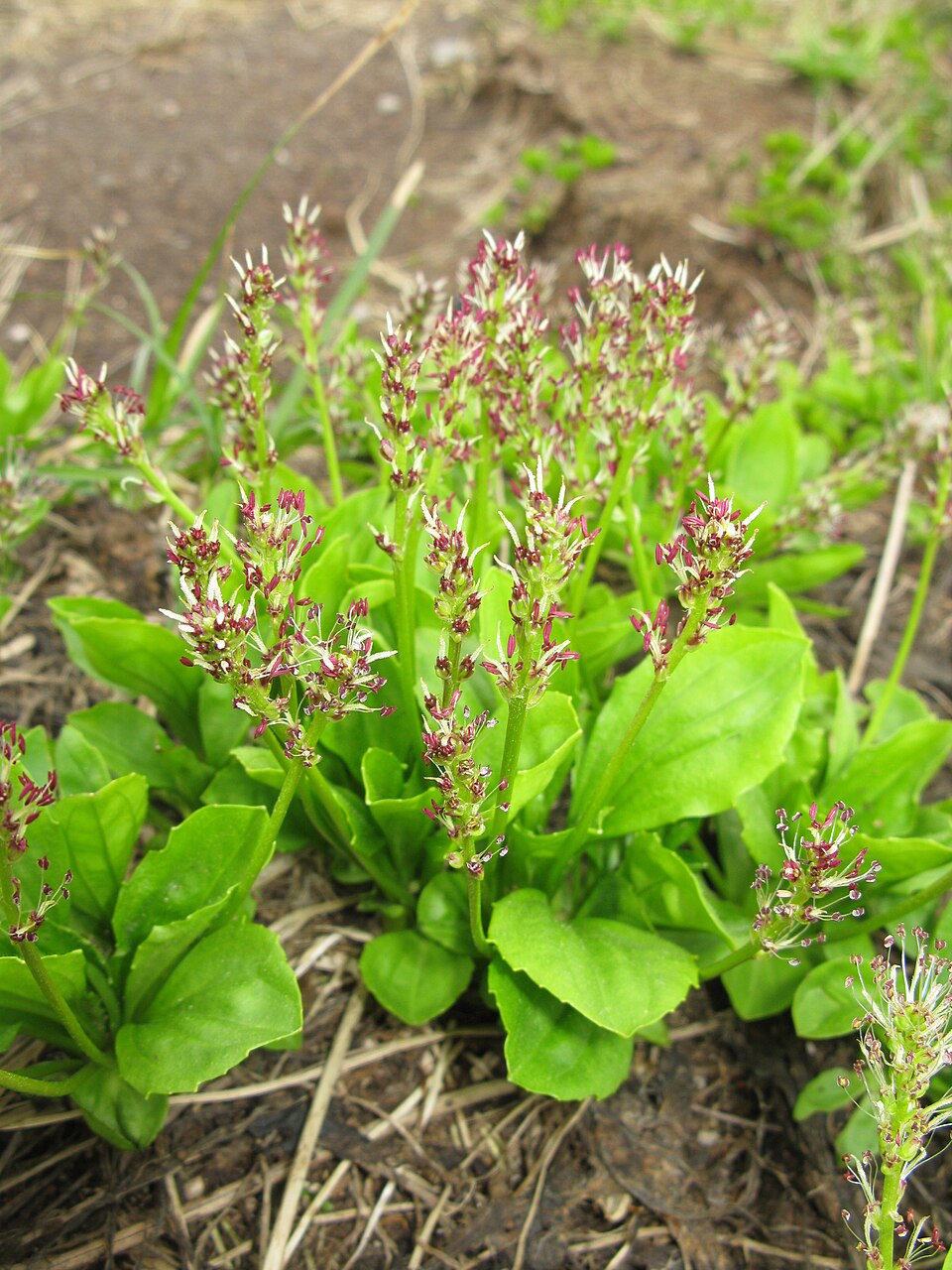
iNaturalist· cc-by
(c) Petr Harant, some rights reserved (CC BY), uploaded by Petr Harant
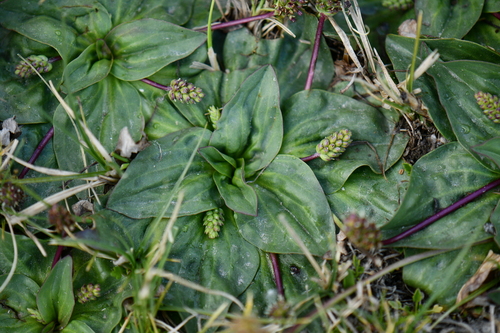
iNaturalist· cc-by-nd
(c) Eric Huybrechts, some rights reserved (CC BY-ND)
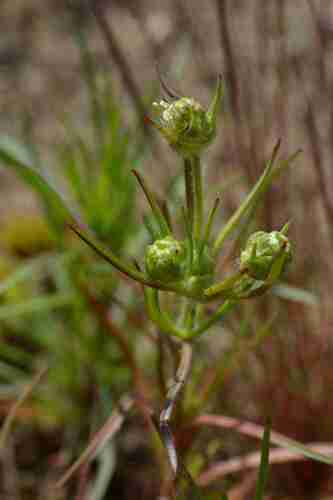
iNaturalist· cc-by-nc
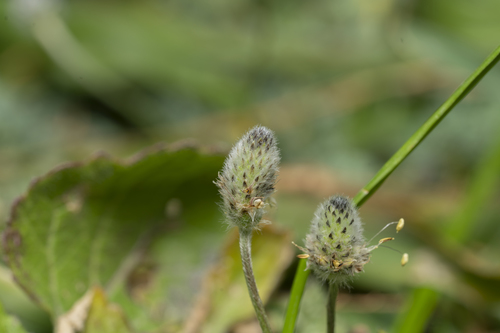
(c) Miroslav Marić, some rights reserved (CC BY-NC), uploaded by Miroslav Marić
Summary
Source: WikipediaPlantago lanceolata is a species of flowering plant in the plantain family Plantaginaceae. It is known by the common names ribwort plantain, narrowleaf plantain, English plantain, ribleaf, lamb's tongue, and buckhorn. It is a common weed on cultivated or disturbed land.
Description
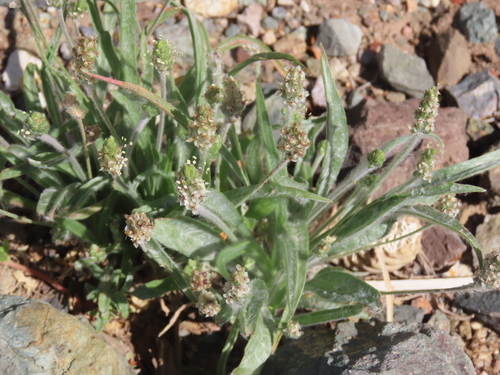
A herb which keeps growing from year to year. It has a well developed taproot. The leaves have stalks. The leaves are 2.5-30 cm long. They are sword shaped and taper to the tip. They can have teeth along the edge. The leaves have 3-7 easy to see veins running along them. The leaves have soft slender hairs. The flower stalks do not have leaves. The flower stalk is usually longer than the leaves. The flower stalk is usually deeply furrowed. The flowers are yellowish.
Edible Uses
Young leaves can be eaten raw or cooked, though they are rather bitter and preparation is time-consuming — the fibrous strands are best removed before eating. Very young leaves are somewhat less fibrous and more palatable. The seed can be cooked and used like sago, or ground into a powder and mixed into flour for bread, cakes, or similar preparations.
Traditional Uses
The tender leaves are cooked as a vegetable. They are also eaten in salads. The leaves are used for sarma in Turkey. They are rolled around a filling of rice or minced meat. The seeds are used like sago. The leaves are also used for liqueur.
Medicinal Uses
Ribwort plantain is a safe and effective treatment for bleeding, quickly stanching blood flow and supporting the repair of damaged tissue. The leaves contain mucilage, tannin, and silicic acid, and a leaf extract has demonstrated antibacterial properties. The leaves are bitter, astringent, demulcent, mildly expectorant, haemostatic, and ophthalmic. Internally they are used for diarrhoea, gastritis, peptic ulcers, irritable bowel syndrome, haemorrhage, haemorrhoids, cystitis, bronchitis, catarrh, sinusitis, asthma, and hay fever. Externally they are applied to skin inflammations, malignant ulcers, cuts, and stings. Heated leaves are used as a wet dressing for wounds and swellings. The root, used in equal portions with Marrubium vulgare, is a traditional remedy for rattlesnake bite. The seeds are used to treat parasitic worms. Seeds contain up to 30% mucilage, which swells in the gut and acts as a bulk laxative while soothing irritated membranes; the husks alone are sometimes used without the seeds. A distilled water made from the plant serves as an excellent eye lotion.
Known Hazards
Care should be exercised when collecting the plant from the wild for medicinal purposes, since they may contain high concentrations of heavy metals such as lead and cadmium where they grow along roads.
Distribution
It is a temperate plant. In Nepal it grows up to 1700 m altitude. in Argentina it grows from sea level to 1,000 m above sea level. It grows on open, sandy soil. Tasmania Herbarium.
Where It Grows
Afghanistan, Africa, Alaska, Albania, Algeria, American Samoa, Argentina, Armenia, Asia, Australia, Austria, Bahamas, Balkans, Belarus, Belgium, Bermuda, Bhutan, Bolivia, Bosnia, Botswana, Brazil, Britain, Bulgaria, Canada, Canary Is., Caucasus, Central America, Central Asia, Chile, China, Colombia, Congo DR, Cook Is., Costa Rica, Crete, Croatia, Cuba, Cyprus, Czech Republic, Denmark, Dominican Republic, East Africa, Easter Island, Eswatini, Europe*, Falklands, Finland, France, Gabon, Georgia, Germany, Greece, Greenland, French Guiana, Haiti, Himalayas, Hungary, Iceland, India, Indonesia, Iran, Iraq, Ireland, Italy, Jamaica, Japan, Kazakhstan, Kenya, Korea, Kuwait, Kyrgyzstan, Lebanon, Lesotho, Libya, Luxembourg, Macedonia, Madagascar, Malawi, Manchuria, Mauritania, Mediterranean, Mexico, Middle East, Mongolia, Morocco, Namibia, Nepal, Netherlands, New Zealand, Niue, Norfolk Island, North Africa, North America, Norway, NW India, Pakistan, Palestine, Peru, Poland, Portugal, Puerto Rico, Romania, Russia, Rwanda, Saudi Arabia, Scandinavia, SE Asia, Siberia, Sicily, Slovenia, South Africa, South America, Southern Africa, Spain, Sri Lanka, Sudan, Swaziland, Sweden, Switzerland, Syria, Taiwan, Tajikistan, Tanzania, Tasmania, Tonga, Tunisia, Turkey, Türkiye, Turkmenistan, Ukraine, Uruguay, USA, Uzbekistan, Venezuela, West Indies, Yemen, Yugoslavia, Zimbabwe,
Cultivation
Succeeds in any moderately fertile soil in a sunny position. Plants also succeed in very poor land. An important food plant for the caterpillars of many species of butterflies. In garden design, as well as the above-ground architecture of a plant, root structure considerations help in choosing plants that work together for their optimal soil requirements including nutrients and water.
Propagation
Sow seed in spring in a cold frame. Once seedlings are large enough to handle, prick them out into individual pots and plant out in early summer. If seed is plentiful, a direct outdoor sowing can be made in situ from mid to late spring.
Other Uses
A good fibre obtained from the leaves is considered suitable for textiles. Mucilage from the seed coats can be used as a fabric stiffener; it is extracted by macerating the seeds in hot water. Gold and brown dyes can be obtained from the whole plant. This plant is a dynamic accumulator and an important food plant for the caterpillars of many butterfly species. It is suited to food forest and wildlife garden settings.
Other Information
The leaves and young flowers are foraged and eaten in restaurants in Sweden. It is sold in local markets.
Notes
The plantains or Plantaginaceae are mostly in temperate regions. There are about 165 Plantago species. This plant causes hay-fever due to its pollen.
Nutrition
| Part | Moisture | kJ | kcal | Protein | Vit A | Vit C | Iron | Zinc |
|---|---|---|---|---|---|---|---|---|
| Leaves | 87 | 172 | 42 | 2.1 | — | — | — | — |
| Leaves | 79 | 19 | 2.2 | — | — | — | — | — |
Synonyms
Also Known As
Baltanga, Code de sorce, Damarlica, Gul, Hiunca llanten, Isapgol, Lamb's tongue, Lanzafina, Lechuguilla, Lengua de vaca, Llanten, Llanten menor, Llanthen de hoja angosta, Long-leaved plantain, Masloon, Muska bokvica, Ozkolistni trpotec, Pelhves, Pentranevro, Piantai, Plangtarl long, Plantago, Plantatge, Planten, Ribgrass, Ribwort plantain, Rumput iga, Siete venas, Sinco nervi, Sinirliot, Smalkjempe, Smalle weegbree, Spitzwegerich, Tanchagem, Tansagem
References (78)
- Abbet, C., et al, 2014, Ethnobotanical survey on wild alpine food plants in Lower and Central Valais (Switzerland). Journal of Ethnopharmacology 151 (2014) 624–634
- Ambasta, S.P. (Ed.), 2000, The Useful Plants of India. CSIR India. p 466
- Bhatia, H., et al, 2018, Traditionally used wild edible plants of district Udhampur, J&K, India. Journal of Ethnobiology and Ethnomedicine (2018) 14:73
- Biscotti, N. et al, 2018, The traditional food use of wild vegetables in Apulia (Italy) in the light of Italian ethnobotanical literature. Italian Botanist 5:1-24
- Blamey, M and Grey-Wilson, C., 2005, Wild flowers of the Mediterranean. A & C Black London. p 421
Show all 78 references Hide references
- Bonet, M. A. & Valles, J., 2002, Use of non-crop food vascular plants in Montseny biosphere reserve (Catalonia, Iberian Peninsula). International Journal of Food Sciences and Nutrition (2002) 53, 225–248
- Bremness, L., 1994, Herbs. Collins Eyewitness Handbooks. Harper Collins. p 203
- Cerne, M., 1992, Wild Plants from Slovenia used as Vegetables. Acta Horticulturae 318
- Christanell, A., et al, 2010, The Cultural Significance of Wild Gathered Plant Species in Kartitsch (Eastern Tyrol, Austria) and the Influence of Socioeconomic Changes on Local Gathering Practices. Chapter 3 in Ethnobotany in the New Europe. Berghahn Books.
- Cordero, S. E., Abello, L. A., & Galvez, F. L., 2017, Plantas silvestres comestibles y medicinales de Chile y otras partes del mundo. CORMA p 220
- Crawford, M., 2012, How to grow Perennial Vegetables. Green Books. p 150
- Curtis, W.M., 1993, The Student's Flora of Tasmania. Part 3 St David's Park Publishing, Tasmania, p 560
- Dalar, A., et al, 2016, Health attributes of ethnic vegetables consumed in the Eastern Anatolia region of Turkey: Antioxidant and enzyme-inhibitory properties. Journal of Ethnic Foods. 3 (2016) 142-149
- Dangol, D. R. et al, 2017, Wild Edible Plants in Nepal. Proceedings of 2nd National Workshop on CUAOGR, 2017.
- Dashorst, G.R.M., and Jessop, J.P., 1998, Plants of the Adelaide Plains & Hills. Botanic Gardens of Adelaide and State Herbarium. p 134
- Demir, I. & Ayaz, N., 2022, Wild edible plants contributing to the traditional foods of Mardin (Turkey) Province. Indian Journal of Traditional Knowledge Vol 21(3), July 2022, pp 569-582
- Denes, A., et al, 2012, Wild plants used for food by Hungarian ethnic groups living in the Carpathian Basin. Acta Societatis Botanicorum Poloniae 81 (4): 381-396
- Diaz-Betancourt, M., et al, 1999, Weeds as a future source for human consumption. Rev. Biol. Trop. 47(3):329-338
- Dogan, Y., et al, 2004, The Use of Wild Edible Plants in Western and Central Anatolia (Turkey). Economic Botany 58(4) pp. 684-690
- Dogan, Y., 2012, Traditionally used wild edible greens in the Aegean Region of Turkey. Acta Societatis Botanicorum Poloniae 81(4): 329-342
- Dogan, Y., et al, 2015, Of the importance of a leaf: the ethnobotany of sarma in Turkey and the Balkans. Journal of Ethnobiology and Ethnomedicine, 11:56
- Dolina, K. & Luczaj, L., 2014, Wild food plants used on the Dubrovnik coast (south-eastern Croatia) Acta Soc Bot Pol 83(3):175–181
- Dretakis, M. et al, 2012, Flora and Fauna Biodiversity in an ancient olive grove in Crete (Greece) in Calabrese G. (Ed.) Study on Biodiversity in Century-Old Olive Groves. CIHEAM - Mediterranean Agronomic Institute of Bari. p 94
- Ertug, F, Yenen Bitkiler. Resimli Türkiye Florası -I- Flora of Turkey - Ethnobotany supplement
- Facciola, S., 1998, Cornucopia 2: a Source Book of Edible Plants. Kampong Publications, p 173
- Flora of Australia Volume 49, Oceanic Islands 1, Australian Government Publishing Service, Canberra. (1994) p 325
- Fox, F. W. & Young, M. E. N., 1982, Food from the Veld. Delta Books. p 292
- Geraci, A., et al, 2018, The wild taxa utilized as vegetables in Sicily (Italy): a traditional component of the Mediterranean diet. Journal of Ethnobiology and Ethnomedicine (2018) 14:14
- Girard, N. J., 2020, Sustainable Foraging of Wild Edible Plants in Norway. A Biocultural Approach. M. Sc. thesis Norwegian University. p 133
- Guil-Guerrero, J. L., et al, 2001, Edible Wild Plants. in Recent Progress in Medicinal Plants Vol. 8 Sci. Tech publishing, Texas
- Hadjichambis, A. C., et al, 2007, Wild and semi-domesticated food plant consumption in seven circum-Mediterranean areas. International Journal of Food Sciences and Nutrition. 2007, 1-32.
- Hibbert, M., 2002, The Aussie Plant Finder 2002, Florilegium. p 236
- http://nordicfood lab/org/blog/2102/9/wild-edible-plants-an-overview
- http://www.botanic-gardens-ljubljana.com/en/plants
- Hussey, B.M.J., Keighery, G.J., Cousens, R.D., Dodd, J., Lloyd, S.G., 1997, Western Weeds. A guide to the weeds of Western Australia. Plant Protection Society of Western Australia. p 196
- Hyde-Wyatt, B.H. & Morris D.I., 1975, Tasmanian Weed Handbook. Dept of Ag Tasmania. p 87
- Irving, M., 2009, The Forager Handbook, A Guide to the Edible Plants of Britain. Ebury Press p 240
- Joshi, N., et al, 2007, Traditional neglected vegetables of Nepal: Their sustainable utilization for meeting human needs. Tropentag 2007. Conference on International Agricultural Research for Development.
- Kermath, B. M., et al, 2014, Food Plants in the Americas: A survey of the domesticated, cultivated and wild plants used for Human food in North, Central and South America and the Caribbean. On line draft. p 669
- Kew Plants of the World Online
- Kiple, K.F. & Ornelas, K.C., (eds), 2000, The Cambridge World History of Food. CUP p 434
- Lamp, C & Collet F., 1989, Field Guide to Weeds in Australia. Inkata Press. p 219
- Long, C., 2005, Swaziland's Flora - siSwati names and Uses http://www.sntc.org.sz/flora/
- Low, T., 1991, Wild Herbs of Australia and New Zealand. Angus & Robertson. p 50 (Drawing)
- Łukasz Łuczaj and Wojciech M Szymański, 2007, Wild vascular plants gathered for consumption in the Polish countryside: a review. J Ethnobiol Ethnomedicine. 3: 17
- Luczaj, L. et al, 2012, Wild food plant use in 21st century Europe: the disappearance of old traditions and the search for new cuisines involving wild edibles. Acta Soc Bot Pol 81(4):359–370
- Luczaj, L. et al, 2013, Wild edible plants of Belarus: from Rostakinski's questionnaire of 1883 to the present. Journal of Ethnobiology and Ethnomedicine 9:21
- MacKinnon, A., et al, 2009, Edible & Medicinal Plants of Canada. Lone Pine. p 256
- Malezas Comestibles del Cono Sur, INTA, 2009, Buernos Aires
- Manandhar, N.P., 2002, Plants and People of Nepal. Timber Press. Portland, Oregon. p 368
- Mattalia, G., et al, 2012, Traditional uses of wild food and medicinal plants among Brigasc, Kye ́, and Provenc ̧al communities on the Western Italian Alps. Genet Resour Crop Evol. Springer
- Menendez-Baceta, G., et al, 2012, Wild edible plants traditionally gathered in Gorbeialdea (Biscay, Basque Country) Genetic Resources and Crop Evolution 59:1329-1347
- Mir, M. Y., 2014, Documentation and ethnobotanical survey of wild edible plants used by the tribals of Kupwara, J & K, India. International Journal of Herbal Medicine. 2(4): 11-18
- Nanagulyan, S., et al, 2020, Wild plants and fungi sold in the markets of Yerevan (Armenia). Journal of Ethnobiology and Ethnomedicine 16:26
- Paczkowska, G . & Chapman, A.R., 2000, The Western Australian Flora. A Descriptive Calatogue. Western Australian Herbarium. p 457
- Paoletti, M.G., Dreon, A.L., and Lorenzoni, G.G., 1995, Pistic, Traditional Food from Western Friuli, NE Italy. Economic Botany 49(1) pp 26-30
- Pieroni, A., 1999, Gathered wild food plants in the Upper Valley of the Serchio River (Garfagnana), Central Italy. Economic Botany 53(3) pp 327-341
- Plants for a Future database, The Field, Penpol, Lostwithiel, Cornwall, PL22 0NG, UK. http://www.scs.leeds.ac.uk/pfaf/
- Plants of Haiti Smithsonian Institute http://botany.si.edu/antilles/West Indies
- Rashid, A., Anand, V.K. & Serwar, J., 2008, Less Known Wild Plants Used by the Gujjar Tribe of District Rajouri, Jammu and Kashmir State. International Journal of Botany 4(2):219-244
- Redzic, S. J., 2006, Wild Edible Plants and their Traditional Use in the Human Nutrition in Bosnia-Herzegovina. Ecology of Food and Nutrition, 45:189-232
- Redzic, S., 2010, Use of Wild and Semi-Wild Edible Plants in Nutrition and Survival of People in 1430 Days of Siege of Sarajevo during the War in Bosnia and Herzegovina (1992–1995). Coll. Antropol 34 (2010) 2:551-570
- Ruiters-Welcome, A. K., 2019, Food plants of southern Africa. Ph.D. thesis. Univ. of Johannesburg p 87
- Schunko, C., et al, 2010, Organic farmers use of wild food plants and fungi in a hilly area in Styria (Austria). Journal of Ethnobiology and Ethnomedicine 6:17
- Schunko, C., et al, 2012, Intracultural variation of knowledge about wild plant uses in the Biosphere Reserve Grosses Walsertal (Austria). Journal or Ethnobiology and Ethnomedicine, 8:23
- Skinner, G. & Brown, 1981, C., Simply Living. A gatherer's guide to New Zealand's fields, forests and shores. Reed. p 17
- Sp. pl. 1:113. 1753
- Sukarya, D. G., (Ed.) 2013, 3,500 Plant Species of the Botanic Gardens of Indonesia. LIPI p 1130
- Swaziland's Flora Database http://www.sntc.org.sz/flora
- Tasmanian Herbarium Vascular Plants list p 44
- Tardio, J., et al, Ethnobotanical review of wild edible plants in Spain. Botanical J. Linnean Soc. 152 (2006), 27-71
- Uphof,
- Upson, R., & Lewis R., 2014, Updated Vascular Plant Checklist and Atlas for the Falkland Islands. Falklands Conservation and Kew.
- Vorstenbosch, T., et al, 2017, Famine food of vegetal origin consumed in the Netherlands during World War II. Journal of Ethnobiology and Ethnomedicine (2017) 13:63
- Welcome, A. K. & Van Wyk, B.-E., 2019, An inventory and analysis of the food plants of southern Africa. South African Journal of Botany 122 (2019) 136–179
- World Checklist of Useful Plant Species 2020. Royal Botanic Gardens, Kew
- www.wildediblefood.com
- Zizka, G., 1991, Flowering Plants of Easter Island. Palmarum Hortus Francofurtensis