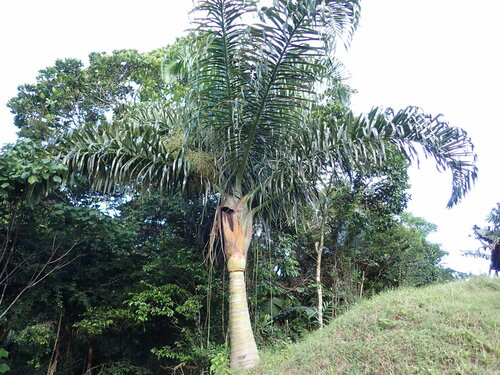
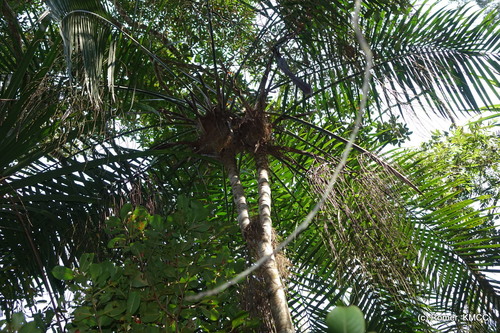
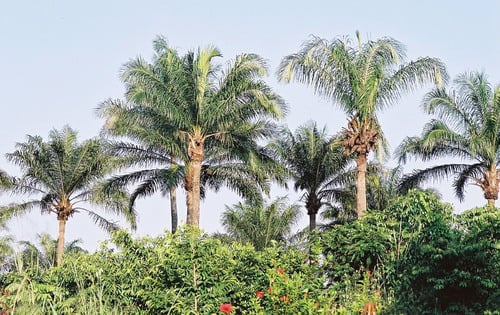
Calamus rotang
L.
Rattan Cane
iNaturalist· cc-by-nc-nd
(c) jennyhsu47, some rights reserved (CC BY-NC-ND)
iNaturalist· cc-by-nc
(c) Rujuta Vinod, some rights reserved (CC BY-NC)
iNaturalist· cc-by-nc
(c) Sarinda Perera, some rights reserved (CC BY-NC)
Summary
Source: WikipediaCalamus rotang, also known as common rattan, is a plant species native to India, Sri Lanka and Myanmar (Burma). It is one of the scandent (climbing) rattan palms used to make Malacca cane furniture, baskets, walking-sticks, umbrellas, tables and general wickerwork, and is found in Southwest Asia. The basal section of the plant grows vertically for 10 metres or so, after which the slender, tough stem of a few centimetres in diameter, grows horizontally for 200 metres or more. It is extremely flexible and uniform in thickness, and frequently has sheaths and petioles armed with backward-facing spines which enable it to scramble over other plants. It has pinnate, alternate leaves, 60–80 cm long, armed with two rows of spines on the upper face. The plants are dioecious, and flowers are clustered in attractive inflorescences, enclosed by spiny spathes. The edible fruits are top-shaped, covered in shiny, reddish-brown imbricate scales, and exude an astringent red resin known medicinally and commercially as "dragon's blood". The canes are sought after and expensive, but have to a large extent been replaced by sticks made from plants, such as bamboos, rushes and osier willows.
Description
An erect or climbing palm. It can have one or several stems. It grows to 10 m long. It is spiny. The leaves are light or mid green. They are 80 cm long and composed of narrow, long, shaped leaflets. The flowers are star shaped and 3 pointed. They are cream and 1.5 cm long. The fruit are round.
Edible Uses
Edible Parts: Fruit Shoots Edible Uses: Edible portion: Shoots, Fruit. Young shoots - cooked and eaten as a vegetable. Fruit - raw. When ripe the fruit is roundish, as large as a hazelnut and is covered with small, shining scales, laid like shingles, one upon the other. The subacid pulp which surrounds the kernel is sucked out and eaten as a means of quenching the thirst. Sometimes the fruit is pickled with salt and eaten at tea-time. The globose fruits are about 13mm in diameter.
Traditional Uses
The young tender shoots are used as a vegetable. They are also used for chutney with chillies. The fruit are sometimes sucked. They are also pickled with salt and eaten.
Medicinal Uses
Antidote Febrifuge Vermifuge The wood is vermifuge. The leaves are used in the treatment of biliousness and diseases of the blood. The root is used in the treatment of chronic fevers and as an antidote to snake venom.
Distribution
It is a tropical and subtropical plant. It needs a temperature above 10°C. It needs moist, well-drained soil. It is best in partial shade. Plants are damaged by frost. It grows in thickets in damp ground. It suits hardiness zones 11-12.
Where It Grows
Asia, Australia, Bangladesh, East Timor, India, Nepal, Northeastern India, SE Asia, Sri Lanka, Timor-Leste,
Cultivation
Most species in this genus are more or less vigorous climbing plants in rainforests. In general, they are likely to grow best with their roots in the shade but with their stems able to grow up to the light. They are also likely to grow best in a humus-rich soil. A dioecious species, both male and female forms need to be grown if fruit and seed are required.
Propagation
Seed
Other Uses
Basketry Furniture String Weaving Wood Other uses rating: High (4/5). Other Uses: This is the species which yields the best Rattan Cane of commerce. Other species are, however, used as substitutes. It is split into strips and plaited or woven into baskets, chairs, sofas, and carriages. It is twisted into ropes, or stretched entire across rivers, as the main supports of indigenous suspension bridges. The core of the cane is made into furniture, basketry etc. The skin peel is used for weaving of chair seats and bags. Special Uses
Other Information
The fruit are sold in markets. Shoots are sold in local markets.
Notes
There are 375-400 Calamus species. There are 175 species in tropical Asia.
Nutrition
| Part | Moisture | kJ | kcal | Protein | Vit A | Vit C | Iron | Zinc |
|---|---|---|---|---|---|---|---|---|
| Fruit | — | 79 | 0.6 | — | 0.5 | 1.7 | — | — |
| Shoots | — | — | — | — | — | — | — | — |
Synonyms
Also Known As
Bet, Chachi bet, Heart, Pemu, Perambu, Pri, Raigong, Sanchi-bet, Tingdon, Vetasa, Vetra
References (27)
- Ambasta S.P. (Ed.), 2000, The Useful Plants of India. CSIR India. p 95
- BARC, 2016, State of Biodiversity for Food and Agriculture in Bangladesh. Bangladesh Agricultural Research Council.
- Bircher, A. G. & Bircher, W. H., 2000, Encyclopedia of Fruit Trees and Edible Flowering Plants in Egypt and the Subtropics. AUC Press. p 72
- Brickell, C. (Ed.), 1999, The Royal Horticultural Society A-Z Encyclopedia of Garden Plants. Convent Garden Books. p 201
- Cundall, P., (ed.), 2004, Gardening Australia: flora: the gardener's bible. ABC Books. p 278
Show all 27 references Hide references
- Etherington, K., & Imwold, D., (Eds), 2001, Botanica's Trees & Shrubs. The illustrated A-Z of over 8500 trees and shrubs. Random House, Australia. p 154
- Haynes, J., & McLaughlin, J., 2000, Edible palms and Their Uses. University of Florida Fact sheet MCDE-00-50-1 p 4
- Hedrick, U.P., 1919, (Ed.), Sturtevant's edible plants of the world. p 142
- Janick, J. & Paul, R. E. (Eds.), 2008, The Encyclopedia of Fruit & Nuts. CABI p 106
- Jones, D.L., 1994, Palms throughout the World. Smithtonian Institution, Washington. p 54
- Kar, A., & Borthakur, S. K., 2008, Wild edible fruits of Karbi's of Karbi Anglong district of Assam, India, Pleione 2(2): 175-181
- Kar, A., & Borthakur, S. K., 2008, Wild vegetables of Karbi - Anglong district, Assam, Natural Product Radiance, Vol. 7(5), pp 448-460
- Lim, T. K., 2015, Edible Medicinal and Non Medicinal Plants. Volume 9, Modified Stems, Roots, Bulbs. Springer p 20
- Medhi, P. & Borthakur, S. K., 2012, Phytoresources from North Cachur Hills of Assam -3: Edible plants sold at Hflong market. Indian Journal or Natural Products and Resources. 3(1) pp 84-109
- Medhi, P. & Borthakur, S. K., 2013, Wild edible plants sold by the Zeme Nagas at the makeshift market of Mahur, Dima Hasao district of Assam. Pleione 7(1): 84 - 93. 2013.
- Medhi, P., Sarma, A and Borthakur, S. K., 2014, Wild edible plants from the Dima Hasao district of Assam, India. Pleione 8(1): 133-148
- Menninger, E.A., 1977, Edible Nuts of the World. Horticultural Books. Florida p 130
- Pegu, R., et al, 2013, Ethnobotanical study of Wild Edible Plants in Poba Reserved Forest, Assam, India. Research Journal of Agriculture and Forestry Sciences 1(3):1-10
- Singh, H.B., Arora R.K.,1978, Wild edible Plants of India. Indian Council of Agricultural Research, New Delhi. p18, 53
- Singh, V. B., et al, (Ed.) Horticulture for Sustainable Income and Environmental Protection. Vol. 1 p 214
- Sp. pl. 1:325. 1753
- Tamil herbs, 2007, Edible Plants of the Tropical Dry Evergreen Forest.
- Teron, R. & Borthakur, S. K., 2016, Edible Medicines: An Exploration of Medicinal Plants in Dietary Practices of Karbi Tribal Population of Assam, Northeast India. In Mondal, N. & Sen, J.(Ed.) Nutrition and Health among tribal populations of India. p 149
- USDA, ARS, National Genetic Resources Program. Germplasm Resources Information Network - (GRIN). [Online Database] National Germplasm Resources Laboratory, Beltsville, Maryland. Available: www.ars-grin.gov/cgi-bin/npgs/html/econ.pl (10 April 2000)
- Wiersema, J. H. & Leon, B., 2013, World Economic Plants. A Standard Reference CRC Press. 2nd Ed. p 128
- World Checklist of Useful Plant Species 2020. Royal Botanic Gardens, Kew
- Yesodharan, K. & Sujana, K. A., 2007, Wild edible plants traditionally used by the tribes in the Parambokulam Wildlife Sanctuary, Kerala, India. Natural Product Radiance 6(1) pp 74-80