Calamus moti
Bailey
Lawyer vine, Yellow Wait-a-while, Yellow Lawyer Cane
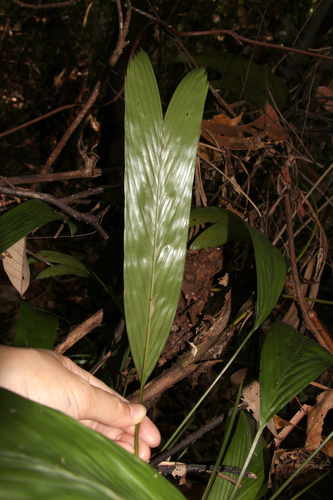
iNaturalist· cc-by-nc-nd
(c) tyler_hoar, some rights reserved (CC BY-NC-ND), uploaded by tyler_hoar
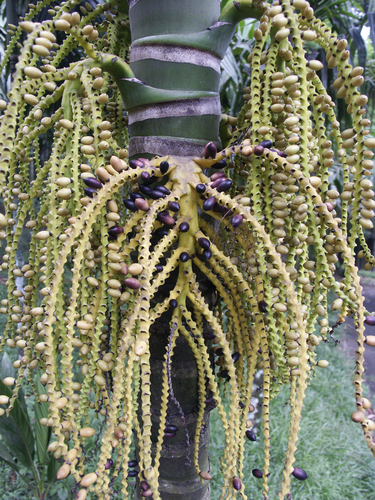
iNaturalist· cc-by-nc
(c) Sophie Mowles, some rights reserved (CC BY-NC)
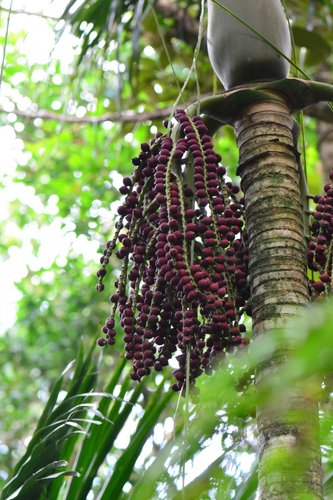
iNaturalist· cc-by-nc
(c) Craig Robbins, some rights reserved (CC BY-NC), uploaded by Craig Robbins
Summary
Source: WikipediaCalamus moti is a climbing rainforest plant in the palm family Arecaceae endemic to Queensland, Australia. It has a slim flexible stem which does not support the plant, instead it climbs to the forest canopy with the assistance of long tendrils armed with stout recurved hooks.
Description
A tall slender climbing palm or rattan. It forms clumps and can form impenetrable thickets. It can have many stems. The stems are green but turn yellow with age. Stems are 5-20 m long. There are sharp spines on the stems and slender climbing structures on the leaf sheath opposite the leaf, with hooks which curve backwards. These structures can be 3-4 m long. The leaves occur along the stem at fairly wide intervals. The leaves are 2-4 m long with 80-100 narrow leaflets. The leaf stalk curves and has spines. Leaflets are 30-50 cm long by 2-3 cm wide. The edges are constricted and curved downwards near the base of the leaflet. The flowering stalk is long and slender and hangs downwards. The flowers develop on small branches. Several flowering stalks occur on the plant at the same time. The flower are cream or white and 3-5 cm across. Male and female flowers are on separate plants. The fruit is cream when ripe and round. It has a small pointed tip and is 8-13 mm across. It is covered with small overlapping scales. There is a thin fleshy coat over a round seed.
Edible Uses
The base of the plant is roasted, peeled, then pounded before eating. The fruit, shoots, and roots are edible portions.
Traditional Uses
The base of the plant is roasted, peeled, then pounded before eating.
This uses section is brief — help expand it
Distribution
It is a tropical and subtropical plant. It grows in rainforests in high rainfall areas. They need warm, shady sites. They need a rich, well-drained soil. They are sensitive to frost when young. In Northeast Australia they grow from sea level to above 1,000 m altitude.
Where It Grows
Australia*,
Cultivation
Plants can be grown from seed. Seed should be sown fresh. Seed grow within 6-12 months. Seedlings are difficult to transplant.
Propagation
Seed - it has a fairly short viability and is best sown as soon as it is ripe.
Other Uses
The large diameter stems (to 30mm) are used in the manufacture of cane furniture. The long and slender stems of Calamus species are put to various uses according to their size, length, flexibility, elasticity and toughness. The most slender canes are employed entire for binding purposes, and in making chairs, blinds, mats, wicker or basketwork, fishing implements, etc. Twisted together, they make very strong cables. The largest and more resistent canes are used entire as cables, the framework of wicker chairs etc. Usually, however, for many purposes the stems are split throughout their length into 2 - 4 or more strips from which the inner soft brittle and spongy portion is removed by means of a knife or same other instrument, so as to leave the external portion, which is hard, tough, flexible, elastic and has its outer surface very clean and smooth as if it had been varnished. Strips vary in width according to the use to which they are to be put. Those for delicate work, such as the network of furniture, small bags, hats, etc, are from 1 - 3mm wide; those employed as lashings in native housebuilding or in fastening the removable head of the Malay axe to its handle are from 5-6 mm wide. Collecting and preparing the stems is very simple. The stem is cut near the ground and detached from the trees by taking a strong hold of its base and thus pulling down the entire plant with its leaves. The most recent growth at the top of the plant is removed and then, handling it from the upper end, the stem is forcibly drawn in the opposite direction between two pieces of wood, thus removing the spiny coverings. It is then cut into lengths of about 5 metres, each piece is bent into two equal parts and the stems are fastened into bundles ready for market. The most valued stems are not thicker than a man's little finger and have a fine polished straw-yellow glassy surface.
Notes
There are 375-400 Calamus species. There are 175 species in tropical Asia.
Nutrition
| Part | Moisture | kJ | kcal | Protein | Vit A | Vit C | Iron | Zinc |
|---|---|---|---|---|---|---|---|---|
| Fruit | 70.3 | 447 | 107 | 1.6 | — | — | — | — |
| Tubers | — | — | — | — | — | — | — | — |
| Leaves | — | — | — | — | — | — | — | — |
| Nuts | — | — | — | — | — | — | — | — |
| Bulb | — | — | — | — | — | — | — | — |
| Shoots | — | — | — | — | — | — | — | — |
| Roots | — | — | — | — | — | — | — | — |
References (15)
- Bodkin, F., 1991, Encyclopedia Botanica. Cornstalk publishing, p 188
- Cooper, W. and Cooper, W., 2004, Fruits of the Australian Tropical Rainforest. Nokomis Editions, Victoria, Australia. p 69
- Cribb, A.B. & J.W., 1976, Wild Food in Australia, Fontana. p 63
- Cronin, L., 1989, The Concise Australian Flora. Reed. p 233
- Cronin, L., 2000, Australian Palms, Ferns, Cycads and Pandans. Cronin Publications. p 72
Show all 15 references Hide references
- Elliot, W.R., & Jones, D.L., 1982, Encyclopedia of Australian Plants suitable for cultivation. Vol 2. Lothian. p 405
- Jackes, B.R., 2001, Plants of the Tropics. Rainforest to Heath. An Identification Guide. James Cook University. p 42
- Jones, D.L. & Gray, B., 1977, Australian Climbing Plants. Reed. p 61, 82
- Jones, D.L., 1994, Palms throughout the World. Smithtonian Institution, Washington. p 157
- Jones, D.L., 2000, Palms of Australia 3rd edition. Reed/New Holland. p 81
- Morley, B.D., & Toelken, H.R., (Eds), 1983, Flowering Plants in Australia. Rigby. p 394
- Nicholson, N & H., 1994, Australian Rainforest Plants 4, Terania Rainforest Publishing. NSW. p 19
- Riffle, R.L. & Craft, P., 2003, An Encyclopedia of Cultivated Palms. Timber Press. p 285
- Townsend, K., 1994, Across the Top. Gardening with Australian Plants in the tropics. Society for Growing Australian Plants, Townsville Branch Inc. p 110
- Williams, K.A.W., 1999, Native Plants of Queensland Volume 4. Keith A.W. Williams North Ipswich, Australia. p 84