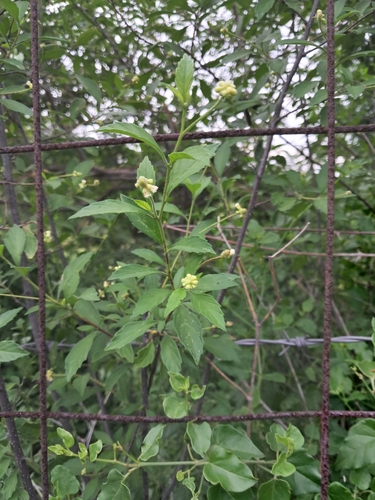
Anchusa strigosa
Labill.
Voudoglosso
iNaturalist· cc-by-nc
(c) Ron Frumkin, some rights reserved (CC BY-NC), uploaded by Ron Frumkin
iNaturalist· cc-by-nc
(c) Noam Markus, some rights reserved (CC BY-NC), uploaded by Noam Markus
iNaturalist· cc-by
(c) Eleftherios Katsillis, some rights reserved (CC BY), uploaded by Eleftherios Katsillis
Summary
Source: WikipediaAnchusa strigosa is a non-succulent species of herbaceous plants in the Boraginaceae family endemic to the Eastern Mediterranean regions, particularly Greece, Cyprus, Turkey, Lebanon, Israel, Jordan, and Iran. It is known widely by its common names of strigose bugloss and prickly alkanet.
Description
Probably the same as the next (Anchusa strigosa Banks & Sol.) but still an unresolved name in The Plant List.
This description is brief — help expand it
Edible Uses
The roots of Anchusa (like those of Alkanna and Lithospermum) contain anchusin (or alkanet-red), a red-brown resinoid colouring matter. It is insoluble in water, but soluble in alcohol, chloroform and ether. The red-tinge was used in women's cosmetics as rouge to redden the cheeks. In some species, the resinoid was collected and used for medicinal purposes. Gustaf Dalman, who conducted geographical and ethnographic research in Palestine in the early 20th-century, heard the plant lisān eth-thōr described to him in the country as being an edible wild herb, and which he applied to A. officinalis, saying that its young leaf growths of spring were collected by some of the indigenous Arab peoples of the land, who then boiled them to be eaten. After boiling, the leaves are finely chopped and sautéed in oil and garlic, and used as a meat garnish or as a viand with eggs. The Greek physician and botanist Dioscorides (c. 40–90 CE) mentions the medicinal properties of Anchusa (Greek: ἄγχουσα) in his day, adding that "the ointment makers use the root for thickening ointments." Burns and skin lesions can be cured with an ointment prepared from crushed leaves of the plant with the addition of olive oil. The Jewish philosopher and physician, Maimonides (1138–1204 CE), recalls the genera Lingua Bovina ("ox-tongue") in his Guide to Good Health (Regimen Sanitatis), saying that it is "a proven light drug used in compound decoctions", after its leaves were dried, ground into a powder, and infused in hot water.
Traditional Uses
The leaves are eaten raw, boiled or fried.
This uses section is brief — help expand it
Distribution
It is a Mediterranean climate plant.
Where It Grows
Cyprus, Mediterranean,
References (1)
- Della, A., et al, 2006, An ethnobotanical survey of wild edible plants of Paphos and Larnaca countryside of Cyprus. J. Ethnobiol. Ethnomed. 2:34