Dioscorea transversa
R. Br.
Long yam, Rainforest long yam, Pencil yam
iNaturalist· cc-by-nc
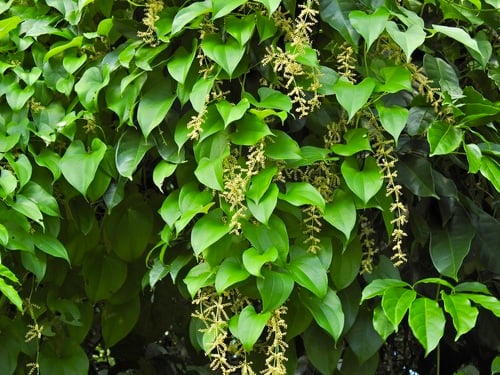
(c) Martin Bennett, some rights reserved (CC BY-NC), uploaded by Martin Bennett
iNaturalist· cc-by-nc
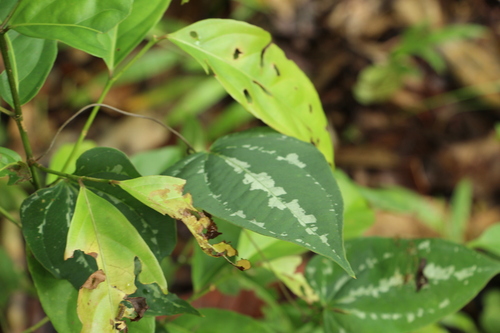
(c) Tim, some rights reserved (CC BY-NC)
Summary
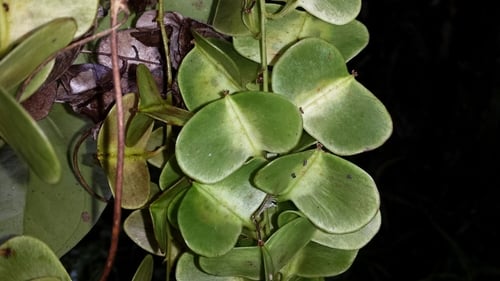
Source: WikipediaDioscorea transversa, the pencil yam, is a vine of eastern and northern Australia. The leaves are heart-shaped, shiny, with 5-7 prominent veins. The seed pods are rounded, green or pink before drying to a straw brown papery texture. The edible tubers are typically slender and long. There are two forms: an eastern rainforest and wet sclerophyll form which doesn't have bulbils, and a northern form which occurs in open forests and has small bulbils and large inground tubers.
Description
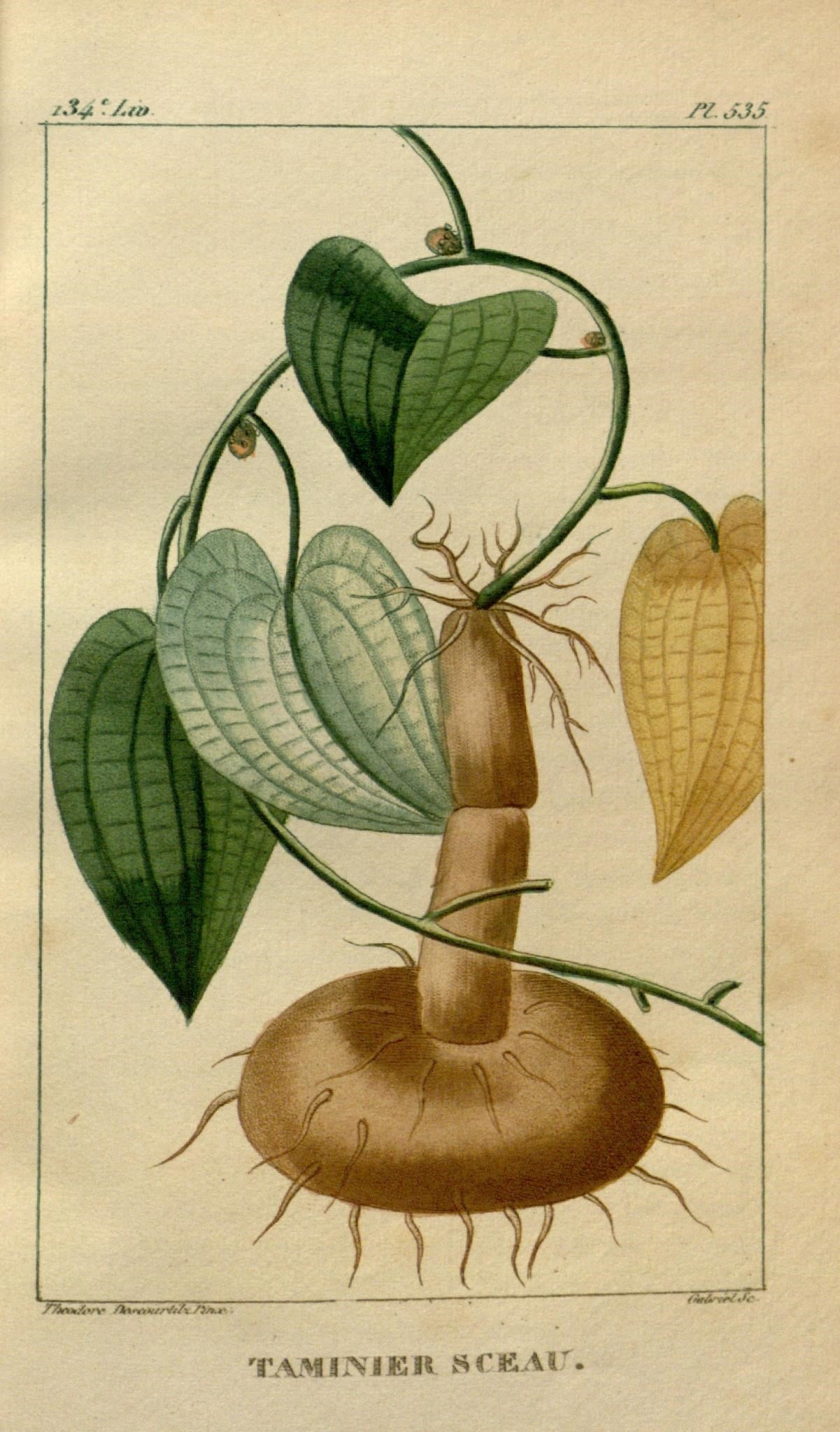
A yam. A twining climbing plant. It has a large tuber underground from which it re-grows each year. The tuber can be 50 cm long and 5 cm wide. It has scattered hairs. The leaves are alternate and heart-shaped. There are small poorly developed lobes at the base of the leaf. The leaves are 5-10 cm long by 3-6 cm wide. The leaves have prominent veins. The male flowers occur in clusters in the axils of leaves and the female flowers are single in the clusters of leaves. The flowers are pale green and have a strong scent. The fruit is a 3 winged capsule. It is 2.5 cm wide and 1.5 cm long. They are light brown. The seeds are 3 and round. They are 1.5 cm across. It can have aerial bulbils.
Edible Uses
The tubers were a staple food of Australian Aboriginals and are eaten after cooking, usually in ground ovens. The 1889 book 'The Useful Native Plants of Australia records that common names included "long yam", Indigenous Australians from Central Queensland referred to it as "kowar" and that "the small young tubers are eaten by the aborigines without any preparation."
Traditional Uses
The yam tuber is cooked and eaten. They need to be leached in running water for several hours before cooking. The aerial bulbils along the vine are also used.
Medicinal Uses
The tubers are used for medicinal purposes by the native Aborigines.
Distribution
It is a tropical plant. It grows naturally in monsoonal vine forests. It needs rich, moist soils and a protected, sunny position. It is damaged by drought or frost. It grows from sea level to 1,000 m above sea level.
Where It Grows
Australia*, New Caledonia, Pacific, Torres Strait,
Cultivation
Plants can be grown from seed or by dividing the yam.
Propagation
Seed - germinates readily.
Production
It grows vigorously in the wet season.
Other Information
It is a popular yam.
Notes
There are about 650 species of Dioscorea.
Nutrition
| Part | Moisture | kJ | kcal | Protein | Vit A | Vit C | Iron | Zinc |
|---|---|---|---|---|---|---|---|---|
| Tuber | 68.3 | 404 | 97 | 2.6 | — | 107 | 5.2 | 0.4 |
Synonyms
Also Known As
Gulaka, Kayawal, Mun-banda, Muranga, Murani, Murrumurru, Wungmarratj
References (48)
- Bindon, P., 1996, Useful Bush Plants. Western Australian Museum. p 102
- Bodkin, F., 1991, Encyclopedia Botanica. Cornstalk publishing, p 345
- Bourret, D., 1981, Bonnes-Plantes de Nouvelle-Caledonie et des Loyaute. ORSTOM. p 40
- Cherikoff V. & Isaacs, J., The Bush Food Handbook. How to gather, grow, process and cook Australian Wild Foods. Ti Tree Press, Australia p 35, 195, 199
- Cooper, W. and Cooper, W., 2004, Fruits of the Australian Tropical Rainforest. Nokomis Editions, Victoria, Australia. p 152
Show all 48 references Hide references
- Cribb, A.B. & J.W., 1976, Wild Food in Australia, Fontana. p 141
- Edible and Useful Native Plants (off internet)
- Elliot, W.R., & Jones, D.L., 1984, Encyclopedia of Australian Plants suitable for cultivation. Vol 3. Lothian. p 282
- Fell, D.G. & Stanton, D.J., 2015: The vegetation and flora of Mabuyag, Torres Strait, Queensland. Memoirs of the Queensland Museum – Culture 8(1):1-33. Brisbane. ISSN 1440-4788
- Garde, M., et al, 2003, A Preliminary List of Kundedjnjenghmi Plant Names. Northern Land Council. (Arnhem Land, Australia)
- Hardwick, G., 2001, Economically Useful Plants for Northern Australia: Master Species List. Crusader eBooks.
- Haslam, S., 2004, Noosa's Native Plants. Noosa Integrated Catchment Assn. Inc. p 334
- Hibbert, M., 2002, The Aussie Plant Finder 2002, Florilegium. p 87
- Hiddins, L., 1999, Explore Wild Australia with the Bush Tucker Man. Penguin Books/ABC Books. p149
- Isaacs, J., 1987, Bush Food, Aboriginal Food and Herbal Medicine. Weldons. p 90, 92
- Jackes, B.R., 2001, Plants of the Tropics. Rainforest to Heath. An Identification Guide. James Cook University. p 50
- Jones D, L, 1986, Ornamental Rainforest Plants in Australia, Reed Books, p 287
- Jones, D.L. & Gray, B., 1977, Australian Climbing Plants. Reed. p 61, 97
- Lazarides, M. & Hince, B., 1993, Handbook of Economic Plants of Australia, CSIRO. p 82
- Lim, T. K., 2015, Edible Medicinal and Non Medicinal Plants. Volume 9, Modified Stems, Roots, Bulbs. Springer p 38
- Low, T., 1991, Wild Food Plants of Australia. Australian Nature FieldGuide, Angus & Robertson. p 61
- Low, T., 1992, Bush Tucker. Australia’s Wild Food Harvest. Angus & Robertson. p 17, 105
- Melzer, R. & Plumb, J., 2011, Plants of Capricornia. Belgamba, Rockhampton. p 364
- Morley, B.D., & Toelken, H.R., (Eds), 1983, Flowering Plants in Australia. Rigby. p 342
- Mua Bioversity Profile, 2013, Profile for Management of the Habitats and Related Ecological and Cultural Resources of Mua Island. Torres Strait Regional Authority Land & Sea Management Unit. p 142
- Nicholson, N & H., 1994, Australian Rainforest Plants 4, Terania Rainforest Publishing. NSW. p 29
- Norrington, L., & Campbell, C., 2001, Tropical Food Gardens. Bloomings Books. p 43
- Paczkowska, G. & Chapman, A.R., 2000, The Western Australian Flora. A Descriptive Catalogue. Western Australian Herbarium. p 60
- Pearson, S. & A., 1992, Rainforest Plants of Eastern Australia. Kangaroo Press p 88
- Prodr. 295. 1810
- Ratcliffe D & P., 1987, Australian Native Plants for Indoors. Little Hills press. p 82
- RIRDC, 2010, New Root Vegetables fo the Native Food Industry, Australian Government RIRDC Publication 9/161
- Ryan, M. (Ed.), 2003, Wild Plants of Greater Brisbane. Queensland Museum. p 227
- Smith, K., 1998, Growing Uncommon Fruits and Vegetables. New Holland. p 103
- Smith, K & I., 1999, Grow your own bushfoods. New Holland. Australia. p 77
- Smith, N and Wightman, G.M., 1990, Ethnobotanical Notes from Belyuen Northern Territory Australia. Northern Territory Botanical Bulletin No 10. Parks and Wildlife Commission of the Northern Territory. p 12, 11
- Smith, N. M., 1991, Ethnobotanical Field Notes from the Northern Territory, Australia, J. Adelaide Bot. Gard. 14(1): 1-65
- Smith, Nicholas et al. 1993, Ngarinyman Ethnobotany: Aboriginal Plant Use from the Victoria River Area Northern Australia. Northern Territory Botanical Bulletin No 16. Parks and Wildlife Commission of the Northern Territory. p 20, 19.
- Townsend, K., 1994, Across the Top. Gardening with Australian Plants in the tropics. Society for Growing Australian Plants, Townsville Branch Inc. p 161
- Low, T., 1992, Bush Tucker. Australia’s Wild Food Harvest. Angus & Robertson. p (Contents)
- Tiwi Plants and Animals. 2001, Aboriginal flora and fauna knowledge from Bathurst and Melville Islands, northern Australia. Northern Territory Botanical Bulletin; No. 24 p 44
- Vigilante, T., et al, 2013, Island country: Aboriginal connections, values and knowledge of the Western Kimberley islands in the context of an island biological survey. Records of the Western Australian Museum Supplement 81: 145-182
- Wheeler, J.R.(ed.), 1992, Flora of the Kimberley Region. CALM, Western Australian Herbarium, p 986
- Wightman, G. & Andrews, M., 1991, Bush Tucker Identikit. Common Native Food Plants of Australia’s top end. Conservation Commission Northern Territory. p 48
- Wightman, G. M. & Andrews, M.R., 1989, Plants of Northern Territory Monsoon Vine Forests (Vol 1). Conservation Commission of Northern Territory. p 122
- Wightman, Glenn et al. 1992, Mangarrayi Ethnobotany: Aboriginal Plant Use from the Elsey Area Northern Australia. Northern Territory Botanical Bulletin No 15. Parks and Wildlife Commission of the Northern Territory. p 18, 19.
- Yallakool Reserve Plant List July 1, 2009 Off internet
- Yunupinu Banjgul, Laklak Yunupinu-Marika, et al. 1995, Rirratjinu Ethnobotany: Aboriginal Plant Use from Yirrkala, Arnhem Land, Australia. Northern Territory Botanical Bulletin No 21. Parks and Wildlife Commission of the Northern Territory. p 35.