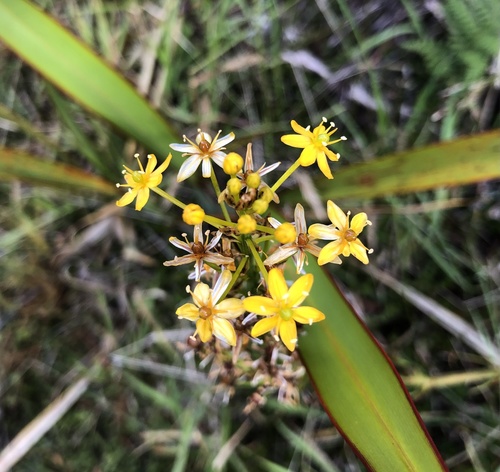
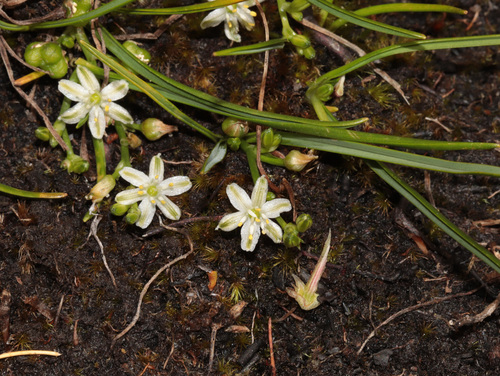
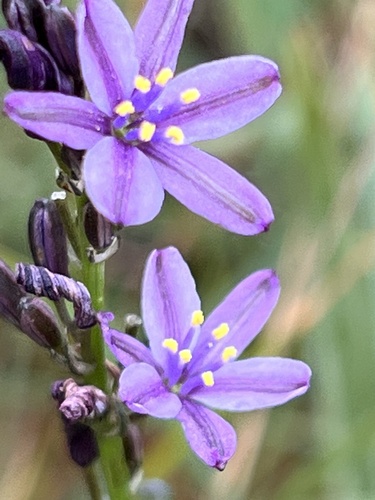
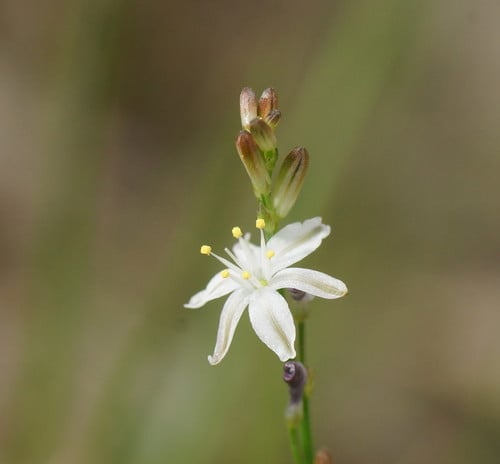
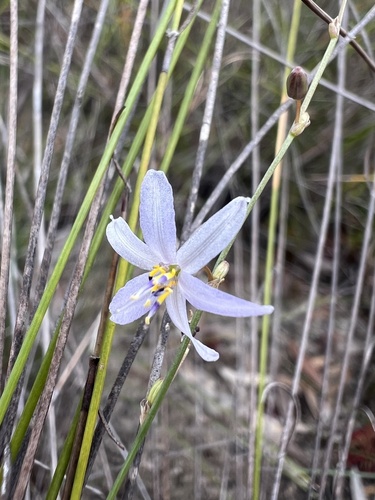
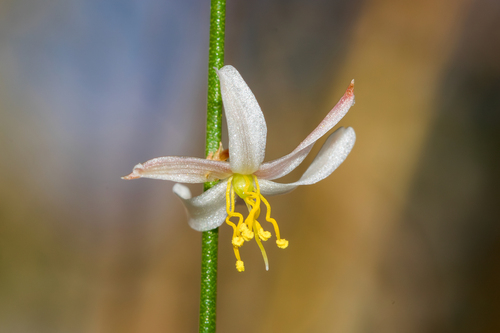
Caesia parviflora var. vittata
R. Br.
Blue grass lily
gbif· cc-by-nc
robertwayne
gbif· cc-by-nc
robertwayne
gbif· cc-by-nc
Daniel
Summary
Source: WikipediaCaesia parviflora, the pale grass lily, is a species of flowering plant in the family Asphodelaceae, subfamily Hemerocallidoideae, native to Australia, being found in New South Wales, Queensland, Victoria, Tasmania, South Australia and Western Australia. This is a small plant up to 50 centimeters tall, found in heath, woodland and dry sclerophyll forest, usually near grasses. It often grows on sandstone-based soils. The lily-like flower is about 1.2 centimeters wide and has three grey or purple stripes on each petal. Flowering occurs in spring and summer. The original specimen was collected in Sydney, dated 16 October 1803. In 1810, the species appeared in Prodromus Florae Novae Hollandiae, authored by the prolific Scottish botanist, Robert Brown. The generic name honours Federico Cesi, a 17th-century Italian naturalist. The specific epithet parviflora translates to "small flowered". At least three subspecies are recognised: Caesia parviflora var. parviflora, with white flowers Caesia parviflora var. vittata, with blue flowers Caesia parviflora var. minor, less than 20 cm tall, with blue or white flowers. This subspecies is considered endangered.
Description
A tufted herb. It keeps growing from year to year. It is 10-60 cm high and 10-50 cm wide. The leaves are 30 cm long and grass-like. The stems are 50 cm tall and branched. The flowers are 2 cm across. They are borne in clusters of 2-4. There are 6 petals which are lilac blue.
Edible Uses
The tubers and roots are edible.
Distribution
It is a temperate plant. It can grow in light or heavy soils and need an open sunny position.
Where It Grows
Australia*, Tasmania,
Cultivation
Plants are grown from seed. They can be grown by division.
Notes
There are 7 Caesia species. It has also been put in the family Liliaceae and Anthericaceae.
Synonyms
References (10)
- Bodkin, F., 1991, Encyclopedia Botanica. Cornstalk publishing, p 182
- Cherikoff V. & Isaacs, J., The Bush Food Handbook. How to gather, grow, process and cook Australian Wild Foods. Ti Tree Press, Australia p 151, 194
- Cribb, A.B. & J.W., 1976, Wild Food in Australia, Fontana. p 160
- Cronin, L., 1989, The Concise Australian Flora. Reed. p 100
- Elliot, W.R., & Jones, D.L., 1982, Encyclopedia of Australian Plants suitable for cultivation. Vol 2. Lothian. p 402
Show all 10 references Hide references
- Hibbert, M., 2002, The Aussie Plant Finder 2002, Florilegium. p 48
- Lim, T. K., 2015, Edible Medicinal and Non Medicinal Plants. Volume 9, Modified Stems, Roots, Bulbs. Springer p 19
- Morley, B.D., & Toelken, H.R., (Eds), 1983, Flowering Plants in Australia. Rigby. p 326
- Plants for a Future database, The Field, Penpol, Lostwithiel, Cornwall, PL22 0NG, UK. http://www.scs.leeds.ac.uk/pfaf/
- Steenbeeke, Greg as part of the Plants Directory project. List of plant species from northern NSW that may be used as food plants p 12