Costus lucanusianus
J. Braun & K. Schum.
Spiral ginger
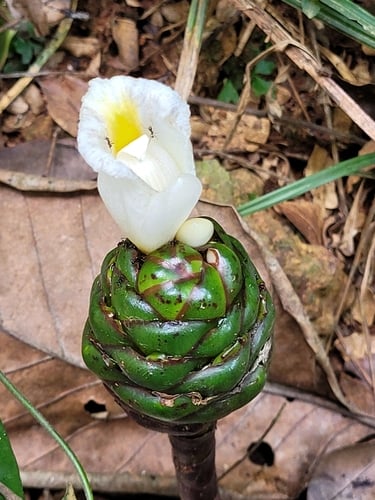
iNaturalist· cc-by-nc
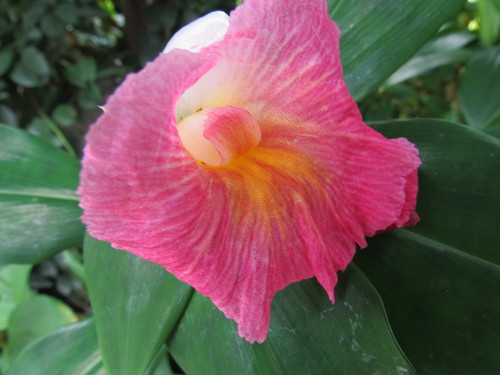
(c) 刘光裕 Liu Guangyu, some rights reserved (CC BY-NC), uploaded by 刘光裕 Liu Guangyu
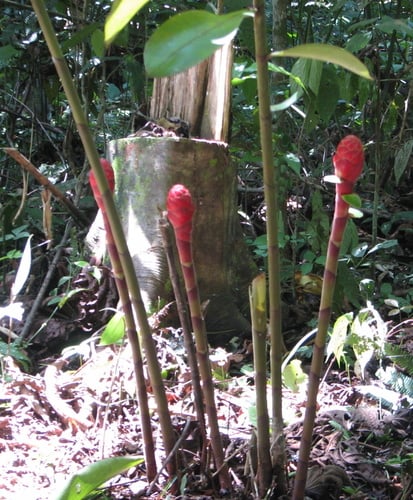
iNaturalist· cc-by-nc
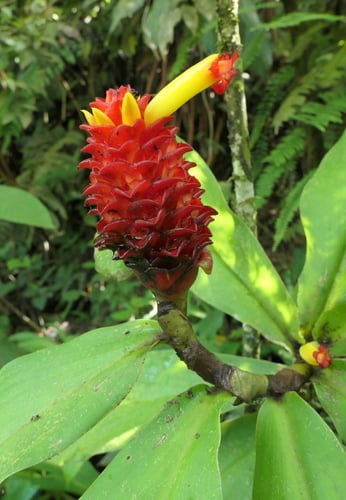
(c) ariefb, some rights reserved (CC BY-NC)
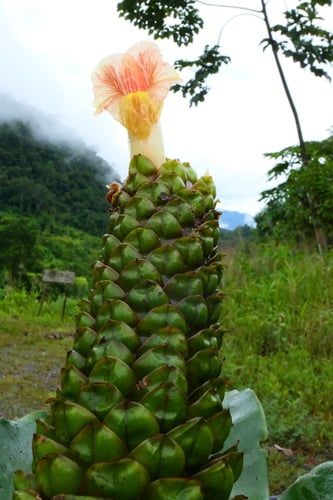
iNaturalist· cc-by-nc
(c) Mahesh A, some rights reserved (CC BY-NC), uploaded by Mahesh A
Summary
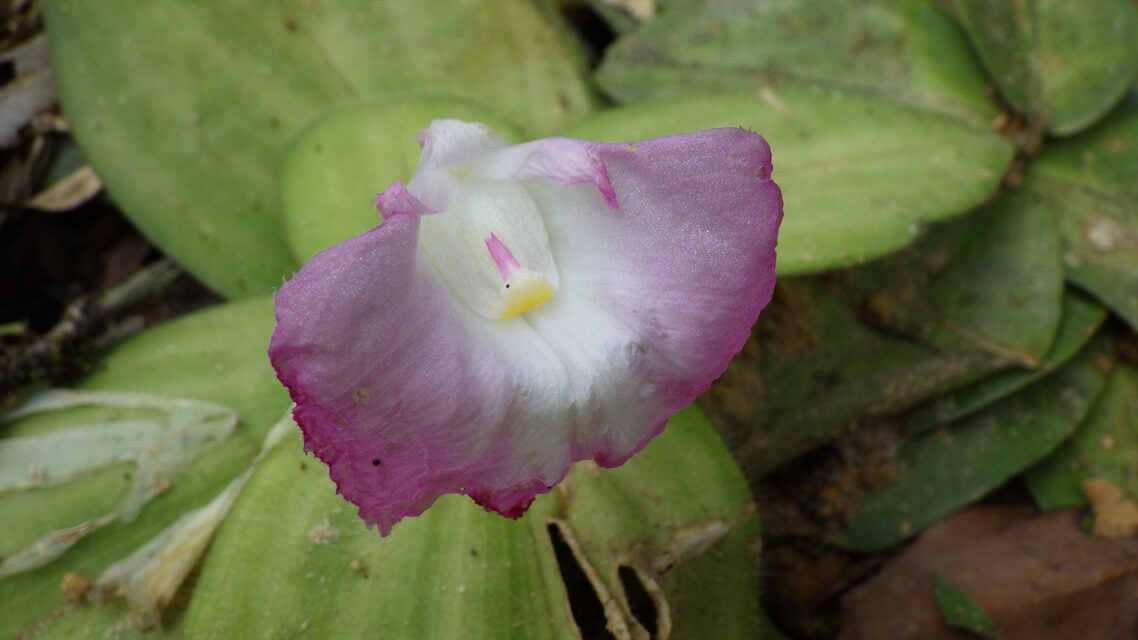
Source: WikipediaCostus lucanusianus is a species of plant native to Africa. It is widely distributed across North East Africa, West Africa, Central Africa, East Africa, and Southern Tropical Africa. Costus lucanusianus is commonly cultivated. Costus lucanusianus has many different traditional medicinal uses. Rhizomes of Costus lucanusianus are higher in percent diosgenin than those of Cheilocostus speciosus. Costus lucanusianus is sometimes confused with Costus afer. Costus lucanusianus and Costus aureus are very similar vegetatively, though they differ in flower color.
Description
A herb. It has underground rhizomes or underground stems. It is a plant that keeps growing from year to year. It grows 3 m tall. The leaves are simple and arranged in spirals. The leaf blade is 21-24 cm long by 5-6 cm wide. It is rounded at the base and tapers to the tip. The flowers contain both sexes. There is a red funnel shaped tip. The fruit is a narrow capsule about 1 cm long. It has many small black seeds.
Edible Uses
Young leaves and shoots are cooked and eaten as a vegetable. The stem is eaten raw as a sweet. Flowers are eaten raw or used in cooking as a flavouring.
Traditional Uses
The young leaves and shoots are cooked and eaten. The stem is eaten raw as a sweet. The flowers are eaten raw. The flowers are used in cooking as a flavouring.
Medicinal Uses
Costus lucanusianus is commonly used as a medicinal plant in tropical Africa. A lot of research has been carried out into the closely related C. afer, but little has been carried out directly on this species. The rhizomes yield 0.7% total steroidal sapogenins and 0.6% diosgenin. This is a higher percentage of diosgenin than is found in C. speciosus., from which diosgenin is isolated for the pharmaceutical industry. The juice from the fresh stems has shown a significant dose-related relaxation of rat duodenum and uterus in vitro. Different extracts from the leaves did not show any antibacterial or antifungal activity, and different extracts from the rhizome tested negative for antitrypanosomal and antiplasmodial activity. An infusion of the inflorescence is used to treat tachycardia and stomach complaints. The stems are strongly diuretic. They are used in the treatment of rheumatism. A stem decoction, the warmed stem sap or the pounded fruit are taken to treat cough, bronchitis and a sore throat. The stem is mashed or chewed to treat cough. The stem sap is rubefacient and burns on open wounds, but it is also anodyne and healing. It is taken internally to treat jaundice, and to prevent miscarriage. It is applied externally to treat urethral discharges; venereal diseases; and is applied to mumps and measles. It is used as eye drops to control filariasis. The leaf sap is acid and is used as eye drops to treat eye troubles and headache with vertigo, and in frictions to treat oedema and fever. It is also used as nose drops and the leaf pulp is rubbed on the head to calm insanity. The rhizome pulp is applied to abscesses and ulcers to mature them, and mixed with water it is taken to treat diarrhoea.
Distribution
It is a tropical plant. It grows in humid locations in forests up to 1,200 m altitude. It can grows in part shade.
Where It Grows
Africa, Benin, Burkina Faso, Burundi, Cameroon, Central Africa, Central African Republic, CAR, Chad, Congo DR, Côte d'Ivoire, East Africa, Equatorial Guinea, Ethiopia, Gabon, Ghana, Guinea, Guinée, Ivory Coast, Liberia, Nigeria, Sierra Leone, Uganda, West Africa,
Cultivation
It can be grown from seeds. It can also be grown from stem cuttings. Sections of the stem or rhizome 2.5 cm long can be planted.
Propagation
Seed - best sown fresh. Germinates best at a temperature of 20c. Division. The rhizomes are cut into pieces 2.5 cm long and planted in a mixture of sand and peat moss. Cuttings of stem sections. The stems are cut into pieces 2.5 cm long and planted in a mixture of sand and peat moss. Bulbils sometimes develop in the enlarged fruit head of some species. These can be potted up and will grow into new plants.
Other Uses
A decoction of the plant is sometimes used to coagulate the latex of Landolphia owariensis.
Synonyms
Also Known As
Aniakoinia, Bokako, Howa, Okako, Makakokako, Zaza boto
References (9)
- Aweke, G., 2007. Costus lucanusianus J.Braun & K.Schum. [Internet] Record from Protabase. Schmelzer, G.H. & Gurib-Fakim, A. (Editors). PROTA (Plant Resources of Tropical Africa), Wageningen, Netherlands. < http://database.prota.org/search.htm>. Accessed 15 October 2009.
- Burkill, H. M., 1985, The useful plants of west tropical Africa, Vol. 1. Kew.
- Chapman, J. D. & Chapman, H. M., 2001, The Forest Flora of Taraba and Andamawa States, Nigeria. WWF & University of Canterbury. p 208
- Grubben, G. J. H. and Denton, O. A. (eds), 2004, Plant Resources of Tropical Africa 2. Vegetables. PROTA, Wageningen, Netherlands. p 225
- Latham, P., 2004, Useful Plants of Bas-Congo province. Salvation Army & DFID p 94
Show all 9 references Hide references
- Liengola, I. B., 2001, A contribution to the study of native edible plants by the Turumbu and Lokele of the Tshopo District, Province Orientale, D. R. Congo. Syst. Geogr. Pl. 71:687-698
- Termote, C., et al, 2011, Eating from the wild: Turumbu, Mbole and Bali traditional knowledge of non-cultivated edible plants, District Tshopo, DRCongo, Gen Resourc Crop Evol. 58:585-618
- von Katja Rembold, 2011, Conservation status of the vascular plants in East African rain forests. Dissertation Universitat Koblenz-Landau p 163
- World Checklist of Useful Plant Species 2020. Royal Botanic Gardens, Kew