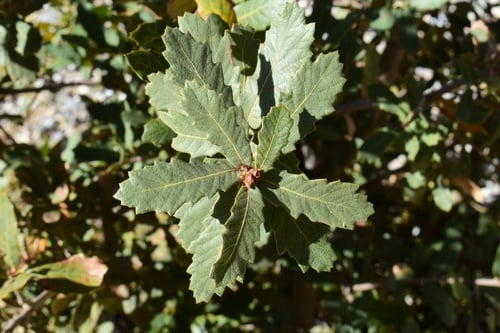
Lithocarpus wallichianus
(Hanes) Rehd.
gbif· cc0
President and Fellows of Harvard College
gbif· cc0
President and Fellows of Harvard College
gbif· cc0
President and Fellows of Harvard College
Description
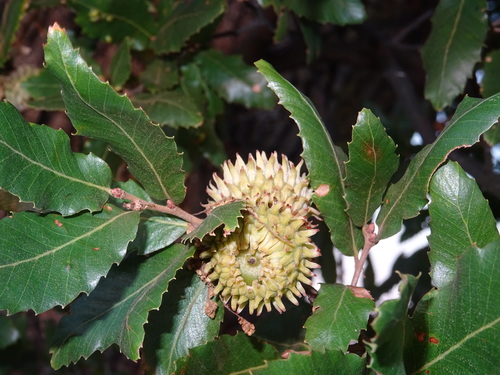
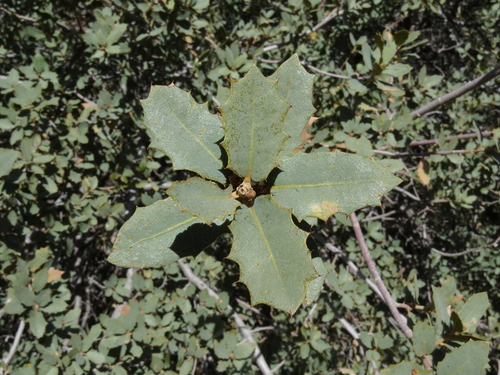
A tree. It grows 40 m tall. The trunk is 90 cm across. The leaves are leathery. They are oval and 11-15 cm long by 2-5 cm wide. Flowers can be male, both sexes or mixed. The fruit cups occur in groups of 2-3. They are saucer shaped and without a stalk. The acorns or nuts are oval and 1-2 cm across.
Edible Uses
Seed - raw or cooked. Somewhat bitter. The ovoid seed is 10 - 17mm in diameter with a thick, woody shell. The seed (or acorn) is a rich source of carbohydrates and would almost certainly have been eaten by traditional peoples, especially in times of shortage. The main disadvantage is that the seed is also likely to contain bitter-tasting, astringent tannins. Traditionally, these tannins would have been largely removed either by leaching the seeds in water or by baking them. The seeds can be eaten raw but would usually be cooked whole or be dried and ground into a powder that can then be used to make a gruel, or as a thickener in soups and stews, or as an additive to flour for making bread, cakes etc.
Traditional Uses
The seed are usually cooked before eating.
This uses section is brief — help expand it
Distribution
It is a tropical plant.
Where It Grows
Asia, Indochina, Malaysia, SE Asia, Singapore, Thailand,
Cultivation
Lithocarpus wallichianus is a plant of the moist tropics, where it is usually found at elevations up to 1,600 metres. The varous species in this genus usually grow in regions where there can be year-round rainfall, generally disliking dry seasons. In the wild, Lithocarpus species are mainly found in well-drained soils, often growing on slopes. In cultivation they tend to be tolerant of a range of soil textures and to prefer an acid to neutral pH. Young plants usually grow sucessfully in the shade of woodland, but older trees like a more sunny position.
Propagation
Seed - it quickly loses viability if it is allowed to dry out. It can be stored moist and cool, but is best sown as soon as it is ripe in an outdoor seed bed, though it must be protected from mice, squirrels etc. Small quantities of seed can be sown in deep pots in a cold frame. Plants produce a deep taproot and need to be planted out into their permanent positions as soon as possible, in fact seed sown in situ will produce the best trees. Trees should not be left in a nursery bed for more than 2 growing seasons without being moved or they will transplant very badly.
Other Uses
The bark of most species is rich in tannins and can be used as a dye and preservative for ropes etc. The sapwood is yellowish or brownish. The heartwood is yellow-brown, red-brown or dark red-brown; it is not always clearly demarcated from the lighter-coloured sapwood. The texture is rather coarse and uneven; the grain fairly straight but sometimes interlocked; there is a true oak-line silver figure prominent on the radial surface. The wood is strong to very strong; hard to very hard; moderately heavy to heavy; moderately durable under exposed conditions and very difficult to treat. It seasons fairly slowly, without any defects except for some staining, slight bowing and end-checking; shrinkage is high. It is easy to saw when green, but slightly difficult to work when dried; planing is easy and the planed surface is smooth; turned wood has a rough surface when finished. Nailing properties are poor. A medium hardwood, it is suitable for medium to heavy construction under cover and with protection from termite attacks; when well seasoned it can be used for furniture making, interior finishing, panelling, parquet flooring, decorative veneers etc. It is used locally for purposes such as fence post, mining props, shingles, boat building, and for making tool handles, rice pounder, poles for carts etc. The wood makes a good fuel and can be used to make charcoal.
Also Known As
Mempening merah
References (5)
- Milow, P., et al, 2013, Malaysian species of plants with edible fruits or seeds and their evaluation. International Journal of Fruit Science. 14:1, 1-27
- Saw, L.G., LaFrankie, J. V. Kochummen, K. M., Yap S. K., 1991, Fruit Trees in a Malaysian Rain Forest. Economic Botany, Vol. 45, No. 1, pp. 120-136
- Soepadmo, E. and Saw, L. G., 2000, Tree Flora of Sabah and Sarawak. Forestry Malaysia. Volume Three. p 94
- Suwardi, A. B., et al, 2020, Ethnobotany and conservation of indigenous edible fruit plants in South Aceh, Indonesia. Biodiversitas Vol. 21, No. 5, pp 1850-1860
- World Checklist of Useful Plant Species 2020. Royal Botanic Gardens, Kew