Plectocomia pierreana
Beccari
gbif· cc-by
Moscow State University (copyright is managed by Dr. Alexey P. Seregin)
gbif· cc-by
Moscow State University (copyright is managed by Dr. Alexey P. Seregin)
Summary
Source: WikipediaPlectocomia pierreana is a species of liana in the Arecaceae, or palm tree, family. It is a spiny climber, with either a single stem or a cluster of stems up to 35 m in length, stems are 1 to 9 cm in diameter. Its spines are up to 2 cm long. The palm is native to Thailand, Cambodia, Laos, Vietnam and China. It occurs in the dense forests and stunted forest of Cambodia, particularly in Kampot and Kampong Chhnang provinces. Growing in Bokor National Park, in Kampot, it occurs in the stunted forest community, called forêt sempervirente basse de montagne by Pauline Dy Phon, that occurs around 920 m, though the plant possibly occurs up to 1014 m. It has also been reported as very common in Phnom Kulen National Park, Siem Reap province, Cambodia, growing particularly in the Evergreen Forest community. In Vietnam it has been identified in Lào Cai, Tuyên Quang and Vĩnh Phúc provinces. Present in Yunnan, Guangxi and Guangdong provinces in China, it is found in lowland to montane rainforests below 1200 m, growing rapidly and abundantly. In Cambodia, the plant is known as phdau traèhs, phdau ach moën or phdao sno, and the stalk/trunk is used to make ropes and in basketwork. Producing large rattan, between 20 and 40 mm in diameter, out of which furniture, baskets, fish-traps, e.t.c are made, wai teleuk (local name in Lao language, wai means rattan) is commercially exploited in Laos.
Description
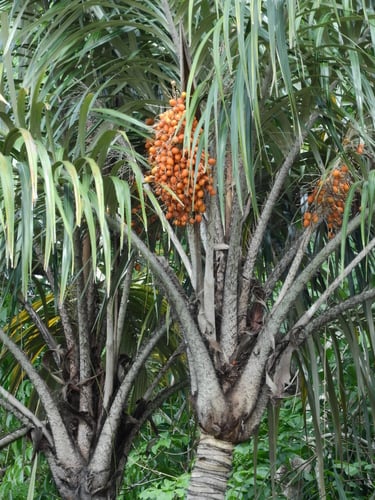
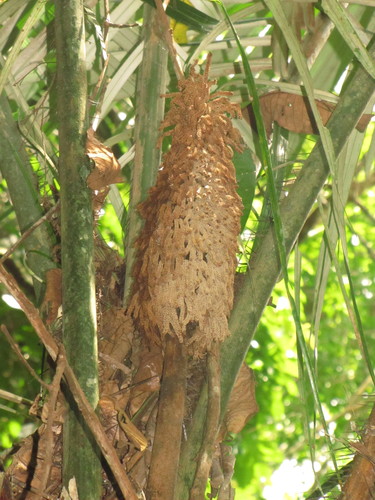
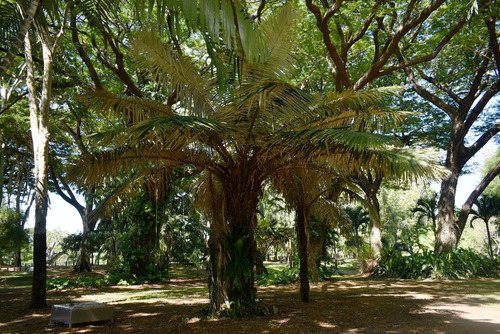
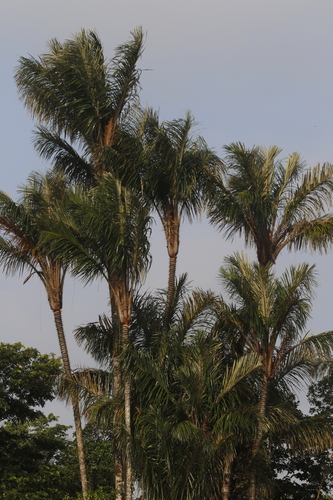
A rattan. The stems grow in clusters. They are 35 m long and 1-9 cm wide. The leaf sheaths are green with a brown coating and yellowish-brown needle like spines 2 cm long. The leafy stalk is 3 m long with 25-40 leaflets on each side. They are rboadly sword shaped and the middle ones are 20-55 cm long by 2-5 cm wide.
Edible Uses
The shoot is sometimes eaten. The palm heart (the inner core and growing bud of the stem) is harvested. It provides a crispy food, rich in nutrients, that can be eaten raw or cooked.
Traditional Uses
The shoots are eaten. Caution: It is claimed it can reduce a man's sexual potency!
This uses section is brief — help expand it
Known Hazards
It is claimed the shoots can reduce a man's sexual potency.
Distribution
It is a tropical plant. In Indochina it grows in evergreen forests between 300-1,000 m altitude. In Yunnan.
Where It Grows
Asia, Cambodia, China, Indochina, Laos, SE Asia, Thailand, Vietnam,
Cultivation
A dioecious species, both male and female forms need to be grown if fruit and seed are required. A monocarpic species, it can grow for many years without flowering, then flowers prolifically before setting seed and dying.
Other Uses
The canes are used for handicrafts and low quality furniture. The canes have a soft core, they have poor durability and flexibility and are 5 - 100mm in diameter.
Synonyms
References (1)
- Evans, T. D., et al, 2002, A Synopsis of the Rattans (Arecaceae: Calamoideae) of Laos and Neighbouring Parts of Indochina. Kew Bulletin, Vol. 57, No. 1 (2002), pp. 1-84