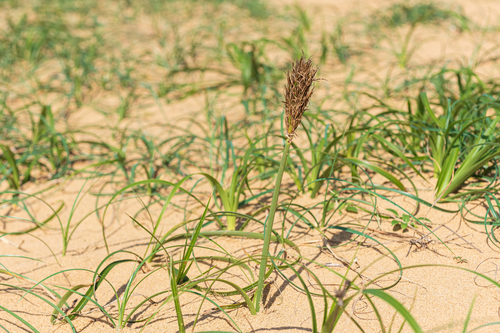
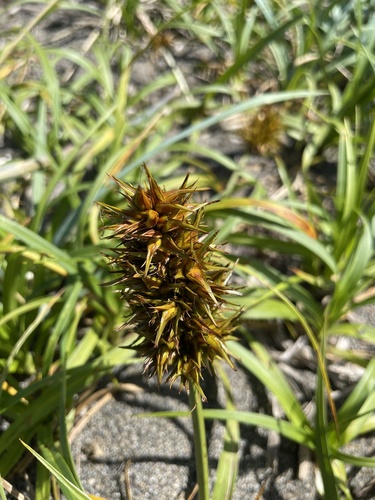
Fuirena umbellata
Rottb.
iNaturalist· cc-by-nc-sa
(c) Reinaldo Aguilar, some rights reserved (CC BY-NC-SA)
iNaturalist· cc-by-nc
(c) Erwin Sieben, some rights reserved (CC BY-NC), uploaded by Erwin Sieben
iNaturalist· cc-by
(c) Wilderness Safaris Botswana - Conservation Team, some rights reserved (CC BY), uploaded by Wilderness Safaris Botswana - Conservation Team
Description
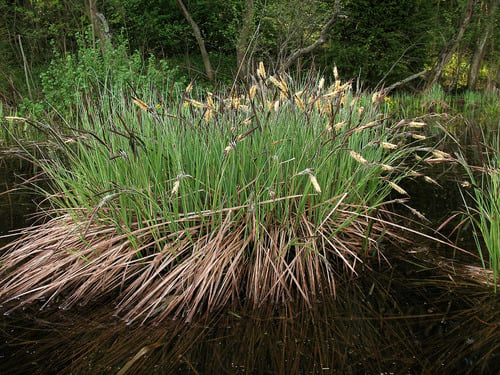
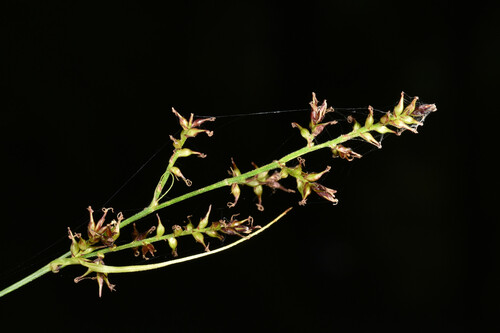
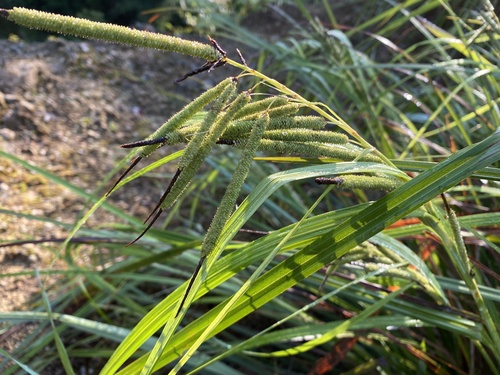
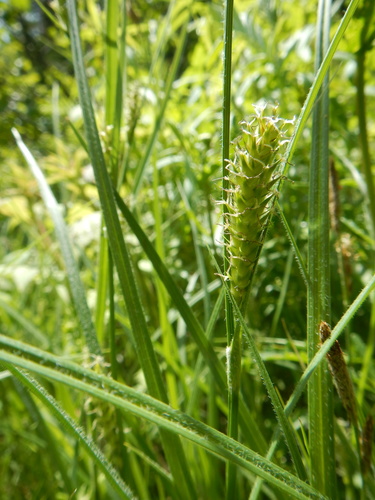
A sedge. It is a herb that keeps growing from year to year. It grows 1 m tall. The leaves are narrowly sword shaped and 20 cm long. They have 5 veins. The lower leaves are only a sheath with no blade. The flower spikelets are hairy.
Edible Uses
The tubers are edible. This report probably refers to the bulbil at the base of the flowering culm. The plant is burnt and the ashes used as a salt.
Medicinal Uses
Newborn babies are washed in an infusion of the leaves.
Distribution
It is a tropical plant. It grows in areas of permanent shallow water. It can be in mangroves. In Argentina it grows below 500 m above sea level.
Where It Grows
Africa, Argentina, Asia, Australia, Belize, Botswana, Brazil, Burkina Faso, Central Africa, Central African Republic, CAR, Central America, East Africa, Gabon, Gambia, Ghana, Guatemala, Guinea, Guinée, Guinea-Bissau, Indochina, Laos, Liberia, Madagascar, Mexico, Mozambique, Pacific, Panama, Papua New Guinea, PNG, Paraguay, Sao Tome and Principe, SE Asia, Sierra Leone, South America, West Africa, Zambia,
Cultivation
The plant is found as a weed in rice fields. The basal node of the flowering culm is swollen into a bulbil, so that the tufted plant resembles a shallot (Allium cepa var). The plant spreads by means of these bulbils, making it a difficult weed to eradicate.
Other Uses
When growing as a weed, the plant is ploughed in as a green manure in rice fields. The plant may serve as a mud-binder to resist tidal scouring.
Notes
There are about 30 Fuirena species.
Synonyms
Also Known As
Burume-combe, Camatao, Cameta, Gove, Macook, Mangatchaca, Mela, Ococo, Pama, Vahobonoka, Vendramalomana
References (5)
- Altschul, S.V.R., 1973, Drugs and Foods from Little-known Plants. Notes in Harvard University Herbaria. Harvard Univ. Press. Massachusetts. no.
- Fowler, D. G., 2007, Zambian Plants: Their Vernacular Names and Uses. Kew. p 66
- Simpson, D. A. & Inglis, C. A., 2001, Cyperaceae of Economic, Ethnobotanical and Horticultural Importance: A checklist. Kew Bulletin Vol. 56, No. 2 (2001), pp. 257-360
- Standley, P. & Steyermark, J., 1958, Flora of Guatemala. Fieldiana: Botany, Volume 24 part 1 p 162
- World Checklist of Useful Plant Species 2020. Royal Botanic Gardens, Kew