Camellia oleifera
Abel
Tea-oil
iNaturalist· cc0
no rights reserved, uploaded by 葉子
iNaturalist· cc0
no rights reserved, uploaded by 葉子
iNaturalist· cc-by-nc
(c) MP Zhou, some rights reserved (CC BY-NC), uploaded by MP Zhou
Summary
Source: WikipediaCamellia oleifera, which originated in China, is notable as an important source of edible oil (known as tea oil or camellia oil) obtained from its seeds. It is commonly known as the oil-seed camellia or tea oil camellia, though to a lesser extent other species of camellia are used in oil production too. It is widely distributed in China and is cultivated extensively there. It is found in forests, thickets, banks of streams and foothills at elevations of 500 to 1,300 metres. This species looks much similar to Camellia sasanqua except the dark green, evergreen leaves are a bit larger, three to five inches long and two to three inches wide. Single, white, fragrant flowers are produced in mid to late fall, and this large shrub or small tree will reach a height of 20 feet with thin, upright, multiple trunks and branches. The crown forms a rounded or oval vase with lower branches removed.
Description
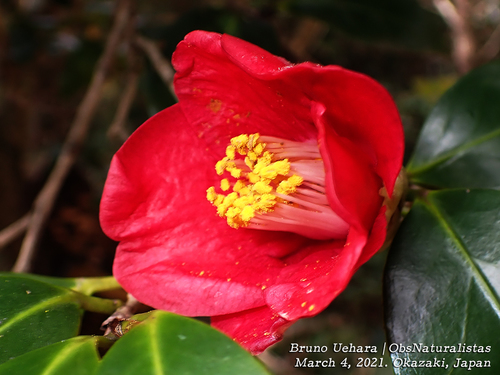
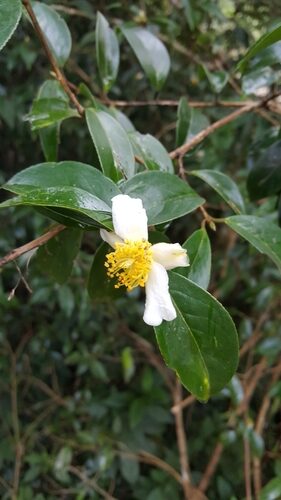
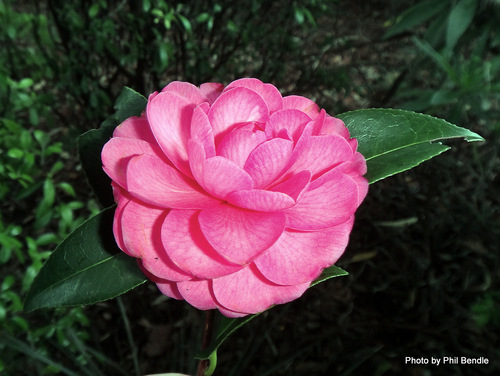
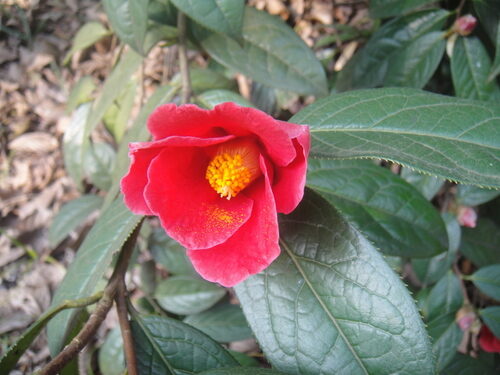
A shrub. In forests it can be a small tree. It grows 3-4 cm high. The young branches are hairy. New growth is bright yellow-green. The leaves are leathery and narrowly oblong. They are 3-5 cm long by 2-3 cm wide. The flower buds are pink and the flowers are white. The flowers usually occur singly in the axils near the ends of branches. The fruit are round capsules about 2 cm across.
Edible Uses
An oil obtained from the seed is used in cooking. A high quality cooking oil which stores well at room temperature and is of comparative quality to olive oil. The seed contains 40 - 50% oil, of which up to 88% is oleic acid. The globose to ellipsoid capsule is 20 - 40mm in diameter, 1 - 3-loculed with 1 or 2 brown to reddish brown, globose to semiglobose seeds 15 - 20mm in diameter per locule. The flowers are used to flavour tea.
Traditional Uses
An edible oil is extracted from the seeds.
This uses section is brief — help expand it
Medicinal Uses
Anthelmintic The seed oil is used in the treatment of ringworm.
Distribution
It is a tropical plant. It grows on exposed grassy slopes. It is native to southern China. In Sichuan and Yunnan.
Where It Grows
Asia, Britain, China, Europe, India, Indochina, Laos, Myanmar, Northeastern India, SE Asia, Sikkim, Thailand, Vietnam,
Cultivation
Prefers a woodland soil but thrives in a warm open well-drained loam if leafmould is added. A calcifuge plant, preferring a pH between 5 and 7. Prefers the partial shade of a light woodland. This species is not hardy in the colder areas of the country, it tolerates temperatures down to between -5 and -10°c. It succeeds on a wall at Kew and outdoors in milder areas. Prefers a wet summer and a cool but not very frosty dry winter. Plants are not very self-compatible, self-fertilized flowers produce few seeds and these are of low viability. This species has been cultivated for many centuries in China for the oil in its seed. A very ornamental plant, some named forms have been developed for their ornamental value. This species is closely related to C. sasanqua.
Propagation
Seed - can be sown as soon as it is ripe in a greenhouse. Stored seed should be pre-soaked for 24 hours in warm water and the hard covering around the micropyle should be filed down to leave a thin covering. It usually germinates in 1 - 3 months at 23°c. Prick out the seedlings into individual pots when they are large enough to handle and grow them on in light shade in the greenhouse for at least their first winter. Plant them out into their permanent positions when they are more than 15cm tall and give them some protection from winter cold for their first year or three outdoors. Cuttings of almost ripe wood, 10 - 15cm with a heel, August/September in a shaded frame. High percentage but slow. Cuttings of firm wood, 7 - 10cm with a heel, end of June in a frame. Keep in a cool greenhouse for the first year. Leaf-bud cuttings, July/August in a frame.
Other Uses
Dye Insecticide Oil Oil A non-drying oil is obtained from the seed - used in textile manufacture, soap making and as an illuminant. The oil consists mainly of olein. It is not subject to polymerize or oxidize, nor does it form solids at low temperatures. A grey dye is obtained from the pink or red petals. The seed cake has insecticidal activity. Special Uses
Other Information
It is cultivated as a food plant.
Notes
There are about 250-300 Camellia species.
Synonyms
Also Known As
Chau-kung, Du-tra, Hinguwa, So
References (8)
- Arora, R. K., 2014, Diversity in Underutilized Plant Species - An Asia-Pacific Perspective. Bioversity International. p 112
- Chen, J., et al, 2010, Identification and evaluation of antioxidants defatted Camellia oleifera seeds by isopropanol slating-out pretreatment. Food Chemistry 121: 1246-1254
- Hu, Shiu-ying, 2005, Food Plants of China. The Chinese University Press. p 554
- Kunshan, Shi, Non-wood forest products in Asia. FAO Corporate Document Repository
- Liu, Yi-tao, & Long, Chun-Lin, 2002, Studies on Edible Flowers Consumed by Ethnic Groups in Yunnan. Acta Botanica Yunnanica. 24(1):41-56
Show all 8 references Hide references
- Savita, et al, 2006, Studies on wild edible plants of ethnic people in east Sikkim. Asian J. of Bio Sci. (2006) Vol. 1 No. 2 : 117-125 (As Camellia drupifera)
- Schmidt-Vogt, D., 2001, Secondary Forests in Swidden Agriculture in the Highland of Thailand. Journal of tropical Forest Science 13(4): 748-767
- World Checklist of Useful Plant Species 2020. Royal Botanic Gardens, Kew