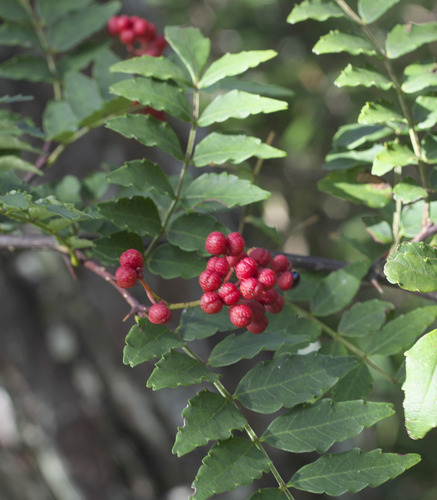
Harrisonia abyssinica
Oliv.
iNaturalist· cc-by-nc
(c) Odile Weber, some rights reserved (CC BY-NC)
iNaturalist· cc-by-nc
(c) Odile Weber, some rights reserved (CC BY-NC)
iNaturalist· cc-by-nc
(c) Odile Weber, some rights reserved (CC BY-NC)
Summary
Source: WikipediaHarrisonia abyssinica is a species of shrub or small tree in the family Rutaceae. Native to Tropical Africa, its habitat is usually in transitional zones between deciduous woodlands and evergreen forest.
Description
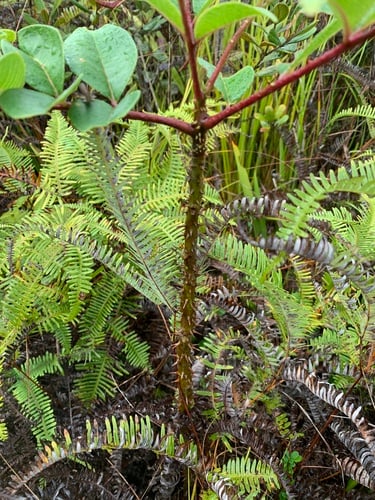
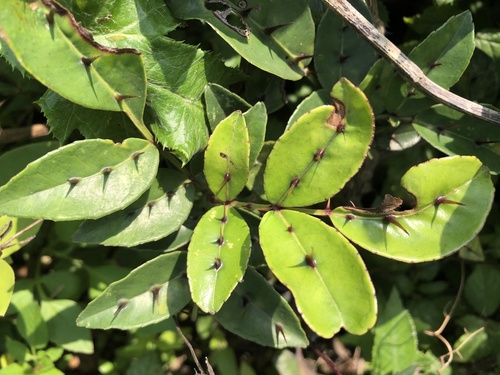
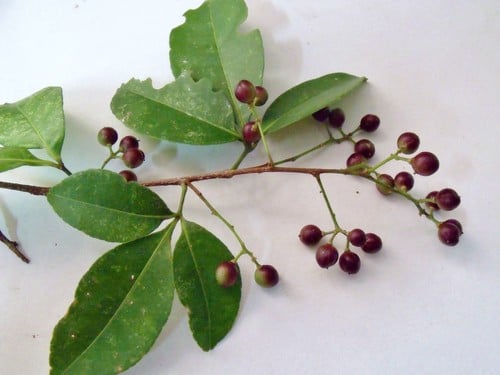
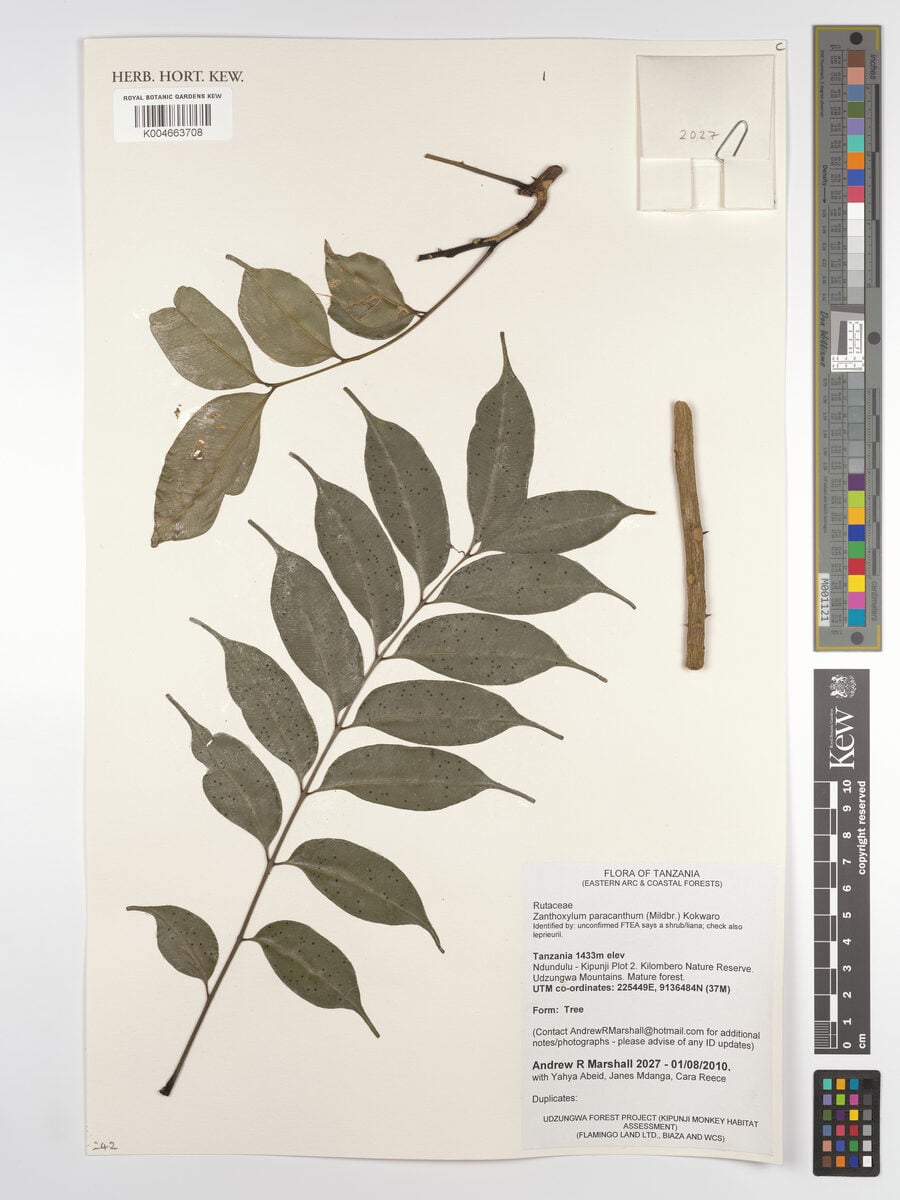
A shrub or small tree. It keeps its leaves throughout the year. It can be climbing. It grows 6 m high The larger branches have thorns 2 cm long. These are on cone shaped corky growths. The branches are long and flexible. The leaves are alternate and compound. They have 2-7 pairs of leaflets and one at the end. The leaves are 25 cm long. The leaflets are almost round and 1-9 cm long by 1-4 cm wide. They are unequal at the base. There can be teeth along the edge. The flowers contain both sexes. They are grouped on shoots 2-14 cm long in the axils of leaves or at the ends of branches. The fruit have 4-8 lobes and are a berry. They are 4-9 mm across. They turn red or black when ripe. They are fleshy and have 4-8 seeds.
Edible Uses
The fruits are edible. The red to black, fleshy, globose globose berry is 4 - 9mm in diameter containing 4 - 8 small seeds.
Traditional Uses
The ripe fruit are eaten.
This uses section is brief — help expand it
Medicinal Uses
The roots and bark from the stem are used to treat gonorrhoea, dysentery and tuberculosis as well as an ascaricide.
Distribution
It is a tropical plant. It grows in dry evergreen forest. It grows from sea level to 1,700 m altitude. It can form dense thickets on poor eroded soils. It grows in areas with a rainfall between 150-2,000 mm per year.
Where It Grows
Africa, Angola, Benin, Burkina Faso, Burundi, Cameroon, Central Africa, Central African Republic, CAR, Chad, Congo, Côte d'Ivoire, East Africa, Eritrea, Ethiopia, Gabon, Gambia, Ghana, Guinea, Guinée, Guinea-Bissau, Ghana, Ivory Coast, Kenya, Liberia, Malawi, Mali, Mauritania, Mozambique, Niger, Nigeria, Rwanda, Sahel, Senegal, Sierra Leone, Somalia, Southern Africa, South Sudan, Sudan, Tanzania, Togo, Uganda, West Africa, Zambia,
Cultivation
It can be grown from seeds or stem cuttings. Stem cuttings root easily when treated with rooting hormone.
Propagation
Seed - Stem cuttings root easily when treated with the rooting hormone.
Other Uses
The wood is easy to work, durable and resistant to fungi, termites and wood borers. It is used for making stools, bows, in house construction etc. In Ghana the stems, with the bark removed, are used to make state umbrellas and as the supports of chiefs' palanquins. The wood is used for fuel. Pruned trees and shrubs are used as living fences. The plant has wide-spreading roots and can form dense thickets on eroded soils. This could make it useful as a soil stabilizer, especially on eroded slopes.
Notes
There are 3 Harrisonia species. The roots are used in medicine. Also put in the family Simaroubaceae.
Synonyms
Also Known As
Baingou, Kadhatula, Mkidori, Mkiliulu, Mkoromando, Mkusu, Mpapuradoko, Msamburini, Msangalasa, Msoma, Mucudo, Mucuto, Umugaanzacyaaro
References (8)
- Emongor, V.E., 2008. Harrisonia abyssinica Oliv. [Internet] Record from Protabase. Schmelzer, G.H. & Gurib-Fakim, A. (Editors). PROTA (Plant Resources of Tropical Africa), Wageningen, Netherlands. < http://database.prota.org/search.htm>. Accessed 16 October 2009.
- Fowler, D. G., 2007, Zambian Plants: Their Vernacular Names and Uses. Kew. p 61
- Molla, A., Ethiopian Plant Names. http://www.ethiopic.com/aplants.htm
- Mutie, F. G., 2020, Conservation of Wild Food Plants and Their Potential for Combatting Food Insecurity in Kenya as Exemplified by the Drylands of Kitui County. Plants 2020, 9, 1017
- Mutie, F. M., et al, 2023, Important Medicinal and Food Taxa (Orders and Families) in Kenya, Based on Three Quantitative Approaches. Plants 2023, 12, 1145
Show all 8 references Hide references
- Pakia, M., 2000, Plant Ecology and Ethnobotany of two sacred forests (Kayas) at the Kenya Coast. M. Sc. Thesis.
- White, F., Dowsett-Lemaire, F. and Chapman, J. D., 2001, Evergreen Forest Flora of Malawi. Kew. p 550
- World Checklist of Useful Plant Species 2020. Royal Botanic Gardens, Kew