Bridelia micrantha
(Hochst.) Baill.
Coast goldleaf, Velvet sweetleaf
iNaturalist· cc-by-nc
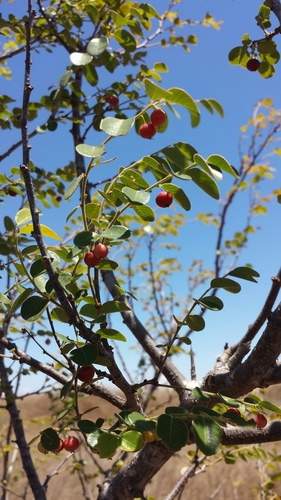
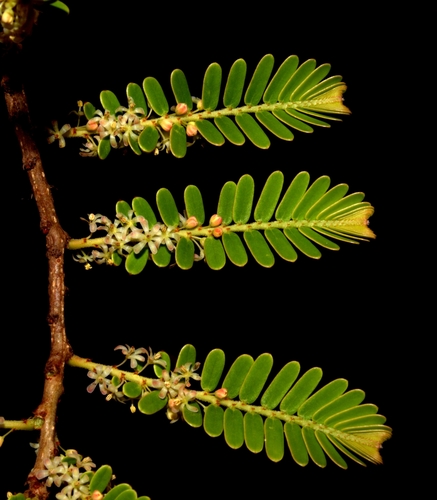
(c) Roddy CJ Ward, some rights reserved (CC BY-NC), uploaded by Roddy CJ Ward
iNaturalist· cc-by-sa
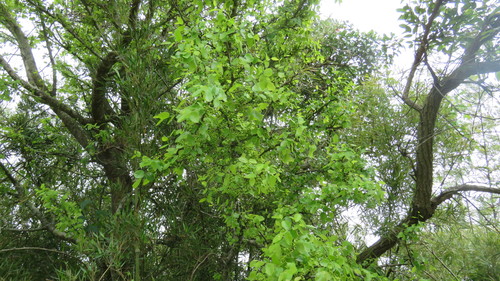
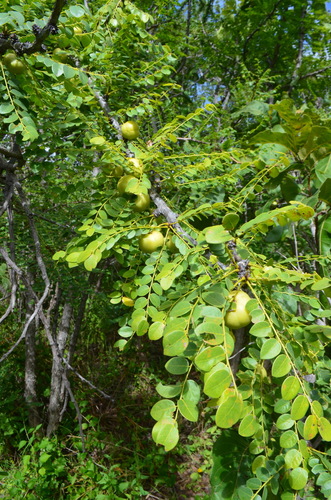
(c) Rosemary Harrison, some rights reserved (CC BY-SA), uploaded by Rosemary Harrison
Summary
Source: WikipediaBridelia micrantha, the mitzeeri or the coastal golden-leaf, is a tree in the family Phyllanthaceae and is native to tropical and southern Africa as well as to the island of Réunion in the Indian Ocean.
Description
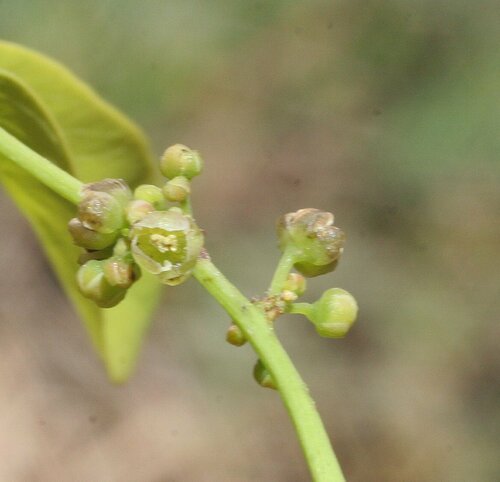
A deciduous tree. It grows up to 21 m tall. It has a wide leafy crown. The trunk is grey-brown. It is smooth when young but rough when older. The twigs are knobbly and covered with small scattered raised brown dots. The leaves are simple and slightly wavy. They are oval and have a point at the end. The base is narrowed or rounded. The leaves are 4-18 cm long and 2.5-10 cm wide. There are 8-15 pairs of veins. The veins and midrib are raised under the leaf. The leaves are on short robust leaf stalks. Young leaves are red. The male and female flowers occur on the same tree. The male flowers have stalks and the female flowers have no stalks. The flowers are white in in clusters in the axils of leaves. The fruit are small and oval. They are black when ripe and 10 mm long by 7 mm wide. They are edible.
Edible Uses
The fruits are sweet and edible when ripe and taste slightly like currants. The ellipsoid fruit turns black when fully ripe, it is up to 8mm × 5mm when dried, slightly larger when fresh.
Traditional Uses
The fruit are eaten raw. They are also used for jam and juice. The bark is eaten as a famine food. The bark is used as a stimulant.
This uses section is brief — help expand it
Medicinal Uses
Bridelia micrantha has been used locally in folk medicine, variously as an anti-abortifacient, an antidote, a laxative or purgative; and to treat diverse conditions of the central nervous system (headache), eye (infections, conjunctivitis), the gastrointestinal system (abdominal pain, constipation, gastritis), respiratory system (common cold), and the skin (scabies); and used hygienically as a mouthwash.
Distribution
A tropical tree. It grows in open woodland and near rivers. It can stand some frost. It is drought resistant. In Malawi it grows between 500-1,750 m altitude. It grows in areas with a rainfall between 800-2,500 mm per year. It can grow in arid places. It can grow in seasonally flooded areas.
Where It Grows
Africa, Angola, Benin, Burkina Faso, Burundi, Cameroon, Central Africa, Central African Republic, CAR, Congo DR, Congo R, Côte d'Ivoire, East Africa, Eswatini, Ethiopia, Gambia, Ghana, Guinea, Guinée, Guinea-Bissau, Ivory Coast, Kenya, Liberia, Malawi, Mali, Mozambique, Niger, Nigeria, Reunion, Rwanda, Sahel, Sao Tome and Principe, Senegal, Sierra Leone, South Africa, Southern Africa, South Sudan, Sudan, Swaziland, Tanzania, Togo, Uganda, West Africa, Zambia, Zimbabwe,
Cultivation
Plants are grown from seed. Seed must be sown fresh. The fruit pulp must be removed and then the seeds sown. The seedlings can be transplanted at the 2 leaf stage. They transplant easily. It can be grown by cuttings and root suckers.
Propagation
Seed - pre-treatment is not necessary, but only fresh seed should be used. The fruit pulp contains a growth inhibitor that must be removed - a suitable pre-treatment technique is to soak the seeds in cold water for 24 hours after removing the pulp. The seed can be sown in situ or in a nursery. Sow the seed in a mixture of river sand and compost (2:1) and keep it moist. Germination is good and uniform, up to 90-100% after 20-25 days. Seedlings and young plants transplant easily; they can be transplanted into nursery bags when they reach the 2-leaf stage. The oily seed has short viability and does not store. Root suckers.
Other Uses
The bark is a source of tannins plus red and black dyes. A red dye is extracted by boiling the bark. A black dye is obtained from the leaves, twigs and wood. The fruit also contains a dye. The pounded bark is used to fill cracks in doors and baskets. The resin is used for sealing cracks in doors, baskets, pottery and winnowing trays. The sapwood is yellowish and the heartwood reddish-brown to dark brown and is hard and moderately heavy (air-dry 670 kg/m³). The wood is durable, fairly hard and termite resistant. Poles from it are used for building huts and granaries, and are sometimes cut for beams or fence posts. The wood can be used for parquet floors, furniture, panelling, tool handles, boats, bows, carpentry, and most general joinery work. The oiled wood resembles black stinkwood. The wood makes excellent firewood and charcoal. Plants have an extensive root system that binds the soil effectively. They can be used along eroded drainage lines and streams where the natural vegetation has been removed. The trees form a canopy under which various other plants can germinate and grow, they can be used to establish new riverine vegetation. The trees can be planted in areas that flood during rainy seasons. It is grown in banana and coffee plantations for the shade it provides. The leaves are used for mulching.
Production
It is fast growing. Fruit are collected at the end of the rainy season. In South Africa fruit are available April to May. A fruit weighs 0.4 g.
Other Information
They are eaten especially by children. It is cultivated.
Notes
There are about 60 Bridelia species.
Nutrition
| Part | Moisture | kJ | kcal | Protein | Vit A | Vit C | Iron | Zinc |
|---|---|---|---|---|---|---|---|---|
| Fruit | 81.1 | 281 | 67 | 0.9 | — | 5.4 | 0.9 | 0.3 |
Synonyms
Also Known As
Aericho, Akati, Athuno, Bissaca, Bissai, Bissaio, Bissaque, Bissoia, Bussaca, Chuguru, Dimualongo, Endure, Fibweza, Fudetchir, Gangan, Gugri, Imphisimakhata, Isihlalamangewibi, Kapasa, Kimwindu, Kimzindu, M'bonhe, Mahlombe, Massopa, Mitserie, Mitzeerie, Mkarakara, Mkarati, Mlewezi, Molyamahogovu, Motsere, Mpasa, Msonga, Msopa, Msumba, Mtututu, Muindu, Munzere, Mutsinguno, Mwisya, Nkarati, N'taque, N'tongue, Olanga, Orweco, Rigaa arba, Swatima, Tagate, Tolingi, Tolingue, Umhlalamagwababa, Umhlahlamakawaba, Untangue, Untongue, Utchak, Welakoo, Xema, Yegisla-tifir, Yejega
References (61)
- Abbiw, D.K., 1990, Useful Plants of Ghana. West African uses of wild and cultivated plants. Intermediate Technology Publications and the Royal Botanic Gardens, Kew. p 46 (As Bridelia micrantha var. micrantha)
- Adansonia 3:164. 1863
- Asfaw, Z. and Tadesse, M., 2001, Prospects for Sustainable Use and Development of Wild Food Plants in Ethiopia. Economic Botany, Vol. 55, No. 1, pp. 47-62
- Balemie, K., & Kebebew, F., 2006, Ethnobotanical study of wild edible plants in Derashe and Kucha Districts, South Ethiopia. Journal of Ethnobiology and Ethnomedicine.
- Bekele-Tesemma A., Birnie, A., & Tengnas, B., 1993, Useful Trees and Shrubs for Ethiopia. Regional Soil Conservation Unit. Technical Handbook No 5. p 118
Show all 61 references Hide references
- Berihun, T. & Molla, E., 2017, Study on the Diversity and Use of Wild Edible Plants in Bullen District Northwest Ethiopia. Hindawi Journal of Botany. Article ID 8383468
- Bircher, A. G. & Bircher, W. H., 2000, Encyclopedia of Fruit Trees and Edible Flowering Plants in Egypt and the Subtropics. AUC Press. p 66
- Burkill, H. M., 1985, The useful plants of west tropical Africa, Vol. 2. Kew. (Also as Bridelia stenocarpa)
- Busson, 1965,
- Catarino, L., et al, 2016, Ecological data in support of an analysis of Guinea-Bissau's medicinal flora. Data in Brief 7 (2016):1078-1097
- Demise, S. & Asfaw, Z., 2020, Ethno Botanical Study of Wild Edible Plants in Adola District, Southern, Ethiopia. International Journal of Research and Analytical Reviews (IJRAR) 7(2).
- Fowler, D. G., 2007, Zambian Plants: Their Vernacular Names and Uses. Kew. p 25
- Fox, F. W. & Young, M. E. N., 1982, Food from the Veld. Delta Books. p 189
- Grivetti, L. E., 1980, Agricultural development: present and potential role of edible wild plants. Part 2: Sub-Saharan Africa, Report to the Department of State Agency for International Development. p 24, 66
- Hines, D. A. & Eckman, K., 1993, Indigenous multipurpose trees of Tanzania: Uses and economic benefits for people. FAO Forestry Department. p 139
- INFOODS:FAO/INFOODS Databases
- Jardin, C., 1970, List of Foods Used In Africa, FAO Nutrition Information Document Series No 2.p 62, 123
- Johns, T., and Kokwaro, J.O., 1991, Food Plants of the Luo of Siayo District, Kenya. Economic Botany 45(1), pp 103-113
- Katende, A.B., Birnie, A & Tengnas B., 1995, Useful Trees and Shrubs for Uganda. Identification, Propagation and Management for Agricultural and Pastoral Communities. Technical handbook No 10. Regional Soil Conservation Unit, Nairobi, Kenya. p 138
- Kidane, B., et al, 2014, Ethnobotany of Wild and Semi-wild Edible Fruit Species used by Maale and Ari Ethnic Communities in South Ethiopia. Ethnobotany Research and Applications. Vol. 12, 1546-3465-12-455
- Latham, P., 2004, Useful Plants of Bas-Congo province. Latham & DFID p 59
- Latham, P. & Mbuta, A. K., 2014, Useful Plants of Bas-Congo Province, Democratic Republic of Congo. Volume 1. Salvation Army. p 88
- Le Houerou, H. N., (Ed.), 1980, Browse in Africa. The current state of knowledge. International Livestock Centre for Africa, Ethiopia. p 162
- Long, C., 2005, Swaziland's Flora - siSwati names and Uses http://www.sntc.org.sz/flora/
- Lovett, J. C. et al, Field Guide to the Moist Forest Trees of Tanzania. p 46
- Lulekal, E., et al, 2011, Wild edible plants in Ethiopia: a review on their potential to combat food insecurity. Afrika Focus - Vol. 24, No 2. pp 71-121
- Magwede, K., van Wyk, B.-E., & van Wyk, A. E., 2019, An inventory of Vhavenḓa useful plants. South African Journal of Botany 122 (2019) 57–89
- Martin, F.W. & Ruberte, R.M., 1979, Edible Leaves of the Tropics. Antillian College Press, Mayaguez, Puerto Rico. p 88
- Mashile, S. P., et al, 2019, Indigenous fruit plants species of the Mapulana of Ehlanzeni district in Mpumalanga province, South Africa. South African Journal of Botany 122 (2019) 180–183
- Masters, T., 2021, Traditional food plants of the upper Aswa River catchment of northern Uganda—a cultural crossroads. Journal of Ethnobiology and Ethnomedicine (2021) 17:24
- Mbuya, L.P., Msanga, H.P., Ruffo, C.K., Birnie, A & Tengnas, B., 1994, Useful Trees and Shrubs for Tanzania. Regional Soil Conservation Unit. Technical Handbook No 6. p 140
- Mpasiwakomu, R. A., 2017, The Diversity and Utilization of Wild Edible and Medicinal Plant Species found in Uvinza Miombo Woodlands, Tanzania. M. Sc. thesis University of Tanzania.
- Msuya, T. S., et al, 2010, Availability, Preference and Consumption of Indigenous Foods in the Eastern Arc Mountains, Tanzania, Ecology of Food and Nutrition, 49:3, 208-227
- Mutie, F. M., et al, 2023, Important Medicinal and Food Taxa (Orders and Families) in Kenya, Based on Three Quantitative Approaches. Plants 2023, 12, 1145
- Palgrave, K.C., 1996, Trees of Southern Africa. Struik Publishers. p 413
- Palmer, E and Pitman, N., 1972, Trees of Southern Africa. Vol. 2. A.A. Balkema, Cape Town p 1123
- Peters, C. R., O'Brien, E. M., and Drummond, R.B., 1992, Edible Wild plants of Sub-saharan Africa. Kew. p 108
- Plowes, N. J. & Taylor, F. W., 1997, The Processing of Indigenous Fruits and other Wildfoods of Southern Africa. in Smartt, L. & Haq. (Eds) Domestication, Production and Utilization of New Crops. ICUC p 186
- Prins, H. & Maghembe, J. A., 1994, Germination studies on seed of fruit trees indigenous to Malawi. Forest Ecology and Management 64:111-125
- Regassa, T., et al, 2014, Ethnobotany of Wild and Semi-Wild Edible Plants of Chelia District, West-Central Ethiopia. Science, Technology and Arts Research Journal. 3(4): 122-134
- Royal Botanic Gardens, Kew (1999). Survey of Economic Plants for Arid and Semi-Arid Lands (SEPASAL) database. Published on the Internet; http://www.rbgkew.org.uk/ceb/sepasal/internet [Accessed 16th April 2011]
- Ruffo, C. K., Birnie, A. & Tengnas, B., 2002, Edible Wild Plants of Tanzania. RELMA p 172
- Ruiters-Welcome, A. K., 2019, Food plants of southern Africa. Ph.D. thesis. Univ. of Johannesburg p 86
- Schmidt, E., Lotter, M., & McCleland, W., 2007, Trees and shrubs of Mpumalanga and Kruger National Park. Jacana Media p 266
- Swaziland's Flora Database http://www.sntc.org.sz/flora
- Termote, C., et al, 2011, Eating from the wild: Turumbu, Mbole and Bali traditional knowledge of non-cultivated edible plants, District Tshopo, DRCongo, Gen Resourc Crop Evol. 58:585-618 (As Bridelia stenocarpa)
- van Wyk, Be, & Gericke, N., 2007, People's plants. A Guide to Useful Plants of Southern Africa. Briza. p 36
- van Wyk, B, van Wyk, P, and van Wyk B., 2000, Photographic guide to Trees of Southern Africa. Briza. p 72
- van Wyk, B-E., 2011, The potential of South African plants in the development of new food and beverage products. South African Journal of Botany 77 (2011) 857–868
- Vascular Plants of Korup National Park. korupplants.myspecies.info
- Venter, F & J., 2009, Making the most of Indigenous Trees. Briza. p 78
- von Katja Rembold, 2011, Conservation status of the vascular plants in East African rain forests. Dissertation Universitat Koblenz-Landau p 160
- Walsh, M., 2009, The Use of Wild and Cultivated Plants as famine Foods on Pemba Island, Zanzibar. Études océan Indien. 42-43
- Wehmeyer, A. S, 1986, Edible Wild Plants of Southern Africa. Data on the Nutrient Contents of over 300 species
- Welcome, A. K. & Van Wyk, B.-E., 2019, An inventory and analysis of the food plants of southern Africa. South African Journal of Botany 122 (2019) 136–179
- White, F., Dowsett-Lemaire, F. and Chapman, J. D., 2001, Evergreen Forest Flora of Malawi. Kew. p 244
- Williamson, J., 2005, Useful Plants of Malawi. 3rd. Edition. Mdadzi Book Trust. p 47
- Wilson, A.L. & Downs, C. T., 2012, Fruit nutritional composition and non-nutritive traits of indigenous South African tree species. South African Journal ofBotany. 78:30-36
- World Checklist of Useful Plant Species 2020. Royal Botanic Gardens, Kew
- www.worldagroforestrycentre.org/sea/products/afdbases/af
- Zeven, A. C. & de West, J. M. J., 1982, Dictionary of cultivated plants and their regions of diversity. Wageningen. p 126