Tetragastris panamensis
(Engl.) Kuntze
Panama tetragastris
iNaturalist· cc-by-nc
(c) Richard Guerra, some rights reserved (CC BY-NC)
iNaturalist· cc-by-nc
(c) Richard Guerra, some rights reserved (CC BY-NC)
iNaturalist· cc-by-nc
(c) Richard Guerra, some rights reserved (CC BY-NC)
Description
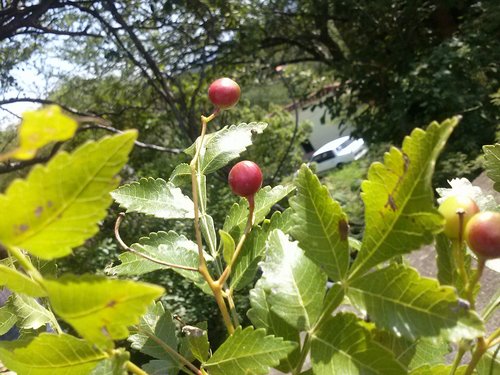
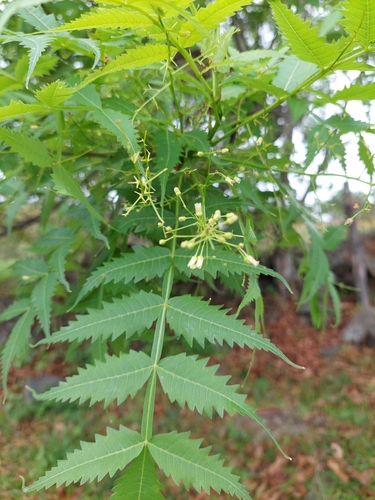
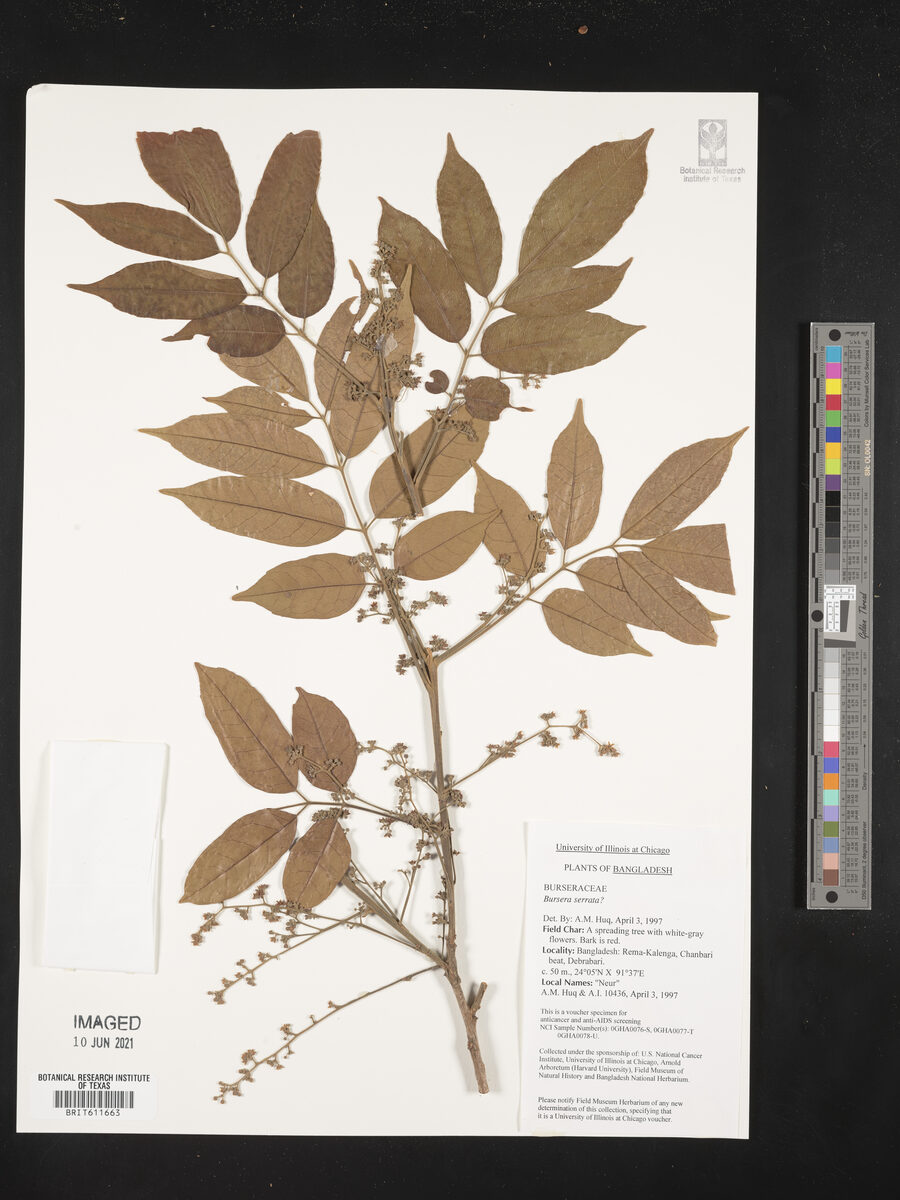
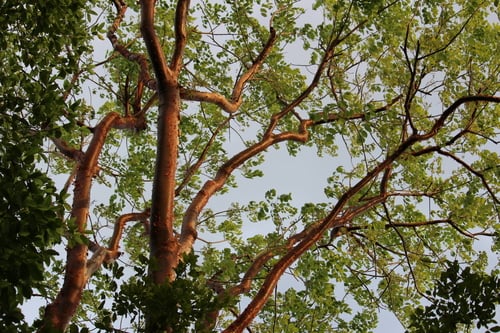
A tree. It grows 3-35 m tall. The crown is wide and spreading. The small branches have yellow hairs. The leaves are 15-37 cm long. They have 7-9 leaflets and these are 5-21 cm long by 2-7 cm wide. The flowers are in loosely branched clusters in the axils of leaves. The flowers are white or yellow. The fruit are fleshy but become 2-5 lobed capsules. They are 1.5-2.5 cm long and 1.5-3 cm wide.
Edible Uses
We have no specific information for this plant, but the fruits of Tetragastris species are generally red, opening at maturity to expose a stone with an edibe, sweet white covering that attracts animals like pacas, peccaries and tortoises, which disperse some seeds throughout the forest. Forest people snack on the white pulp when the stones fall.
Traditional Uses
The aril of layer around the seed is eaten raw.
This uses section is brief — help expand it
Distribution
It is a tropical plant.
Where It Grows
Belize, Bolivia, Brazil, Central America, Colombia, Costa Rica, Ecuador, Guatemala, Guiana, Guianas, Guyana, Honduras, Nicaragua, Panama, Peru, South America, Suriname, Venezuela,
Cultivation
A dioecious species, both male and female forms need to be grown if fruit and seed are required.
Other Uses
The heartwood is light brown to orangey-yellow, sometimes with frequent small, black, resinous spots; it is clearly demarcated from the 4 - 6cm wide band of orange-yellow sapwood. Texture is fine, the grain interlocked; lustre medium; no perceptible odour or taste once seasoned. The wood is heavy, hard, of moderate elasticity, moderately durable, with resistance to attacks by fungi, dry wood borers and termites. The drying rate is normal to slow with a high risk of distortion or checking; once dry it is poorly stable in service. Sawing and machining are nore or less easy, but with a fairly high blunting effect - stellite-tipped sawteeth are recommended. Nailing and screwing are good, though pre-boring is necessary to avoid splitting; gluing is correct. The wood is used for industrial or heavy flooring, furniture, interior stairs, joinery, heavy carpentry, bridges etc.
Nutrition
| Part | Moisture | kJ | kcal | Protein | Vit A | Vit C | Iron | Zinc |
|---|---|---|---|---|---|---|---|---|
| Fruit | 0 | — | — | 3.2 | — | — | — | — |
Synonyms
Also Known As
Anime, Carano, Cuatro estomagos, Chutra, Kerosin, Nempokawe, Witagemo, Witagewe
References (10)
- Bendezu, Y. F., 2018, Arboles nativos de lad Region Ucayali. Instituto Nacional de Innovacion Agraria. p 76
- Condit, R., et al, 2011, Trees of Panama and Costa Rica. Princeton Field Guides. p 110
- Flores, Y., 2018, Arboles nativos de la Region Ucayili. Estacion Experimental Agragia Pucallpa. Pucallpa Peru, 375 p. p 76
- Fouqué, A. 1972. Espèces fruitières d'Amérique tropicale. Institut français de recherches fruitierès outre-mer
- Grandtner, M. M., 2008, World Dictionary of Trees. Wood and Forest Science Department. Laval University, Quebec, Qc Canada. (Internet database http://www.wdt.qc.ca)
Show all 10 references Hide references
- Kermath, B. M., et al, 2014, Food Plants in the Americas: A survey of the domesticated, cultivated and wild plants used for Human food in North, Central and South America and the Caribbean. On line draft. p 860
- Lopez-Diago, D. & Garcia, N., 2021, Wild edible fruits of Colombia. Biota ColomBiana 22 (2) p 33
- Roa, J. A. G. & Boada, D. S. G., 2018, Fundación para el Fortalecimiento de la Fruticultura y Plantas Alimenticias no Convencionales en Colombia.
- Torre, de la, L., et al, 2008, Enciclopedia de las Plantas Útiles del Ecuador. Herbario QCA. Pontificia Universidad Católica del Ecuador. p 266
- Woodson, R. E., et al, 1970, Flora of Panama. Part 6, Family 91. Burseraceae. Annals of the Missouri Botanical Garden. Vol. 57, No. 1. p. 20