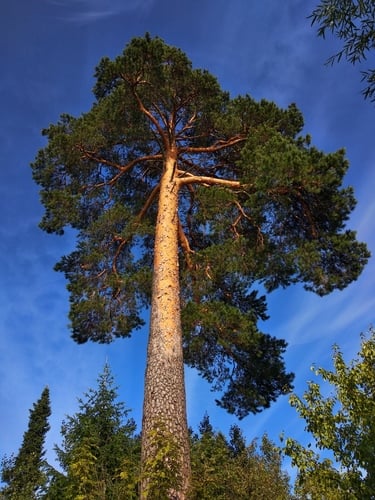
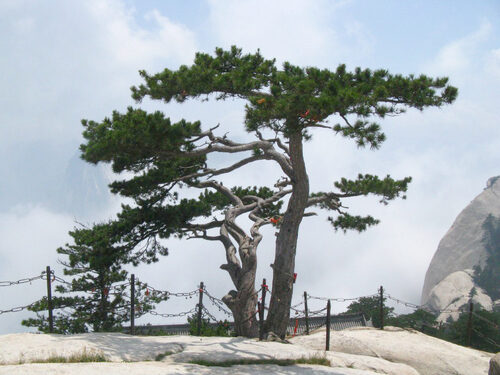
Pinus quadrifolia
Parl. ex Sudw.
Parry pine, Four-leaved nut pine
iNaturalist· cc-by-nc
(c) growbadlands, some rights reserved (CC BY-NC), uploaded by growbadlands
iNaturalist· cc-by-nc
(c) Tom Chester, some rights reserved (CC BY-NC)
Summary
Source: WikipediaPinus quadrifolia, the Parry pinyon, is a pine in the pinyon pine group native to southernmost California in the United States and northern Baja California in Mexico, from 33° 30' N south to 30° 30' N. The Parry pinyon has a lifespan of around 200 to 500 years. It is usually found in rocky areas that often have thin soil. It occurs at moderate altitudes from 1,300 metres (4,300 ft) to 1,800 metres (5,900 ft), rarely as low as 1,200 metres (3,900 ft) and as high as 2,500 metres (8,200 ft). It is scarce and often scattered in this region, forming open woodlands, usually mixed with junipers. Other common names include nut pine and fourleaf pinyon pine.
Description
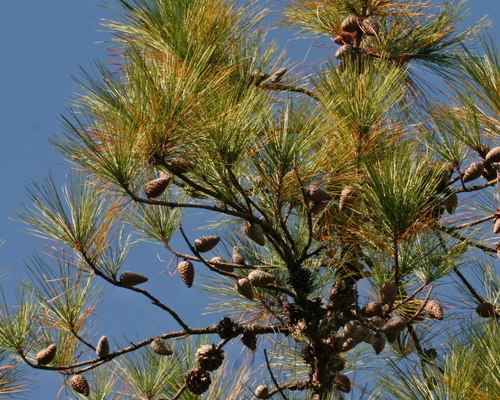
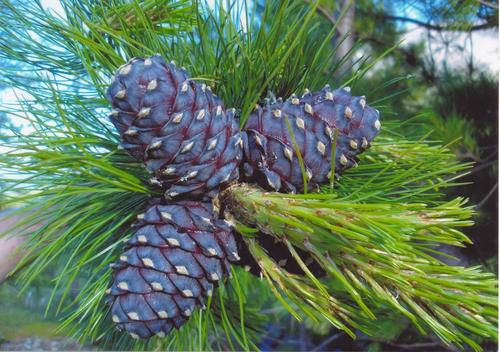
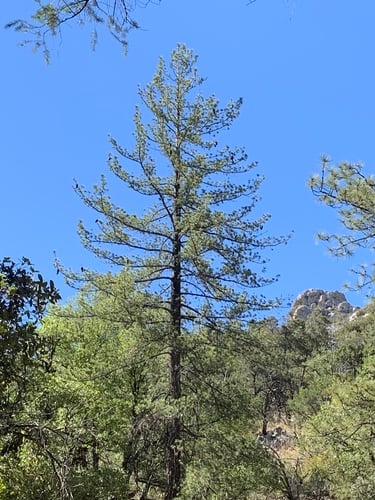
A small tree. It grows 8-15 m tall. The trunk can be 40 cm across. The bark is thick and rough. The leaves or needles are in groups of 4-5. They are 3-5 cm long and dark green and shiny. The cones open to 5-7 cm across and have seeds attached to the scales. The seeds are 10-14 mm long and have a thin shell.
Edible Uses
The seeds can be eaten raw or cooked and were an important food crop for the Indians of Baja California. Oil-rich with a mild resinous flavour and pleasant soft texture, the seeds are a good size at up to 16mm long. They contain approximately 11% protein, 37% fat, and 44% carbohydrate. A vanillin flavouring is obtained as a by-product of resins released from the pulpwood.
Traditional Uses
The nuts are ground and mixed with water and used as a drink. The cooked, unshelled nuts are stored for later use.
This uses section is brief — help expand it
Medicinal Uses
The turpentine derived from pine resin is antiseptic, diuretic, rubefacient, and vermifuge. Taken internally, it is a valuable remedy for kidney and bladder complaints, and is used both internally and as a rub or steam bath for rheumatic conditions. It also benefits the respiratory system, making it useful against diseases of the mucous membranes and complaints such as coughs, colds, influenza, and TB. Externally, it treats skin complaints, wounds, sores, burns, and boils, and is applied as liniment plasters, poultices, herbal steam baths, or inhalers.
Known Hazards
The wood, sawdust and resins from various species of pine can cause dermatitis in sensitive people.
Distribution
It is a Mediterranean climate plant.
Where It Grows
Australia, Mexico, North America, USA,
Cultivation
Thrives in a light well-drained sandy or gravelly loam. Dislikes poorly drained moorland soils. Established plants tolerate drought, succeeding in a hot dry position. This species is closely related to P. cembroides and considered to be no more than a sub-species of it by some botanists. The main difference is that this species has its leaves in bundles of four whilst P. cembroides has them in bundles of two or three. Plants are strongly outbreeding, self-fertilized seed usually grows poorly. They hybridize freely with other members of this genus. It extensively hybridizes with P. californiarum in most of its range. The cones open and shed their seed whilst still attached to the tree. A slow growing tree, taking 25 years from sowing until it produces a crop of seeds. The tree is long-lived, taking 250 - 350 years to reach maturity. Leaf secretions inhibit the germination of seeds, thereby reducing the amount of plants that can grow under the trees. Plants in this genus are notably susceptible to honey fungus.
Propagation
Sow seed in individual pots in a cold frame as soon as it is ripe, or in late winter if necessary. A short stratification of 6 weeks at 4°C can improve germination of stored seed. Plant seedlings into their permanent positions as soon as possible and protect them through their first winter or two. Because plants have a very sparse root system, early transplanting is important for good establishment. Trees should be moved to their final positions when small — between 30 and 90cm — though in practice planting out at around 5–10cm tall works well, provided a thorough weed-excluding mulch is used. Larger transplants establish poorly, putting on little growth for several years, which also compromises root development and wind resistance. Cuttings can be taken, but this method only works on trees less than 10 years old. Use single leaf fascicles with the base of the short shoot attached. Disbudding the shoots a few weeks before taking cuttings can improve success. Cuttings are generally slow to grow away.
Other Uses
A tan or green dye is obtained from the needles. The roots have been used to make baskets, and the bark has been used as a roofing material. The needles contain terpene, which is released by rain and negatively affects the germination of some plants, including wheat. Oleo-resins are present in all pine species but are often insufficient for economical extraction; they are obtained by tapping the trunk or by destructive distillation of the wood, with warmer-region trees giving higher yields. Turpentine makes up an average of 20% of the oleo-resin and is separated by distillation for use as a solvent, in varnish-making, and medicinally. The remaining rosin is used on violin bows and in sealing wax and varnish. Pitch from the resin is used for waterproofing and wood preservation, and has also been applied as a face cream to prevent sunburn and as an adhesive on pottery. The wood is light, soft, and close-grained; it burns well and gives off a pleasant odour.
Notes
It is now a rare species.
Synonyms
Also Known As
Four-needle pinyon, Pinonero parry
References (11)
- Ciesla, W.M., 1998, Non-wood forest products from conifers. Non-wood forest products 12, FAO, Rome, p 73 (As Pinus juarezensis)
- FAO, 2012, Forest Genetic Resources Situation in Mexico. Final Report of Project TCP/ 3301 p 287
- Farjon, A., and Styles, B. T., 1997, Pinus (Pinaceae): Flora Neotropica, Vol. 75, pp. 1-291
- Forest Genetic Resources Situation in Mexico, FAO 2012 Annex 15 p 286
- Grandtner, M. M., 2008, World Dictionary of Trees. Wood and Forest Science Department. Laval University, Quebec, Qc Canada. (Internet database http://www.wdt.qc.ca)
Show all 11 references Hide references
- Kermath, B. M., et al, 2014, Food Plants in the Americas: A survey of the domesticated, cultivated and wild plants used for Human food in North, Central and South America and the Caribbean. On line draft. p 662
- Mapes, C. & Basurto, F., 2016, Biodiversity and Edible Plants of Mexico. Chapter 5 in R. Lira, et al. (eds.), Ethnobotany of Mexico, Ethnobiology, Springer. p 91 (As Pinus juarezensis)
- Moerman, D. F., 2010, Native American Ethnobotany. Timber Press. p 412
- Segura, S., et al, 2018, The edible fruit species in Mexico. Genet Resour Crop Evol (2018) 65:1767–1793
- Wiersema, J. H. & Leon, B., 2013, World Economic Plants. A Standard Reference CRC Press. 2nd Ed. p 533
- World Checklist of Useful Plant Species 2020. Royal Botanic Gardens, Kew