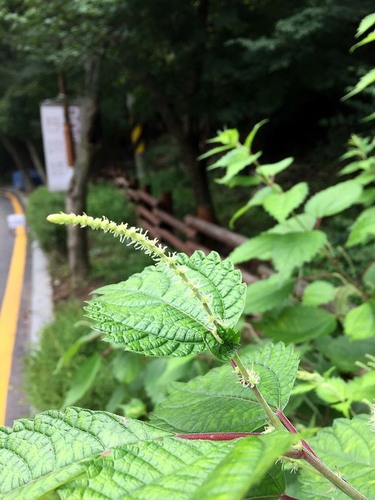
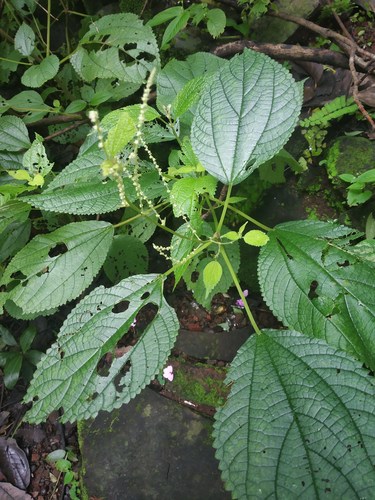
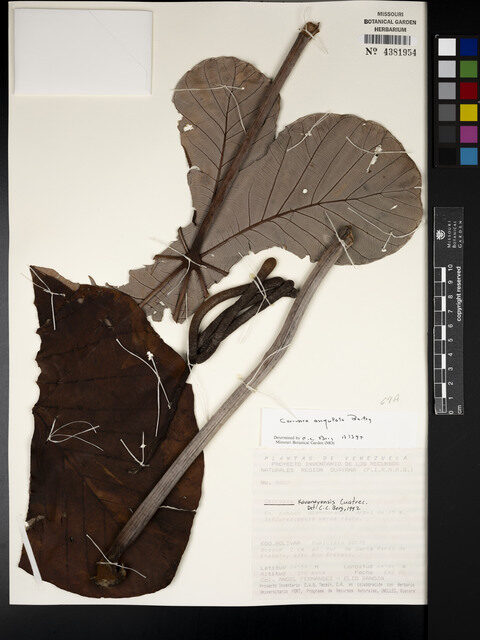
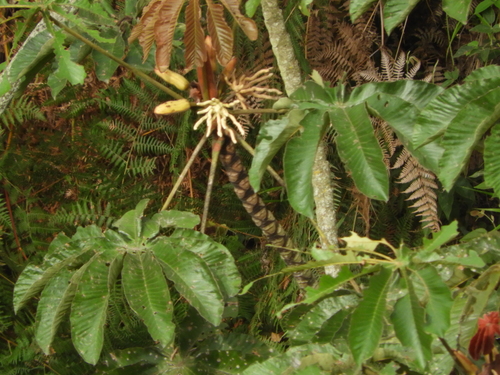
Urera baccifera
(L.) Gaudich. ex Wedd.
Bugrun, Nettle tree
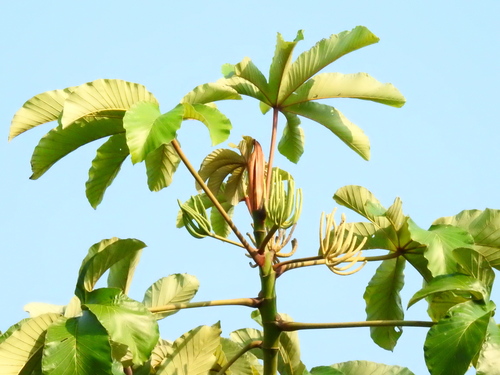
iNaturalist· cc-by-nc
(c) Ivelisse Irizarry, some rights reserved (CC BY-NC), uploaded by Ivelisse Irizarry
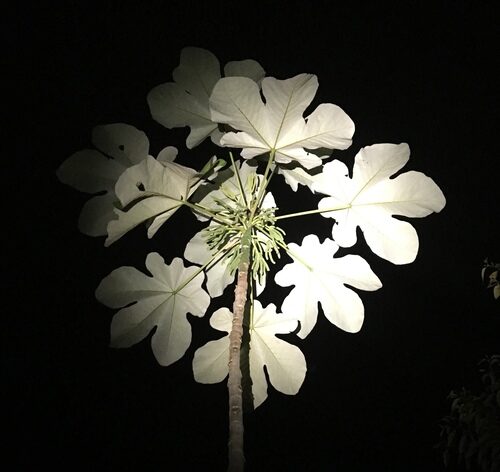
iNaturalist· cc-by-nc
(c) spicy_t, some rights reserved (CC BY-NC)
Summary
Source: WikipediaUrera baccifera is a species of flowering plant in the nettle family known by many common names, including scratchbush, ortiga brava, pringamoza, mala mujer, chichicaste, nigua, guaritoto, ishanga, manman guêpes, and urtiga bronca. It is native to the Americas from Mexico through Central America into South America, as well as the Caribbean. This species is a shrub or a small tree. It can reach five meters in height. The thin, toothed leaves are up to 25 centimeters long by 12.5 wide. The blades are borne on long petioles. The plant is covered in spines and stinging hairs. The inflorescence is a pink or purple cluster of flowers, and the plant is dioecious, with male and female parts on different plants. The spongy, juicy fruit is green or pinkish. The seeds are dispersed by fruit-eating birds and capuchin monkeys. This plant grows in moist tropical forests. It is not very tolerant of shade, so it dies back when the overstory closes. It can be found in forests recently disturbed by fire. In some areas, this plant is one of the first to bear fruit after the damage of a hurricane, and then it becomes an important food source for birds. The fruits also provide food for many species of ant. The ants also collect pearl bodies which form on the leaves, stems, and stalks of the plant. Ants performing this activity include species in genera such as Camponotus, Pheidole, Crematogaster, and Pseudomyrmex. When ants are present on a plant, they rid it of lepidopteran larvae which would feed upon it, such as Smyrna blomfildia, Urbanus esmeraldus, and Pleuroptya silicalis. This provides a benefit for both plant and ant in a mutualistic relationship.
Description
A shrub or small tree. It grows 5 m tall. It has spines and stinging hairs. The leaves are 25 cm long by 12.5 cm wide and have teeth along the edge. They have long leaf stalks. The flowers are a cluster of pink or purple. Male and female flowers are on separate plants. The fruit is spongy and juicy and green to pink.
Edible Uses
None known
Traditional Uses
Caution. The leaves can cause very serious stinging.
This uses section is brief — help expand it
Medicinal Uses
An infusion of the fresh leaves is diuretic. The leaves are used to treat muscle pain — a leaf is held by its petiole and brushed against the skin, causing intense pain that is gradually replaced by numbness over the following days. The Waorani use the plant to relieve all manner of pain, including that from aching muscles, arthritis, pulled muscles, snakebite, stingray wounds, and stings from fire ants and other insects. In the Colombian Amazon, the roots are said to have antihaemorrhagic properties, and a leaf infusion is used to alleviate erysipelas. A decoction of the roots is used in treating gonorrhoea and is also diuretic.
Known Hazards
This is one of the best known plants of Guatemala and all Central America, one known and probably physically so, to all Central Americans, for it is one of the most severely stinging plants that exist in the Americas. The large spine-like prickles are hollow and filled with liquid. When one brushes against a branch or a leaf, the prickles penetrate the flesh and cause the most excruciating pain, as sudden as an electric shock, that may last two or three days. The pain gradually disappears, to be followed by numbness in the affected part. It is needless to explain why the shrub makes an effective hedge plant!!!.
Distribution
It is a tropical plant. It grows in moist forests but needs a sunny position.
Where It Grows
Argentina, Belize, Bolivia, Brazil*, Caribbean, Central America*, Colombia, Costa Rica, Cuba*, Dominican Republic, Ecuador, El Salvador, Grenada, Guatemala, Guiana, Guianas, Guyana, Haiti, Lesser Antilles*, Mexico*, North America, Panama, Paraguay, Peru, Puerto Rico, South America*, Suriname, Trinidad, Venezuela, West Indies*,
Cultivation
It can be used as a hedge.
Propagation
Fresh seed can germinate in 26 days or more, with around 49% sprouting. Cuttings are straightforward — even thick branches root quickly when inserted into the ground.
Other Uses
When a branch or leaf is brushed against, the prickles penetrate the flesh and cause intense pain, making this plant highly effective as a hedge. It is widely planted for this purpose throughout the Americas, and horses and most large animals will not attempt to push through such a barrier. The hedges are most presentable in the early rainy season when new foliage appears, but lose their leaves and become unsightly during the dry season. The plant has been observed to colonise fire-disturbed forest in Brazil's Atlantic forest through high recruitment and low mortality rates, with seeds dispersed by birds. Fibre from the branches has been used to make rope, twine, and paper.
Notes
There are about 40 Urera species. They are in the tropics. It has anti-inflammatory medicinal properties.
Synonyms
Also Known As
Aya chini, Bento, Cansancao-roxa, Chachapa anco'si, Chichicaste, Chini panka, Chukta chini, Guaritoto, Hatun chini, Ishanga, Kiru sapa chini, Kukupa chini, Mala mujer, Manman guepes, Nana-miitosusi, Nigua, Ortiga, Ortiguilla, Pe tini, Pringamoza, Puka chini, Scratchbush, Sinalwo, Urtiga-branca, Urtiga-da-folha-grande, Urtigao, Urtigao-bravo, Urtigao-da-serra, Urtiga-vermelha, Wento, Yuturi chini
References (14)
- Alimenticias - FloraSBS
- Brack, P., et al, 2020, Frutas nativas do Rio Grande do Sul, Brasil: riqueza e potencial alimentício. Native fruits of Rio Grande do Sul, Brazil: richness and potential as food. Rodriguésia 71: e0310201
- Castaneda, H., & Stepp, J. R., 2007, Ecosystems as Sources of Useful Plants for the Guaymi People of Costa Rica. Ethnobotany Journal. 5:249-257
- D'Ambrosio, U., & Puri, R. K., 2016, Foodways in transition: food plants, diet and local perceptions of change in a Costa Rican Ngäbe community. Journal of Ethnobiology and Ethnomedicine (2016) 12:3 p 27
- Garcia-Serrano, C. R., & Del Monte, J. P., 2004, The Use of Tropical Forest (Agroecosystems and wild Plant harvesting) as a Source of Food in the Bribri and Cabecar Cultures in the Caribbean Coast of Costa Rica. Economic Botany 58(1) pp 58-71
Show all 14 references Hide references
- Grandtner, M. M. & Chevrette, J., 2013, Dictionary of Trees, Volume 2: South America: Nomenclature, Taxonomy and Ecology. Academic Press p 681
- INFOODSUpdatedFGU-list.xls
- Kinupp, V. F., 2007, Plantas alimenticias nao-convencionais da regiao metropolitana de Porto Alegre, RS, Brazil p 105
- Kinupp, V. F. & Bergman, I., 2008, Protein and minerals of native species, potential vegetables and fruits. Cienc.Tecnol. Aliment. Vol. 28 No. 4 Campinas Oct/Dec.
- Langlois, H. C., 2004, Ethnobotanical analysis of different successional stages as sources of wild edible plants for the Guaymi people in Costa Rica. M. Sc. thesis University of Florida.
- Plants of Haiti Smithsonian Institute http://botany.si.edu/antilles/West Indies
- Roa, J. A. G. & Boada, D. S. G., 2018, Fundación para el Fortalecimiento de la Fruticultura y Plantas Alimenticias no Convencionales en Colombia.
- Scarpa, G. F., 2009, Wild food plants used by the indigenous peoples of South American Gran Chaco: A general synopsis and intercultural comparison. Journal of Applied Botany and Food Quality 83:90-101
- Torre, de la, L., et al, 2008, Enciclopedia de las Plantas Útiles del Ecuador. Herbario QCA. Pontificia Universidad Católica del Ecuador. p 611