Pouzolzia mixta
Solms-Laub.
Soap nettle, Snuggle-leaf
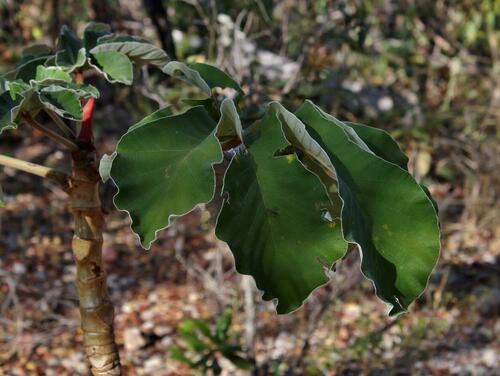
iNaturalist· cc-by-nc
(c) Grant Reed, some rights reserved (CC BY-NC), uploaded by Grant Reed
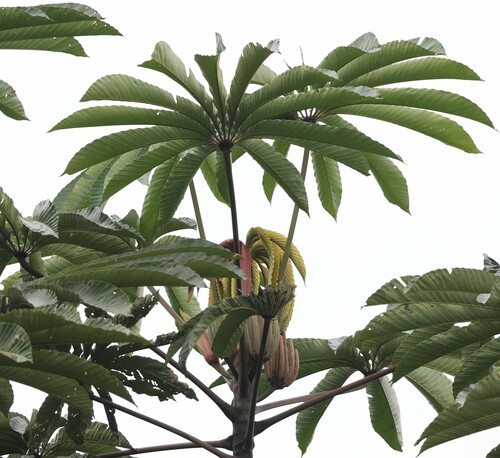
iNaturalist· cc-by-nc
(c) Malcolm Douglas, some rights reserved (CC BY-NC)
Description
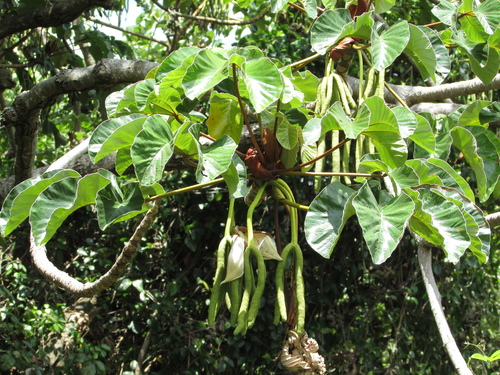
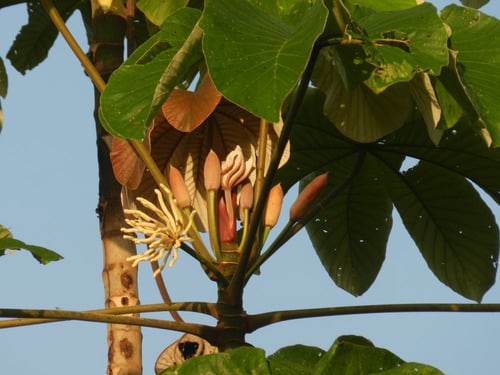
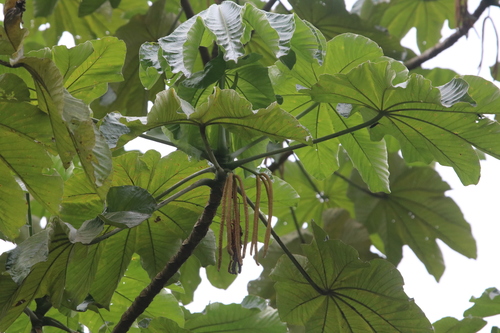
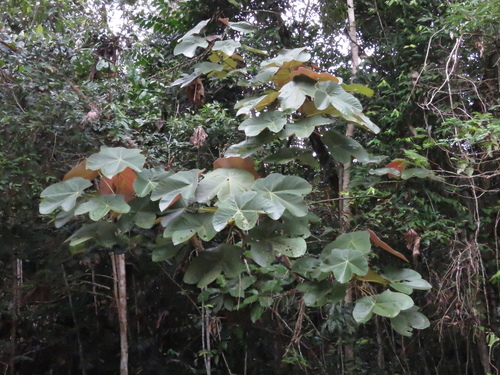
A shrub. It can be 4 m high The stems are slender. The bark is dark purple-brown and smooth. The leaves are alternate. They are 10 cm long by 5 cm wide. There are no teeth along the edge. The leaves taper to the tip. The upper surface is green and the lower surface is covered with white felt. The flowers are in dense round clusters. These are 1 cm across.
Edible Uses
The leaves are eaten as a green vegetable, chopped and cooked with coconut milk or pounded with peanuts.
Traditional Uses
The leaves are eaten as a green vegetable. They are chopped and cooked with coconut milk or pounded with peanuts. Caution: The hairs on the leaves cause itching until it is put into hot water.
Medicinal Uses
The plant is widely used in African traditional medicine. The roots are considered to be aphrodisiac and contraceptive. An extract or decoction is used in the treatment of diarrhoea and dysentery. An infusion is drunk to treat constipation, venereal diseases and female sterility. The powdered root is taken in a porridge as a treatment against uterine pain. The powdered root is inserted into the vagina as a treatment against female sterility and to prevent abortion. An infusion is instilled into the vagina to dilate the birth canal during labour. A paste of the root is applied on burns and a depressed fontanel. A maceration of the root and leaves is drunk to expel the placenta after childbirth. Adventitious roots are crushed and the jelly-like liquid obtained is used to treat burns. Thin strips of bark fibre have been used to stitch wounds. They are thought to have healing effects. A decoction of the stem is administered as an enema for the relief of biliousness. The pounded leaf is mixed with water to form a drink taken for treatment of measles.
Known Hazards
The hairs on the leaves cause itching until they are put into hot water.
Distribution
It is a tropical plant. It grows in open deciduous woodland. It is often on rocky banks and hillsides. It grows between 250-1,900 m altitude. It grows in areas with an annual rainfall between 300-450 mm. It can grow in arid places.
Where It Grows
Africa, Angola, Botswana, Central Africa, East Africa, Eswatini, Ethiopia, Malawi, Middle East, Mozambique, Namibia, South Africa, Southern Africa, Sudan, Swaziland, Tanzania, Uganda, Yemen, Zambia, Zimbabwe,
Cultivation
It can be grown from seeds.
Other Uses
The crushed leaf is used as a substitute for soap to wash hands and clothes. The leaves are covered with woolly hairs and can be made to stick together. Children fashion these woolly leaves in games to make cups, baskets, hats etc. Caution should be employed, however, since these hairs on the leaves can cause itching. A very strong fibre obtained from the stems is used to make nets and string. The stem contains a high amount of gums, like that of ramie (Boehmeria nivea), making degumming of the fibre necessary, though experiments have shown that the fibre can be degummed fairly easily. The traditional method of obtaining the fibre is to scrape off the outer bark, then to dry the remaining stems in the sun. These stems are then soaked in water and partially dried, after which the white inner bark fibre can be peeled off easily. This inner bark is dried and separated into narrow strips. String is made by rolling out these strips with the palm of the hand on the thigh. The various lengths are spliced and rolled together into long skeins of string, which vary from fine to thick, according to the intended purpose.
Production
Leaves are collected in the rainy season.
Other Information
It is a popular green leafy vegetable.
Synonyms
Also Known As
Chidanzua, Isikhukhukhu, Kanyandee, Kurapi, Licopwa, Lugoye, Mkaafuu, Mongololo, Msopo, Mtwaki, Mulambadivhu, Munanzva, Murovhadembe, Muthanzwa, Ondomo, Seepnetel, Sikukuku, Tasva, Tingo, Udekane
References (15)
- Flora Zambesiaca. http://apps.kew.org/efloras
- Fowler, D. G., 2007, Zambian Plants: Their Vernacular Names and Uses. Kew. p 62
- Grubben, G. J. H. and Denton, O. A. (eds), 2004, Plant Resources of Tropical Africa 2. Vegetables. PROTA, Wageningen, Netherlands. p 564
- Magwede, K., van Wyk, B.-E., & van Wyk, A. E., 2019, An inventory of Vhavenḓa useful plants. South African Journal of Botany 122 (2019) 57–89
- Mannheimer, C. A. & Curtis. B.A. (eds), 2009, Le Roux and Muller's Field Guide to the Trees and Shrubs of Namibia. Windhoek: Macmillan Education Namibia. p 30
Show all 15 references Hide references
- Msuya, T. S., et al, 2010, Availability, Preference and Consumption of Indigenous Foods in the Eastern Arc Mountains, Tanzania, Ecology of Food and Nutrition, 49:3, 208-227
- Peters, C. R., O'Brien, E. M., and Drummond, R.B., 1992, Edible Wild plants of Sub-saharan Africa. Kew. p 196
- Royal Botanic Gardens, Kew (1999). Survey of Economic Plants for Arid and Semi-Arid Lands (SEPASAL) database. Published on the Internet; http://www.rbgkew.org.uk/ceb/sepasal/internet [Accessed 13th June 2011]
- Ruffo, C. K., Birnie, A. & Tengnas, B., 2002, Edible Wild Plants of Tanzania. RELMA p 542
- Ruiters-Welcome, A. K., 2019, Food plants of southern Africa. Ph.D. thesis. Univ. of Johannesburg p 106
- Swaziland's Flora Database http://www.sntc.org.sz/flora
- Van Wyk, Br. and van Wyk P., 2009, Field Guide to Trees of Southern Africa. Struik Nature. p 100
- Welcome, A. K. & Van Wyk, B.-E., 2019, An inventory and analysis of the food plants of southern Africa. South African Journal of Botany 122 (2019) 136–179
- World Checklist of Useful Plant Species 2020. Royal Botanic Gardens, Kew
- www.zimbabweflora.co.zw 2011