Laportea peduncularis
(Wedd.) Chew
River nettle
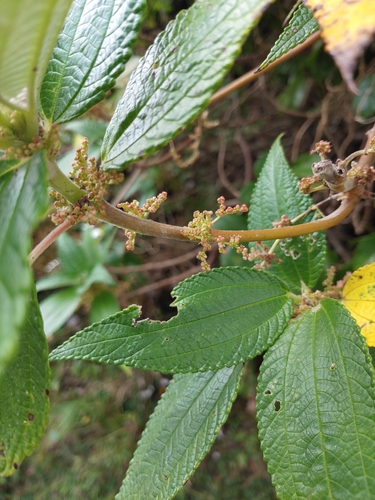
iNaturalist· cc-by-nc
(c) Sharon Louw, some rights reserved (CC BY-NC), uploaded by Sharon Louw
iNaturalist· cc-by-nc
(c) jean hirons, some rights reserved (CC BY-NC)
iNaturalist· cc-by-nc
(c) Sandra Dell, some rights reserved (CC BY-NC)
Summary
Source: WikipediaLaportea peduncularis, the river nettle, is a herbaceous plant in the family Urticaceae. It is consumed for its anti-inflammatory effects.
Description
A herb. It is slender and often grows as an annual. It grows 3 m high. It can be scrambling. It has a few stinging hairs. The leaves are alternate and widely spaced. The leaf blades are 12 cm long by 6 cm wide. The stalks can be 8 cm long. There are teeth along the edge and the leaf tapers to the tip. The leaves are pale underneath. The flowers are green. They are in small clusters.
Edible Uses
The leaves and flowers are cooked as a vegetable.
Traditional Uses
The leaves and flowers are cooked as a vegetable.
This uses section is brief — help expand it
Known Hazards
The plant bears stinging hairs.
Distribution
It is a tropical plant. It grows in upland mountain forest. It grows between 1,100-1,700 m above sea level. It grows in dense shade and often near streams.
Where It Grows
Africa, East Africa, Eswatini, Malawi, Mozambique, South Africa, Southern Africa, Swaziland, Tanzania, Zimbabwe,
Synonyms
Also Known As
Bosbrandnetel, Bubati, Dzaluma, Lubati, Imbabazane, Imbathi, Inkwaze
References (8)
- Fox, F. W. & Young, M. E. N., 1982, Food from the Veld. Delta Books. p 358
- Long, C., 2005, Swaziland's Flora - siSwati names and Uses http://www.sntc.org.sz/flora/
- Magwede, K., van Wyk, B.-E., & van Wyk, A. E., 2019, An inventory of Vhavenḓa useful plants. South African Journal of Botany 122 (2019) 57–89
- Ogle, B. M. & Grivetti, L. E., 1984, Legacy of the Chameleon: Edible Wild Plants in the Kingdom of Swaziland, Southern Africa. A Cultural, Nutritional Study. Part 4 - Nutritional Analysis and Conclusions. Ecology of Food and Nutrition. Vol 17, pp 431-64
- Peters, C. R., O'Brien, E. M., and Drummond, R.B., 1992, Edible Wild plants of Sub-saharan Africa. Kew. p 196
Show all 8 references Hide references
- Ruiters-Welcome, A. K., 2019, Food plants of southern Africa. Ph.D. thesis. Univ. of Johannesburg p 106
- Swaziland's Flora Database http://www.sntc.org.sz/flora
- Welcome, A. K. & Van Wyk, B.-E., 2019, An inventory and analysis of the food plants of southern Africa. South African Journal of Botany 122 (2019) 136–179