Solanum incanum
L.
Bitter tomato
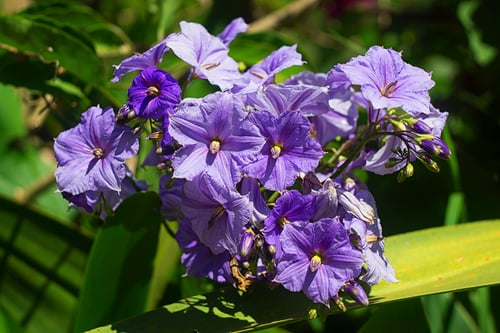
iNaturalist· cc-by-nc
(c) Michael Gochfeld, some rights reserved (CC BY-NC)
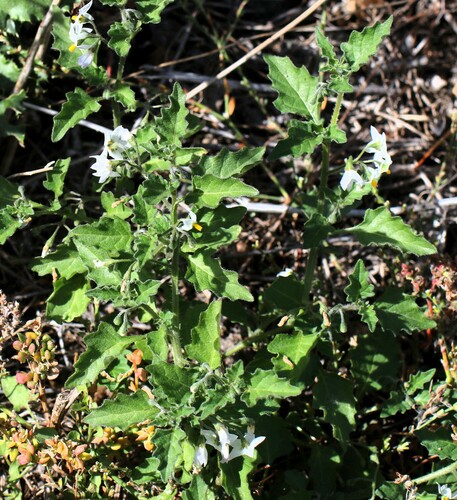
iNaturalist· cc-by-nc
(c) Michael Gochfeld, some rights reserved (CC BY-NC)
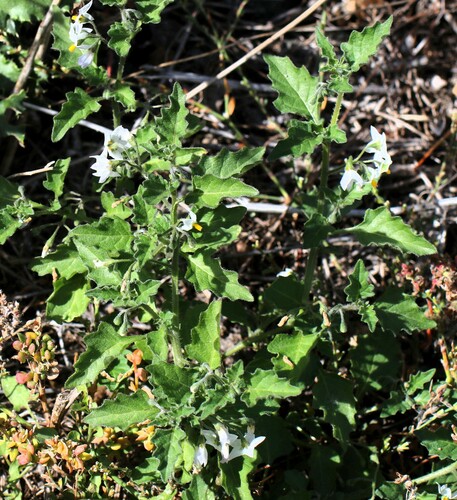
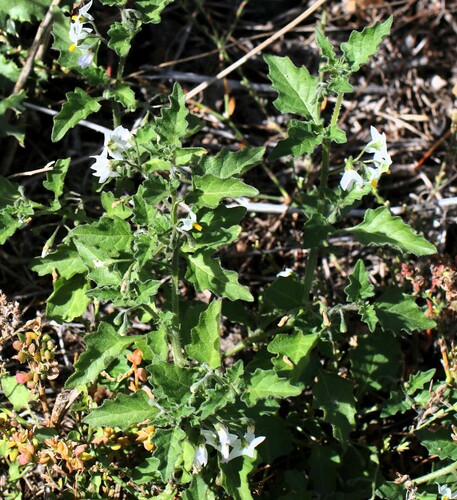
iNaturalist· cc-by-nc
(c) pantanico, some rights reserved (CC BY-NC)
Summary
Source: WikipediaSolanum incanum is a species of nightshade, a flowering plant in the family Solanaceae. It is native to East Africa, West Africa, the Middle East, and eastwards to India. The species was introduced to Taiwan and Vietnam. Common names include thorn apple, bitter apple, bitterball and bitter tomato It may be confused with the similar S. linnaeanum where their ranges overlap in Africa. In ancient India, Solanum incanum was domesticated into the eggplant, Solanum melongena.
Description
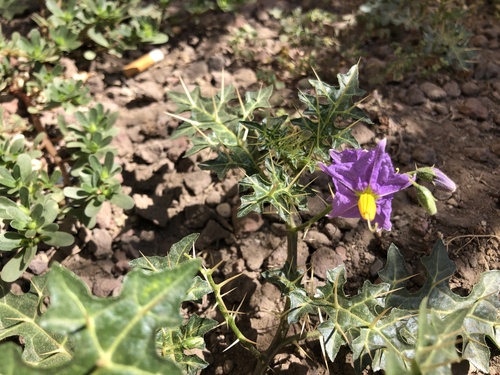
A herb or shrub. It grows 120 cm high. The stems and branches are yellow-green. They have prickles up to 8 mm long. These can be straight or curved. The leaves are 4-8 cm long by 3-6 cm wide. They are broadly oval. The flower are purple-blue. The fruit is a round berry. It is 2-3 cm long and yellow. The seeds are 2.5 mm wide.
Edible Uses
Immature fruit and young leaves are cooked and eaten, or used in pickles. The fruit juice is used as a rennet to curdle milk. The fruit is also pounded with red peppers and cola to make a drink.
Traditional Uses
The immature fruit and young leaves are cooked and eaten. They are used in pickles. The fruit juice is used as a rennet to curdle milk. The fruit are pounded with red peppers and cola to make a drink.
Medicinal Uses
The plant has traditional medicinal uses.
Known Hazards
The wild form of the plant is toxic, though cultivars have been developed that are cultivated for their edible fruits and leaves. The fruits are used as an ingredient of arrow poisons and fish poisons. All Solanum species contain greater or lesser quantities of spirosolane alkaloids, including solanine and solanidine. These are bitter tasting and potentially poisonous when consumed frequently.
Distribution
It is a tropical plant. It grows between 1-2,350 m above sea level. It needs good light. In Pakistan it grows up to 1,400 m altitude. It can grow in arid places.
Where It Grows
Africa, Angola, Arabia, Benin, Botswana, Burundi, Burkina Faso, Cameroon, Central Africa, Chad, Congo DR, East Africa, Egypt, Eswatini, Ethiopia, Ghana, Guinea-Bissau, India, Iran, Kenya, Lesotho, Madagascar, Malawi, Mali, Mediterranean, Middle East, Mozambique, Namibia, Nepal, Nigeria, North Africa, Northeastern India, Oman, Pakistan, Rwanda, Saudi Arabia, Senegal, Sikkim, Socotra, Somalia, South Africa, Southern Africa, Sudan, Swaziland, Syria, Taiwan, Tanzania, Togo, Uganda, West Africa, Yemen, Zambia, Zimbabwe,
Cultivation
It can be cut back and will re-grow.
Propagation
Seed - sow in a seedbed or containers. Plant out into their permanent positions when about 6 - 8cm tall.
Other Uses
The boiled fruits are used as soap and in tanning leather.
Other Information
It is a commercially cultivated vegetable.
Notes
It is used in medicine. This plant is the original plant from which Solanum melongena was selected.
Nutrition
| Part | Moisture | kJ | kcal | Protein | Vit A | Vit C | Iron | Zinc |
|---|---|---|---|---|---|---|---|---|
| Fruit - mature | 92 | 122 | 29 | 1.2 | — | — | — | — |
| Leaves | 92 | 121 | 29 | 1.2 | — | — | — | — |
Synonyms
Also Known As
Asind, Bah N'goyo, Bee, Bitter apple, Data, Gautan-daci, Idi-gaga, Imbway, Intobo, Jakato, Jangli baingan, Jangli khashi, Kori wal, Mahokari, Mahora, Matungusa, Morolwana, Mtonda, Mtula, Mtungusa, Nangali, Nduo, Ngbako, Soropes, Thorn apple, Tingi, Umucucu, Undulele, Waniinye
References (22)
- Dalziel, J. M., 1937, The Useful plants of west tropical Africa. Crown Agents for the Colonies London.
- Diarra, N. et al, 2016, Etude ethnobotanique des plantes alimentaires utilisées en période de soudure dans les régions Sud du Mali. Int. J. Biol. Chem. Sci. 10(1): 184-197
- Flora of Pakistan. www.eFloras.org
- Food Composition Tables for use in Africa FAO http://www.fao.org/infoods/directory No. 830
- Fowler, D. G., 2007, Zambian Plants: Their Vernacular Names and Uses. Kew. p 61
Show all 22 references Hide references
- Gbile, Z. O. and Adesina, S. K., 1988, Nigerian Solanum Species of Economic Importance. Annals of the Missouri Botanical Garden, Vol. 75, No. 3. p 864
- Grivetti, 1976, 1979,
- Grivetti, L. E., 1980, Agricultural development: present and potential role of edible wild plants. Part 2: Sub-Saharan Africa, Report to the Department of State Agency for International Development. p 80
- Grubben, G. J. H. and Denton, O. A. (eds), 2004, Plant Resources of Tropical Africa 2. Vegetables. PROTA, Wageningen, Netherlands. p 565
- Kays, S. J., and Dias, J. C. S., 1995, Common Names of Commercially Cultivated Vegetables of the World in 15 languages. Economic Botany, Vol. 49, No. 2, pp. 115-152
- Kumar, A., et al, 2012, Ethnobotanical Edible Plant Biodiversity of Lepcha Tribes. Indian Forester, 138 (9):798-803
- Majeed, M., et al, 2021, Gathered Wild Food Plants among Diverse Religious Groups in Jhelum District, Punjab, Pakistan. Foods 2021, 10, 594.
- Molla, A., Ethiopian Plant Names. http://www.ethiopic.com/aplants.htm
- Mutie, F. M., et al, 2023, Important Medicinal and Food Taxa (Orders and Families) in Kenya, Based on Three Quantitative Approaches. Plants 2023, 12, 1145
- Peters, C. R., O'Brien, E. M., and Drummond, R.B., 1992, Edible Wild plants of Sub-saharan Africa. Kew. p 186
- Royal Botanic Gardens, Kew (1999). Survey of Economic Plants for Arid and Semi-Arid Lands (SEPASAL) database. Published on the Internet; http://www.rbgkew.org.uk/ceb/sepasal/internet [Accessed 11th June 2011]
- Ruiters-Welcome, A. K., 2019, Food plants of southern Africa. Ph.D. thesis. Univ. of Johannesburg p 103
- Terashima, H., et al, 1991, Ethnobotany of the Lega in the tropical rainforest of eastern Zaire: part 1, Zone de Mwenga. African Study Monographs. Suppl. 15:1-61
- Terashima, H., & Ichikawa, M., 2003, A comparative ethnobotany of the Mbuti and Efe hunter-gatherers in the Ituri Forest, Democratic Republic of Congo. African Study Monographs, 24 (1, 2): 1-168, March 2003
- Welcome, A. K. & Van Wyk, B.-E., 2019, An inventory and analysis of the food plants of southern Africa. South African Journal of Botany 122 (2019) 136–179
- Wild edible plants of Himachal Pradesh
- World Checklist of Useful Plant Species 2020. Royal Botanic Gardens, Kew