Psydrax schimperianus
(A. Rich.) Bridson
Kaheltta
iNaturalist· cc-by-nc
(c) Odile Weber, some rights reserved (CC BY-NC)
iNaturalist· cc-by-nc
(c) Odile Weber, some rights reserved (CC BY-NC)
iNaturalist· cc-by-nc
(c) Odile Weber, some rights reserved (CC BY-NC)
Description
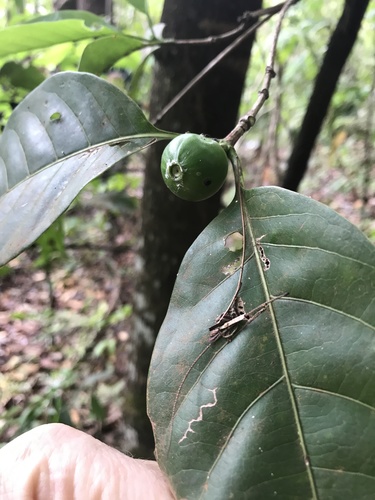
A shrub or small tree. It grows 2-10 m high. The young branches are square in section. There can be wings. The leaf blades are 3-11 cm long by 2-5 cm wide. They are narrowly oval. There are 7-50 flowers in a group. The fruit has a stone and the fruit is 5-7 mm long by 6-8 mm wide. It is black when ripe. The stone is 6 mm long by 4 mm wide.
Edible Uses
The fruit are eaten raw, especially by children, and serve as a famine food.
Traditional Uses
The fruit are eaten raw.
This uses section is brief — help expand it
Distribution
It is a tropical plant. In Ethiopia it grows in the lowlands and middle altitudes.
Where It Grows
Africa, East Africa, Ethiopia, Uganda, Zambia,
Other Information
The fruit are eaten especially by children. They are a famine food.
Synonyms
Also Known As
Gaallee, Gali, Kahelta
References (11)
- Addis, G., Asfaw, Z & Woldu, Z., 2013, Ethnobotany of Wild and Semi-wild Edible Plants of Konso Ethnic Community, South Ethiopia. Ethnobotany Research and Applications. 11:121-141
- Assefa, A. & Abebe, T., 2010, Wild Edible Trees and Shrubs in the Semi-arid Lowlands of Southern Ethiopia. Journal of Science and Development 1 (1) 2010
- East African Herbarium records, 1981,
- Flora Zambesiaca. http://apps.kew.org/efloras
- Fowler, D. G., 2007, Zambian Plants: Their Vernacular Names and Uses. Kew. p 84
Show all 11 references Hide references
- Gemedo-Dalle, T., et al, 2005, Plant Biodiversity and Ethnobotany of Borana Pastoralists in Southern Oromia, Ethiopia. Economic Botany 59(1) pp. 43-65
- Kidane, B., et al, 2014, Ethnobotany of Wild and Semi-wild Edible Fruit Species used by Maale and Ari Ethnic Communities in South Ethiopia. Ethnobotany Research and Applications. Vol. 12, 1546-3465-12-455
- Lulekal, E., et al, 2011, Wild edible plants in Ethiopia: a review on their potential to combat food insecurity. Afrika Focus - Vol. 24, No 2. pp 71-121
- Ocho, D. L., et al, 2012, Assessing the levels of food shortage using the traffic light metaphor by analyzing the gathering and consumption of wild food plants, crop parts and crop residues in Konso, Ethiopia. Journal of Ethnobiology and Ethnomedicine 8:30
- Peters, C. R., O'Brien, E. M., and Drummond, R.B., 1992, Edible Wild plants of Sub-saharan Africa. Kew. p 174
- World Checklist of Useful Plant Species 2020. Royal Botanic Gardens, Kew