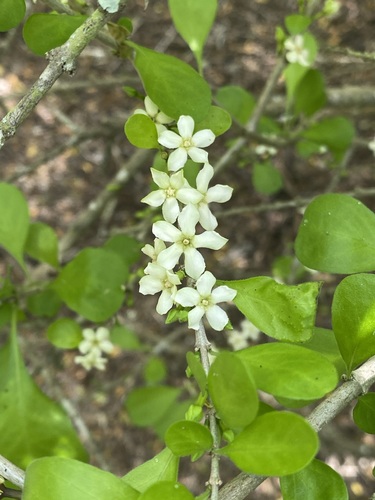
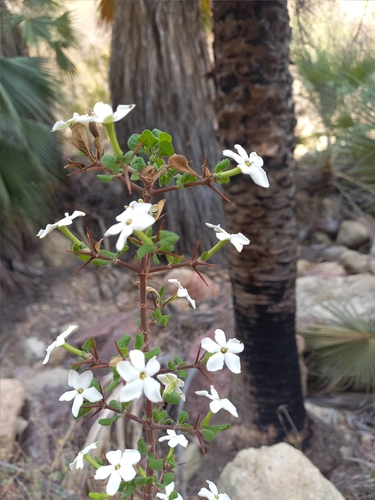
Fadogia homblei
De Willd.
Wild date
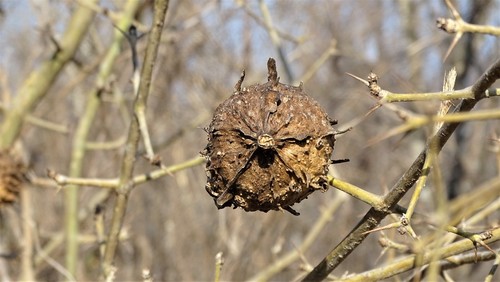
iNaturalist· cc-by-nc
(c) riana60, some rights reserved (CC BY-NC), uploaded by riana60
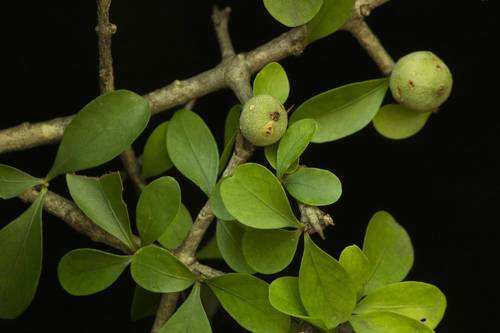
iNaturalist· cc-by-nc
(c) bosmuis, some rights reserved (CC BY-NC)
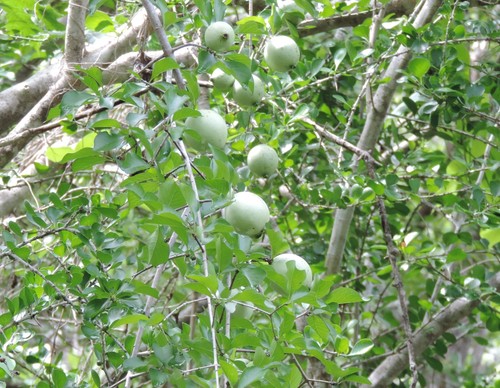
iNaturalist· cc-by-nc-nd
(c) seasav, some rights reserved (CC BY-NC-ND), uploaded by seasav
Summary
Source: WikipediaFadogia homblei is a 60 cm-tall erect perennial sub-Saharan shrublet with subterranean stems producing unbranched annual shoots, and is one of some 47 species of Fadogia in the family Rubiaceae. It occurs in Angola, Tanzania, Malawi, Mozambique, Zambia, Zimbabwe, and in Limpopo and Gauteng Provinces in South Africa. This species has leaves in whorls of 3–5. The leaves are elliptic or lanceolate, shiny above, with greyish-white papillose hairs on the undersurface. Fragrant flowers are in 3-5-flowered whorls arising from the leaf nodes, and are creamy yellow to bright yellow in colour. The fruit is spherical, crowned with the persistent calyx limb, initially green, but turning black when ripe, and is edible. Browsing of this species has long been known to cause 'gousiekte' ("quick disease"), a cardiotoxicosis of ruminants marked by heart failure four to eight weeks after ingestion of certain species of Vangueria, Pavetta, and Fadogia, and is thought to be caused by the polyamine pavettamine. All six plants known to cause gousiekte are members of the family Rubiaceae. Laboratory analysis has revealed that the pavettamine concentration in Fadogia homblei was highest in the topmost leaf pair, and decreased towards the base of the plant. All the gousiekte-causing plants have symbiotic bacteria in their leaves, and at first these were suspected of playing a role in the production of pavettamine. However, cultures of the bacteria have not revealed any traces of pavettamine, showing that the toxin is either from an interaction with the plant or solely produced by the plant. The structure of pavettamine remained elusive, but was finally published in 2010 by Bode et al., some 15 years after it was first isolated, and found to be (2S,4R,8R,10S)-1,11-diamino-6-aza-undecane-2,4,8,10-tetraol. Despite the determination of pavettamine's structure, it has yet to be linked to gousiekte. A large number of compounds were isolated from the fruits, leaves, and stem of the species, including: Scopoletin - anti-fungal, anti-spasmodic, anti-oxidant, anti-inflammatory, and anti-cancer. Luteolin - anti-mutagenic, anti-tumor, anti-oxidant, and anti-inflammatory. Quercetin - 3-O-β-D-galactoside is common in plants and an active ingredient of many herbal remedies, anti-hypertensive, vasodilatory. Lupeol - anti-oxidant, anti-angiogenic, anti-neoplastic, anti-inflammatory, and anti-malarial. Betulinic acid - anti-inflammatory, in vitro anti-malarial, anti-HIV, and anti-cancer. Sitosterol and stigmasterol - common compounds found in almost all plant species. Pinoresinol - inhibitor of 15-lipoxygenase. Uracil - isolated from the leaf of Fadogia homblei, significant as the first finding of uracil from plants other than ferns.
Description
A erect woody shrub. It grows 30-120 cm tall. There are 3-4 stems coming from a slender underground stem or rhizome. The leaves are in rings of 3-5. They are simple and 2-12 cm long by 1-4 cm wide. The flowers are in groups of 2-5. The fruit are black and 6-10 mm long.
Edible Uses
Fruit - raw. A sweet flavour. The small black berries are up to 13mm in diameter and held in clusters on the main stems. The nectar from the flowers is sweet and often sucked by children.
Traditional Uses
The ripe fruit are sweet and eaten fresh. The flower nectar is sucked by children.
This uses section is brief — help expand it
Distribution
It is a tropical plant. It grows in grassland and woodland. It grows between 1,050-1,800 m altitudes.
Where It Grows
Africa, Angola, Central Africa, Congo, East Africa, Eswatini, Malawi, Mozambique, South Africa, Southern Africa, Swaziland, Tanzania, Zambia, Zimbabwe,
Cultivation
It can be grown by seeds or from cuttings of the rootstock.
Propagation
Seed - Root cuttings.
Production
Ripe fruit is collected from October to January.
Other Information
The ripe fruit are especially eaten by children.
Nutrition
| Part | Moisture | kJ | kcal | Protein | Vit A | Vit C | Iron | Zinc |
|---|---|---|---|---|---|---|---|---|
| Fruit | 66.2 | 495 | 118 | 1.4 | — | — | 10 | 0.4 |
Synonyms
Also Known As
Kambolambola, Kindokoli, Ndhlaleni
References (9)
- Fowler, D. G., 2007, Zambian Plants: Their Vernacular Names and Uses. Kew. p 83
- Fox, F. W. & Young, M. E. N., 1982, Food from the Veld. Delta Books. p 319 (As Fadogia monticola)
- INFOODS:FAO/INFOODS Databases (As Fadogia monticola)
- Long, C., 2005, Swaziland's Flora - siSwati names and Uses http://www.sntc.org.sz/flora/
- Ruffo, C. K., Birnie, A. & Tengnas, B., 2002, Edible Wild Plants of Tanzania. RELMA p 320
Show all 9 references Hide references
- Ruiters-Welcome, A. K., 2019, Food plants of southern Africa. Ph.D. thesis. Univ. of Johannesburg p 96
- Wehmeyer, A. S, 1986, Edible Wild Plants of Southern Africa. Data on the Nutrient Contents of over 300 species (As Fadogia monticola)
- Welcome, A. K. & Van Wyk, B.-E., 2019, An inventory and analysis of the food plants of southern Africa. South African Journal of Botany 122 (2019) 136–179
- World Checklist of Useful Plant Species 2020. Royal Botanic Gardens, Kew