Cremaspora triflora
(Thonn. ex Schumach.) K. Schum.
iNaturalist· cc-by-nc
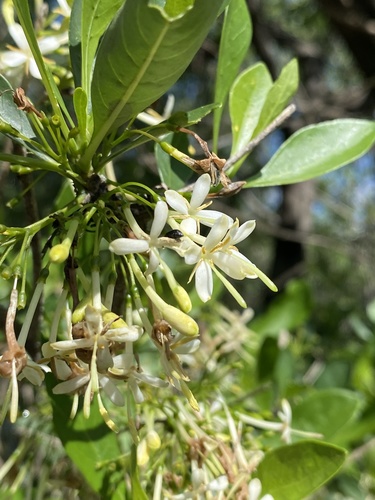
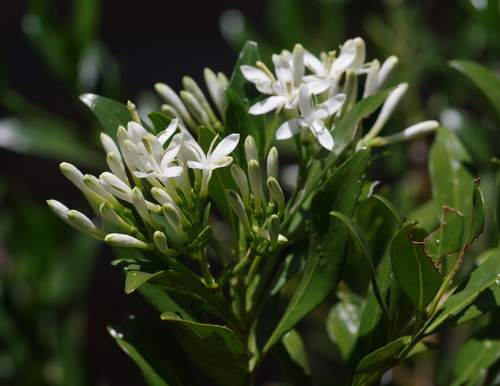
(c) Ehoarn Bidault, some rights reserved (CC BY-NC), uploaded by Ehoarn Bidault
iNaturalist· cc-by-nc
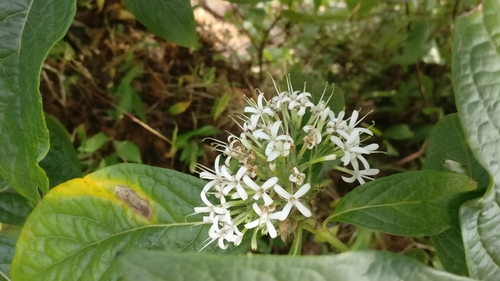
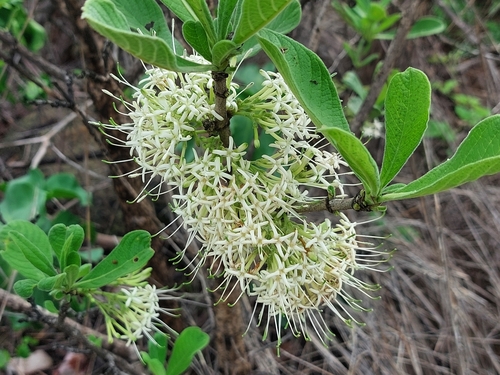
(c) Bart Wursten, some rights reserved (CC BY-NC)
iNaturalist· cc-by-nc
(c) Bart Wursten, some rights reserved (CC BY-NC)
Description
It can be a shrub, woody creeper or small tree. It grows 9 m tall. It usually has many branches. The leaves are simple and entire and opposite. The leaf blade is 2-18 cm long by 1-9 cm wide. It has a rounded base and tapers to the tip. The flowers are in a dense group 2-4 cm wide. The flowers contain both sexes and have a strong sweet smell. The flowers are white or yellow. The fruit is an oval berry 7-15 mm long by 5-7 mm wide. It is red and usually has 2 seeds.
Edible Uses
The ripe fruit are edible and are eaten especially by children.
Traditional Uses
The ripe fruit are edible.
This uses section is brief — help expand it
Medicinal Uses
Used as medicine and as a dye.
Distribution
It is a tropical plant. It grows in evergreen forest from sea level to 2,000 m altitude. It grows in forests, thickets and palm groves. In Zimbabwe it grows between 700-1,800 m above sea level.
Where It Grows
Africa, Angola, Benin, Burkina Faso, Central Africa, Central African Republic, CAR, East Africa, Gabon, Ghana, Guinea, Guinée, Guinea-Bissau, Kenya, Mozambique, Nigeria, Senegal, Sierra Leone, Southern Africa, Sudan, West Africa, Zambia, Zimbabwe,
Other Uses
Both unripe and ripe fruits produce a blue-black dye. It is used in various parts of Africa as a cosmetic to colour the face and body. The crushed seed produces a deep black dye, which is used to dye bark cloth made from Ficus thonningii. It is also used to colour the body and face. The wood is yellowish and hard. It is used in construction as poles and also makes good firewood.
Other Information
The fruit are eaten especially by children.
Notes
There are 3 Cremaspora species. It is used as a dye and medicine.
Synonyms
Also Known As
Landam-edi, Mchesi, Mtsonga nyomba, Mubaba-wanika, Muceki, Sasatcha
References (9)
- Chapman, J. D. & Chapman, H. M., 2001, The Forest Flora of Taraba and Andamawa States, Nigeria. WWF & University of Canterbury. p 197
- Fowler, D. G., 2007, Zambian Plants: Their Vernacular Names and Uses. Kew. p 56
- Glover et al, 1969,
- Jansen, P.C.M., 2005. Cremaspora triflora (Thonn.) K.Schum. [Internet] Record from Protabase. Jansen, P.C.M. & Cardon, D. (Editors). PROTA (Plant Resources of Tropical Africa), Wageningen, Netherlands. < http://database.prota.org/search.htm>. Accessed 15 October 2009.
- Kenya Trees, Shrubs, Lianas, 1994, nzdl.org
Show all 9 references Hide references
- Mutie, F. M., et al, 2023, Important Medicinal and Food Taxa (Orders and Families) in Kenya, Based on Three Quantitative Approaches. Plants 2023, 12, 1145
- Peters, C. R., O'Brien, E. M., and Drummond, R.B., 1992, Edible Wild plants of Sub-saharan Africa. Kew. p 169
- White, F., Dowsett-Lemaire, F. and Chapman, J. D., 2001, Evergreen Forest Flora of Malawi. Kew. p 475
- World Checklist of Useful Plant Species 2020. Royal Botanic Gardens, Kew