Decorsea schlechteri
(Harms) Verdc.
iNaturalist· cc-by-nc
(c) Graeme White, some rights reserved (CC BY-NC), uploaded by Graeme White
iNaturalist· cc0
no rights reserved
Description
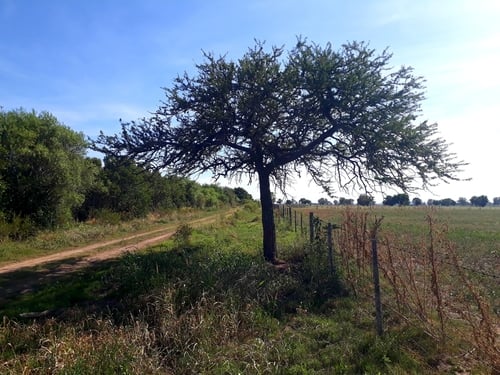
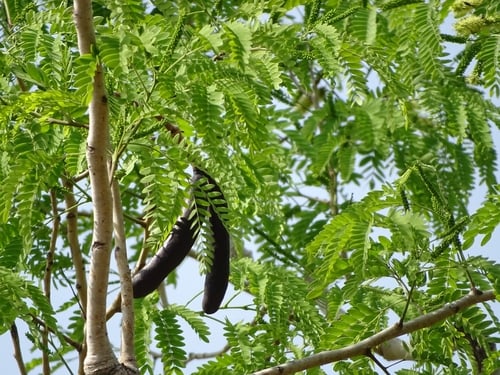
A twining herb. It keeps growing from year to year. It climbs up to 3 m tall. The stems are slender. It grows from a large tuber. The leaves are compound. The leaves have 3 leaflets. They have leaflets along the stalk and one at the end. The leaves are broadly triangle shaped. They are 7.5 cm long by 3.5 cm wide. The flowers appear before the leaves. They are blue or pink. They are like pea flowers. They have a light yellow twisted keel. The fruit is a pod. It is narrow and 8-12 cm long by 5 mm wide. It is curved at the tip. It has a pointed beak.
Edible Uses
Seeds are eaten fresh or boiled. Tubers are washed, peeled, cut into pieces, and boiled or roasted; young tubers are eaten raw.
Traditional Uses
The seeds are eaten fresh or boiled. The tubers are washed and peeled and cut into pieces then boiled or roasted. Young tubers are eaten raw.
This uses section is brief — help expand it
Distribution
It is a tropical plant. It grows on gravel and Kalahari sand. It grows in hot dry woodland. In Zimbabwe it grows up to 1,200 m above sea level. It grows in grass and bush at low and medium altitudes.
Where It Grows
Africa, Botswana, East Africa, Malawi, Mozambique, South Africa, Southern Africa, Tanzania, Zambia, Zimbabwe,
Cultivation
Found in the wild on sandy and loamy soils. This species has a symbiotic relationship with certain soil bacteria; these bacteria form nodules on the roots and fix atmospheric nitrogen. Some of this nitrogen is utilized by the growing plant but some can also be used by other plants growing nearby.
Synonyms
Also Known As
Carume-canhemba, Lisili
References (4)
- Peters, C. R., O'Brien, E. M., and Drummond, R.B., 1992, Edible Wild plants of Sub-saharan Africa. Kew. p 133
- Pickering, H., & Roe, E., 2009, Wild Flowers of the Victoria Falls Area. Helen Pickering, London. p 73
- Tredgold, M.H., 1986, Food Plants of Zimbabwe. Mambo Press. p 9 (As Dolichos schlechteri)
- Wild, 1975,