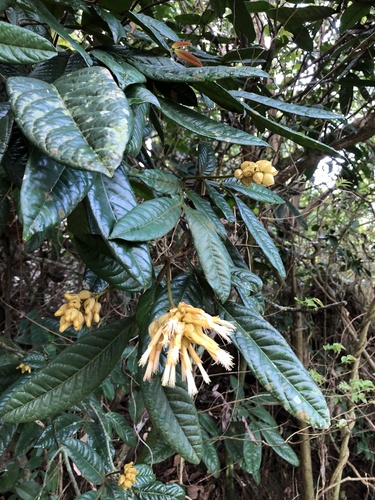
Peltophorum africanum
Sond.
African wattle, Weeping wattle
iNaturalist· cc-by
(c) Wynand Uys, some rights reserved (CC BY), uploaded by Wynand Uys
iNaturalist· cc-by-nc
(c) Sascha Schumann, some rights reserved (CC BY-NC)
iNaturalist· cc-by
(c) Elena_Sherehora, some rights reserved (CC BY)
Summary
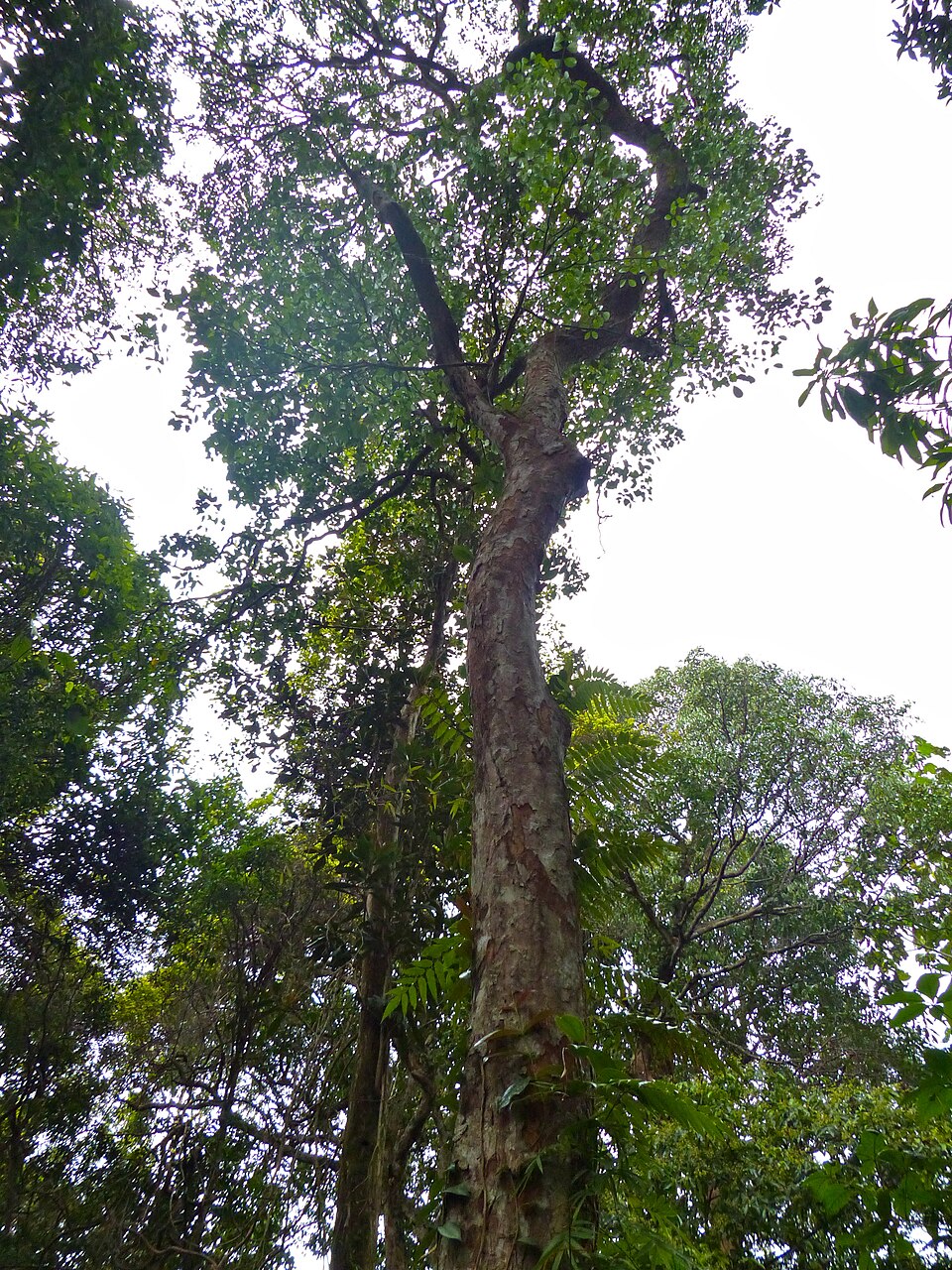
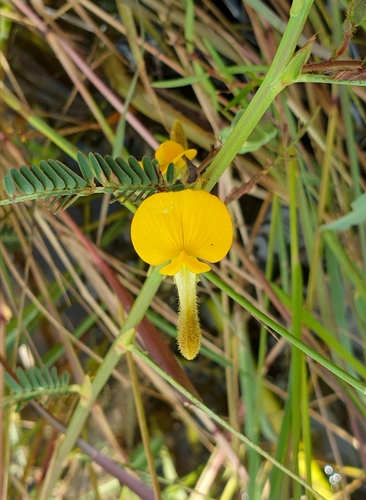
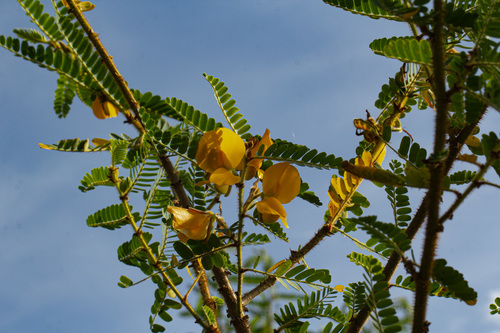
Source: WikipediaPeltophorum africanum, the weeping wattle, is a semi-deciduous to deciduous flowering tree growing to about 15 meters tall. It is native to Africa south of the equator. Their yellow flowers bloom on the ends of branches in upright, showy sprays. During spring time it may happen that water drips from the tree's branches, a phenomenon that is caused by the spittlebug Ptyelus grossus. The immature stages of these spittlebugs congregate on the young shoots and derive their nourishment by sucking the tree's sap. While doing so they secrete pure water, which is the cause of the "weeping" effect.
Description
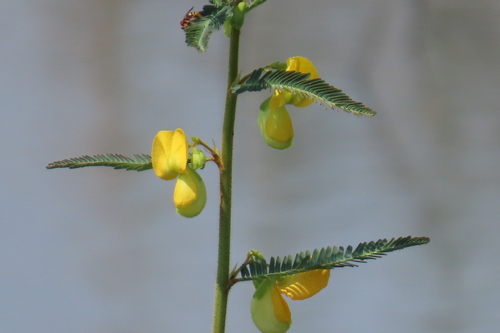
A tree. It grows 10 m tall. It has a rusty brown covering over the plant. It does not have thorns. It loses many leaves during the year. The leaves are twice divided. There are 7 pairs of pinnae about 6 cm long each with 15 pairs of leaflets. These are 8 mm long by 3 mm wide. The flowers are in branching groups at the end of the plant. These are 20 cm long. There are many flowers close together. They are yellow. The fruit are flattened pods that taper to both ends. They are 7 cm long by 2 cm wide. There are about 2 seeds.
Edible Uses
The gum is eaten as a snack, and the leaves are also edible.
Traditional Uses
The gum is eaten as a snack.
This uses section is brief — help expand it
Medicinal Uses
African wattle is commonly used in African traditional medicine, especially the bark and the roots. They are taken internally to treat a range of digestive disorders and as general tonics, whilst externally they are used to treat wounds and sores. Modern research has shown the presence of several medically active compounds. The bark contains bergenin, an isocoumarin. This has been shown to have hepatoprotective activity; anti-arrhythmic effects of the coronary artery; and an inhibitory effect on the growth of the bloodstream form of the parasite Trypanosoma brucei. Both ethanolic and aqueous extracts of the roots and bark have shown inhibition in vitro of the gram-negative bacteria Salmonella typhi, Shigella sonnei, Escherichia coli, Campylobacter jejuni and Aeromonas hydrophila. The ethanol extract of the bark showed strong molluscicidal activity against the snail Biomphalaria alexandrina, a host of schistosomiases (causing bilharzia). An oxidized gallotannin isolated from the stem bark was shown to have strong activity against HIV-1 reverse transcriptase and integrase in an enzyme cell-free system. The bark is anthelmintic, emetic, febrifuge, stomachic, tonic. A decoction, sometimes with the leaves, is used in the treatment of a variety of stomach disorders such as diarrhoea and dysentery; to get rid of intestinal parasites; to treat fevers; to clean the liver and to relieve pain. The fresh bark is chewed to relieve colic and abdominal pain. Steam from a hot bark decoction is applied to sore eyes and, in serious cases, it is dropped into the eyes. Both decoctions and infusions of the root are used in the treatment of nausea and chest pain, and for purifying the blood. An infusion is seen as an effective remedy for heavy, painful kicking of the foetus in pregnant women, but it is only applied if the problem lasts for at least 2 - 3 days. The infusion furthermore stops heavy bleeding on giving birth and is used for treating cough with blood and tuberculosis. A decoction of the root is taken by mouth or gargled to treat sores in the throat. Combined with the roots of Bridelia cathartica and Ochna sp., it is used as a treatment for infertility. The boiled roots are used as an enema to treat backache. The powdered, decorticated root is applied to wounds to hasten healing. The leaves are boiled and the steam directed into the mouth to relieve toothache.
Known Hazards
The gum is reputed to be poisonous.
Distribution
It is a tropical plant. It grows in open woodland and on rocky outcrops and river banks. It is often on sandy soils. It grows from sea level to 1,950 m altitude. It grows in areas with a rainfall of about 100 mm per year. It can tolerate drought. It can grow in arid places. In the Brisbane Botanical gardens.
Where It Grows
Africa, Angola, Australia, Africa, Botswana, Central Africa, Congo, East Africa, Eswatini, India, Kenya, Malawi, Mozambique, Namibia, South Africa, Southern Africa, Sri Lanka, Swaziland, Tanzania, USA, Zambia, Zimbabwe,
Cultivation
Plants can be grown from seeds. Seeds germinate easily.
Propagation
Seed - it has a hard seedcoat and may benefit from scarification before sowing to speed up germination. This can usually be done by pouring a small amount of nearly boiling water on the seeds (being careful not to cook them!) and then soaking them for 12 - 24 hours in warm water. By this time they should have imbibed moisture and swollen - if they have not, then carefully make a nick in the seedcoat (being careful not to damage the embryo) and soak for a further 12 hours before sowing. The seeds take 3 - 10 days to germinate and the germination percentage is usually high. Young plants transplant readily, are fairly fast growing, but need protection from frost for 2 - 3 years although they withstand slight frost. The seed stores well, viability is maintained after 3 years of hermetic storage at room temperature.
Other Uses
A gum is obtained. The bark is crushed in water and then rubbed into the coats of pets to keep away fleas and maggots. The rotten heartwood of dead trees has a pleasant aroma and is used for cosmetic purposes. It is pulverised and the powder simply rubbed onto the body. The heartwood is reddish to dark brown; it is distinctly demarcated from the dirty white to pale brown sapwood. The wood is fine-textured, interlocked-grain, heavy. It works fairly easily, takes a good polish and produces a smooth finish. It is used for carving, turning, making furniture, grinding blocks, wooden buckets, tool handles and wagons. It is not suitable for fence poles or buildings as it is not borer-proof. The wood is widely used as fuel. The dominance of this species in the vegetation is taken as an indication of a high level of arsenic in the soil; indirectly this may indicate the presence of gold. The plant's tolerance to adverse soil conditions makes it a candidate for reclaiming denuded sites such as abandoned mines and mine dumps. An important tree for beekeepers, as it is a good source of nectar and pollen.
Production
Plants grow quickly.
Notes
Also as Caesalpinaceae.
Also Known As
Dzedze, Lisikhabakhombe, Mahabiya, Mashubane, Mezeze, Mosetlha Modija, Mudjiza, Muparara, Mupumhamauva, Musambanyoka, Muzeze, Mwenza, Umkahla, Umsehla, Zeze
References (12)
- Flora Zambesiaca. http://apps.kew.org/efloras
- Grivetti, 1976, 1979,
- Fowler, D. G., 2007, Zambian Plants: Their Vernacular Names and Uses. Kew. p 31
- Grivetti, L. E., 1980, Agricultural development: present and potential role of edible wild plants. Part 2: Sub-Saharan Africa, Report to the Department of State Agency for International Development. p 80
- Peters, C. R., O'Brien, E. M., and Drummond, R.B., 1992, Edible Wild plants of Sub-saharan Africa. Kew. p 123
Show all 12 references Hide references
- Roodt, V., 1998, Trees & Shrubs of the Okavango Delta. Medicinal Uses and Nutritional value. The Shell Field Guide Series: Part 1. Shell Botswana. p 191
- Royal Botanic Gardens, Kew (1999). Survey of Economic Plants for Arid and Semi-Arid Lands (SEPASAL) database. Published on the Internet; http://www.rbgkew.org.uk/ceb/sepasal/internet [Accessed 21st April 2011]
- Ruiters-Welcome, A. K., 2019, Food plants of southern Africa. Ph.D. thesis. Univ. of Johannesburg p 59
- Swaziland's Flora Database http://www.sntc.org.sz/flora
- van Wyk, Ben-Erik, 2019, The diversity and multiple uses of southern African legumes. Australian Systematic Botany, 2019, 32, 519–546
- Welcome, A. K. & Van Wyk, B.-E., 2019, An inventory and analysis of the food plants of southern Africa. South African Journal of Botany 122 (2019) 136–179
- www.zimbabweflora.co.zw 2011