Dichapetalum madagascariense
Poir.
iNaturalist· cc-by-nc
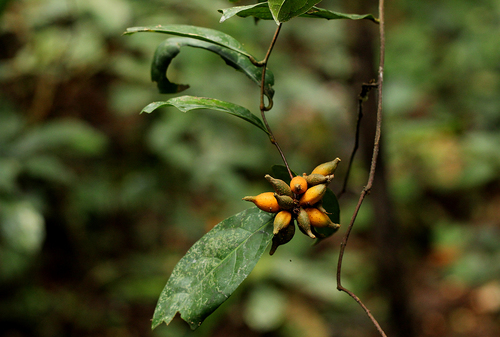
(c) Bart Wursten, some rights reserved (CC BY-NC), uploaded by Bart Wursten
iNaturalist· cc-by-nc
(c) Bart Wursten, some rights reserved (CC BY-NC)
Summary
Source: WikipediaDichapetalum madagascariense is a plant species originally described from Madagascar but now reported from many parts of mainland tropical Africa as well. It is reported from a wide region from Mozambique north to Tanzania and west to Liberia. Dichapetalum madagascariense is a liana climbing over other vegetation.
Description
A shrub or tree. It can grow to 20 m high. The trunk can be 1.7 m around. It can be a woody climber. The fruit are oval and 3-4 cm long.
This description is brief — help expand it
Traditional Uses
Caution: The kernel is poisonous.
This uses section is brief — help expand it
Known Hazards
The kernel is poisonous.
Distribution
It is a tropical plant. It grows in savannah and forest in West Africa. It grows along river banks.
Where It Grows
Africa, Angola, Benin, Central Africa, Central African Republic, CAR, Côte d'Ivoire, Ghana, Guinea, Guinée, Guinea-Bissau, Ivory Coast, Liberia, Madagascar, Nigeria, Sierra Leone, West Africa,
Production
In Central African Republic Plants flower January to May and fruit January to July.
Synonyms
Also Known As
Alo, Akwakiraa gyuhenim, Ekusan, Makpavi, Sumolie
References (7)
- Burkill, H. M., 1985, The useful plants of west tropical Africa, Vol. 1. Kew.
- Codjia, J. T. C., et al, 2003, Diversity and local valorisation of vegetal edible products in Benin. Cahiers Agricultures 12:1-12 (As Dichapetalum guineense)
- Dalziel, J. M., 1937, The Useful plants of west tropical Africa. Crown Agents for the Colonies London.
- Le Houerou, H. N., (Ed.), 1980, Browse in Africa. The current state of knowledge. International Livestock Centre for Africa, Ethiopia. p 162
- liberianfaunaflora.org Plant Atlas
Show all 7 references Hide references
- Peters, C. R., O'Brien, E. M., and Drummond, R.B., 1992, Edible Wild plants of Sub-saharan Africa. Kew. p 104
- World Checklist of Useful Plant Species 2020. Royal Botanic Gardens, Kew