Mukia maderaspatana
(L.) M. Roem.
Madras pea pumpkin, Chirati, Rough bryony
iNaturalist· cc-by-nc
(c) JODY HSIEH, some rights reserved (CC BY-NC)
iNaturalist· cc-by-nc
(c) JODY HSIEH, some rights reserved (CC BY-NC)
iNaturalist· cc-by-nc-sa
(c) harshithjv, some rights reserved (CC BY-NC-SA)
Description
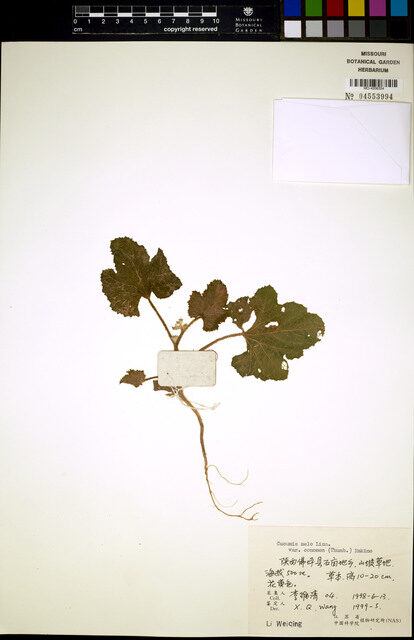
A herb. It is a pumpkin family plant. It keeps growing from year to year. It can be climbing or have the stems trail along the ground. They are 3 m long. They have bristly hairs. The tendrils and thin and simple. The leaves are spear shaped or almost triangle shaped. They can have lobed and teeth. They are 2-9 cm long and 5 mm wide. The fruit are berries. They are in groups of 1-7 on short stalks. They are clustered in the axils of the leaves. They are red. The plant varies a lot. Probably now Cucumis maderaspatana.
Edible Uses
The ripe fruit are eaten, and the leaves and seeds are used in curries.
Traditional Uses
The ripe fruit are eaten. The leaves and seeds are used in curries.
This uses section is brief — help expand it
Distribution
It is a tropical plant. It grows in forest and along rivers. It is often on sandy soils. It grows in savannah grassland. It grows between 300-1,250 m above sea level. In the Indian Himalayas it grows between 1,300-2,100 m above sea level. In Yunnan.
Where It Grows
Africa, Asia, Australia, Bangladesh, Botswana, Cambodia, China, Côte d'Ivoire, East Africa, Eswatini, Gambia, Guinea, Guinée, Guinea-Bissau, Himalayas, India, Indochina, Ivory Coast, Laos, Malawi, Malaysia, Mozambique, Myanmar, Nepal, Niger, Nigeria, Northeastern India, Pakistan, Papua New Guinea, PNG, Philippines, Sahel, SE Asia, Senegal, Sierra Leone, South Africa, Southern Africa, Sri Lanka, Swaziland, Taiwan, Togo, Vietnam, West Africa, Zambia, Zimbabwe,
Other Information
The fruit are eaten especially by children.
Notes
There are about 4 Mukia species.
Synonyms
Also Known As
Agumaki, Bilari, Bristly bryony, Cauqua nham, Chirati, Choti kakdi, Galgughri, Ghugri, Goi gawasi, Guliya-kakri, Gwala kakri, Heen kekeri, Hurya kakdi, Ilayam, Killari, Kooturubudama, Madras sea pumpkin, Math ghughri, Mosu mosu keerai, Mukkalpeeram, Mukkapeera, Musumusukkai, Noogudosa, Pahari kakharu, Telakucha
References (31)
- Ambasta, S.P. (Ed.), 2000, The Useful Plants of India. CSIR India. p 364 (As Melothria maderaspatana)
- A. DC., Monog. phan. 3:623. 1881 (As Melothria maderaspatana)
- Arinathan, V., et al, 2007, Wild edibles used by Palliyars of the western Ghats, Tamil Nadu. Indian Journal of Traditional Knowledge. 6(1) pp 163-168 (As Mukia maderaspatana)
- Das, S. and Mohiuddin, M., 2012, Gender role in Home Garden Management in the Indigenous Community: A case study in Bandarban Hill District, Bangladesh. International Journal of Social Forestry. 5(1):22-37 (As Coccinia cordifolia)
- Flora of Pakistan. www.eFloras.org (As Mukia maderaspatana)
Show all 31 references Hide references
- Fowler, D. G., 2007, Zambian Plants: Their Vernacular Names and Uses. Kew. p 23 (As Mukia maderaspatana)
- Garcia, G. S. C., 2006, The mother-child nexus. Knowledge and valuation of wild food plants in Wayanad, Western Ghats, India. Journal of Ethnobiology and Ethnomedicine, 2:39 (As Mukia maderaspatana)
- Hossain, U. & Rahman, A., 2018, Study and quantitative analysis of wild vegetable floral diversity available in Barisal district, Bangladesh. Asian J. Med. Biol. Res. 2018, 4 (4), 362-371 (As Coccinia cordifolia)
- Karthi, Sathya, & Salome, 2014, Uncultivated Edible Greens from Small Millet Farms Tamil Nadu India. IDRC
- Kuhnlein, H. V., et al, 2009, Indigenous Peoples' food systems. FAO Rome p 193 (As Coccinia cordifolia)
- Kuvar, S. D. & Shinde, R. D., 2019, Wild Edible Plants used by Kokni Tribe of Nasik District, Maharashtra. Journal of Global Biosciences. Volume 8, Number 2, 2019, pp. 5936-5945 (As Mukia maderaspatana)
- Lee, 1979, (As Mukia maderaspatana)
- Melzer, R. & Plumb, J., 2011, Plants of Capricornia. Belgamba, Rockhampton. p 362 (As Mukia maderaspatana)
- Misra S. & Misra M., 2016, Ethnobotanical and Nutritional Evaluation of Some Edible Fruit Plants of Southern Odisha, India. International Journal of Advances in Agricultural Science and Technology, Vol.3 Issue.1, March- 2016, pg. 1-30 (As Mukia maderaspatana)
- Narayanan Ratheesh, M. K. et al, 2011, Wild edible plants used by the Kattunaikka, Paniya and Kuruma tribes of Wayanad District, Kerala, India. Journal of Medicinal Plants Research Vol. 5(15), pp. 3520-3529 (As Mukia maderaspatana)
- Peters, C. R., O'Brien, E. M., and Drummond, R.B., 1992, Edible Wild plants of Sub-saharan Africa. Kew. p 103 (As Mukia maderaspatana)
- Prachi, K., et al, 2012, Underutilized wild fruits of North Maharashtra. Journal of Research in Plant Sciences. (2012) 1:071-076 (As Mukia maderaspatana)
- Pullaiah, Y., Krishnamurthy, K. V. & Bahadur, B. (Ed.), 2016, Ethnobotany of India, Volume 1: Eastern Ghats and Deccan. (As Mukia maderaspatana)
- Radha, B., et al, 2013, Wild Edible Plant Resources of the Lohba Range of Kedarnath Forest Division (KFD), Garhwal Himalaya, India. Int. Res J. Biological Sci. Vol. 2 (11), 65-73 (As Mukia maderaspatana)
- Rajasab, A. H. et al, 2004, Documentation of folk knowledge on edible wild plants of North Karnataka. Indian Journal of Traditional Knowledge. Vol 3(4) pp 419-429 (As Mukia maderaspatana)
- Royal Botanic Gardens, Kew (1999). Survey of Economic Plants for Arid and Semi-Arid Lands (SEPASAL) database. Published on the Internet; http://www.rbgkew.org.uk/ceb/sepasal/internet [Accessed 16th April 2011] (As Mukia maderaspatana)
- Ruiters-Welcome, A. K., 2019, Food plants of southern Africa. Ph.D. thesis. Univ. of Johannesburg p 49 (As Mukia maderaspatana)
- Sen, R., et al, 1985, Ethnobotanical Uses of Herbaria - 4 J. Econ. Tax. Bot. Vol 6. No.2 pp 331-335 (As Melothria maderaspatana and as Mukia scabrella)
- Sharma, B.D., & Lakshminarasimhan, P., 1986, Ethnobotanical Studies on the Tribals of Nasik District (Maharashtra). J. Econ. Tax. Bot. Vol. 8 No. 2 pp 439-446 (As Mukia maderaspatana)
- Singh, V. B., et al, (Ed.) Horticulture for Sustainable Income and Environmental Protection. Vol. 1 p 217 (As Melothria maderaspatana)
- Sp. pl. 2:1012. 1753 (As Cucumis maderaspatanus)
- Swaziland's Flora Database http://www.sntc.org.sz/flora (As Mukia maderaspatana)
- von Katja Rembold, 2011, Conservation status of the vascular plants in East African rain forests. Dissertation Universitat Koblenz-Landau p 174 (As Mukia maderaspatana)
- Welcome, A. K. & Van Wyk, B.-E., 2019, An inventory and analysis of the food plants of southern Africa. South African Journal of Botany 122 (2019) 136–179 (As Cucumis maderaspatanus)
- Wild edible plants of Himachal Pradesh (As Coccinia cordifolia)
- World Checklist of Useful Plant Species 2020. Royal Botanic Gardens, Kew