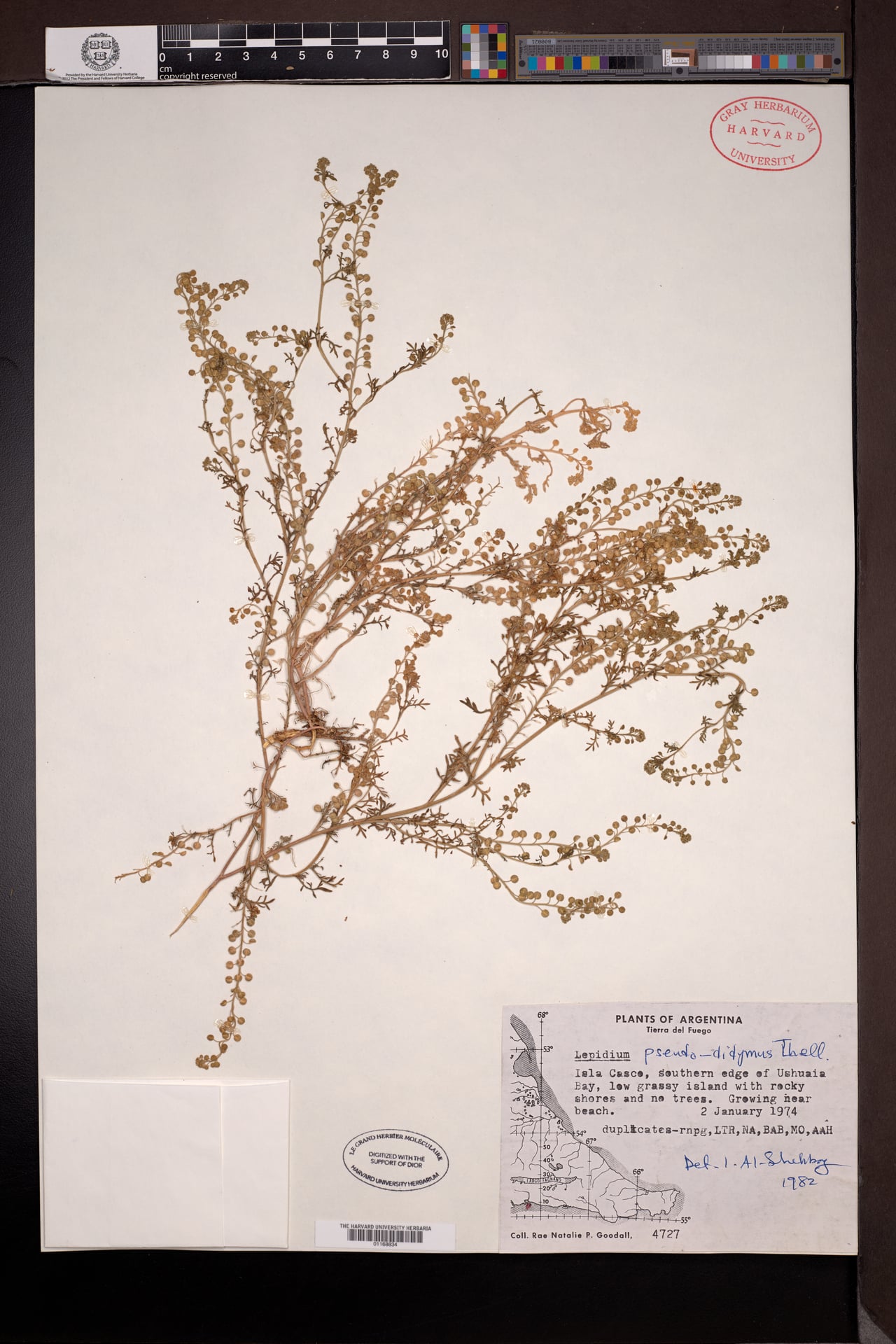
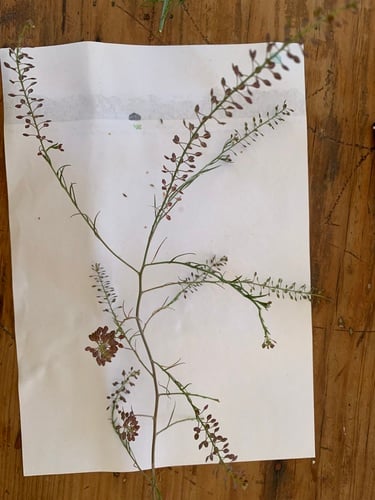
Erucastrum arabicum
Fisch. & C. A. Mey
Ethiopian kale
iNaturalist· cc-by-nc
(c) Riana Fourie, some rights reserved (CC BY-NC), uploaded by Riana Fourie
iNaturalist· cc-by-nc
(c) Riana Fourie, some rights reserved (CC BY-NC), uploaded by Riana Fourie
iNaturalist· cc-by-nc
(c) Riana Fourie, some rights reserved (CC BY-NC), uploaded by Riana Fourie
Description
An annual creeping herb. It lies along the ground. It grows each year from seeds. It grows 1 m high. The leaves are in a ring and are grey-green. They are slightly hairy. The leaves are divided and 18 cm long by 5 cm wide. The large lobe at the end is rounded. The flowers are yellow. They are on long slender shoots. The fruit is a long slender capsule. It can be 5 cm long. The seeds are brown.
Edible Uses
The young leaves and stalks are cooked; roots are removed and the remaining leaves and stalks are boiled for an hour. The leaves are used in soups.
Traditional Uses
The young leaves and stalks are eaten after cooking. The roots are removed and the leaves and stalks boiled for an hour. It can cause the skin to become dry and also produce sleepiness. The leaves are used in soups.
Medicinal Uses
Traditional use reports that consumption can cause the skin to become dry and produce sleepiness.
Known Hazards
In Ethiopia it is believed by some that eating this plant can have side effects such as drowsiness and drying of the skin.
Distribution
It is a tropical plant. In Ethiopia it grows in the highlands. In Kenya it grows from sea level to 2,500 m altitude. It grows in areas with an annual rainfall between 1,100-1,900 mm. It can grow in arid places.
Where It Grows
Africa, Arabia, Asia, Botswana, Burundi, Central Africa, Congo DR, Djibouti, East Africa, Egypt, Ethiopia, India, Kenya, Middle East, Namibia, North Africa, Oman, Rwanda, Saudi Arabia, Somalia, Southern Africa, South Sudan, Sudan, Tanzania, Uganda, United Arab Emirates, UAE, Yemen, Zimbabwe,
Cultivation
An introduced weed in cultivated land in many parts of the world.
Other Uses
The seed contains around 35% oil. It is possibly used for lighting purposes.
Production
Young leaves can be harvested at regular intervals.
Other Information
A famine food. It is of local importance in times of famine.
Notes
The seeds contain about 35% oil.
Nutrition
| Part | Moisture | kJ | kcal | Protein | Vit A | Vit C | Iron | Zinc |
|---|---|---|---|---|---|---|---|---|
| Leaves | 84 | 200 | 4 | — | 500 | 120 | 1.5 | 0.6 |
Synonyms
Also Known As
Cheplemindet, Enyaro, Eshaaga, Eshaga, Gomanza, Itogotia, Moyowarwa, Nechelo, Njunge, Nonion, Oburobwenaku, Shimpa, Togotia, Yewof-gomen
References (22)
- Agea, J. G., et al 2011, Wild and Semi-wild Food Plants of Bunyoro-Kitara Kingdom of Uganda: etc. Environmental Research Journal 5(2) 74-86
- Asfaw, Z., Conservation and use of traditional vegetables in Ethiopia. FAO
- Asfaw, Z. and Tadesse, M., 2001, Prospects for Sustainable Use and Development of Wild Food Plants in Ethiopia. Economic Botany, Vol. 55, No. 1, pp. 47-62
- East African Herbarium records, 1981,
- Ethiopia: Famine Food Field Guide. http://www.africa.upenn.edu/faminefood/category1.htm
Show all 22 references Hide references
- Glover et al, 1966b,
- Godfrey, J. et al, 2013, Harvesting, preparationand preservation of commonly consumed wild and semi-wild food plants in Bunyoro-Kitara Kingdom, Uganda. Int. J. Med. Arom. Plants. Vol.3 No.2 pp 262-282
- Goode, P., 1989, Edible Plants of Uganda. FAO p 54
- Grubben, G. J. H. and Denton, O. A. (eds), 2004, Plant Resources of Tropical Africa 2. Vegetables. PROTA, Wageningen, Netherlands. p 297
- Jardin, C., 1970, List of Foods Used In Africa, FAO Nutrition Information Document Series No 2.p 61 (As Brassica schimperi)
- Journal of Food Composition and Analysis, 2004, 277-289
- Lulekal, E., et al, 2011, Wild edible plants in Ethiopia: a review on their potential to combat food insecurity. Afrika Focus - Vol. 24, No 2. pp 71-121
- Martin, F.W. & Ruberte, R.M., 1979, Edible Leaves of the Tropics. Antillian College Press, Mayaguez, Puerto Rico. p 187 (As Brassica schimperi)
- Maundu, P. et al, 1999, Traditional Food Plants of Kenya. National Museum of Kenya. 288p
- Musinguzi, E., et al, 2006, Utilization of Indigenous Food Plants in Uganda: A Case Study of South-Western Uganda. AJFAND Vol. 6(2):
- Mutie, F. M., et al, 2023, Important Medicinal and Food Taxa (Orders and Families) in Kenya, Based on Three Quantitative Approaches. Plants 2023, 12, 1145
- Ngugi, G., 2000, Case Study from Kenya on Indigenous Wild Vegetables. Paper 4 Workshop in Kenya 1999. p 35
- Peters, C. R., O'Brien, E. M., and Drummond, R.B., 1992, Edible Wild plants of Sub-saharan Africa. Kew. p 97
- Royal Botanic Gardens, Kew (1999). Survey of Economic Plants for Arid and Semi-Arid Lands (SEPASAL) database. Published on the Internet; http://www.rbgkew.org.uk/ceb/sepasal/internet [Accessed 15th April 2011]
- Terashima, H., et al, 1991, Ethnobotany of the Lega in the tropical rainforest of eastern Zaire: part 1, Zone de Mwenga. African Study Monographs. Suppl. 15:1-61
- Terra, G.J.A., 1973, Tropical Vegetables. Communication 54e Royal Tropical Institute, Amsterdam, p 31 (As Brassica schimperi)
- World Checklist of Useful Plant Species 2020. Royal Botanic Gardens, Kew