Combretum collinum
Fresen.
Weeping bushwillow, Variable bushwillow
iNaturalist· cc-by-nc
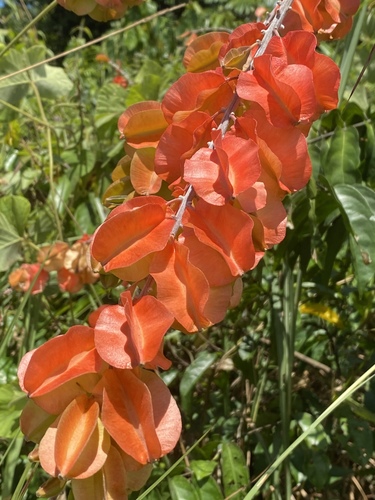
(c) Dewald du Plessis, some rights reserved (CC BY-NC)
iNaturalist· cc-by-nc-sa
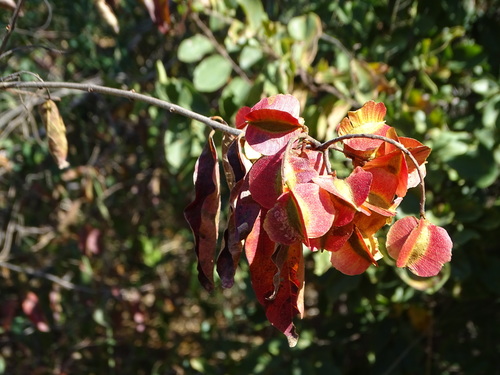
(c) Günter Baumann, some rights reserved (CC BY-NC-SA)
iNaturalist· cc-by-nc
(c) Troos van der Merwe, some rights reserved (CC BY-NC), uploaded by Troos van der Merwe
Description
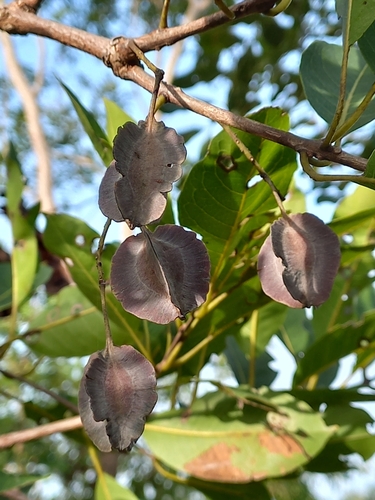
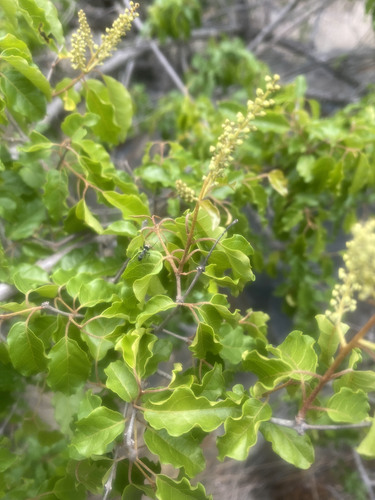
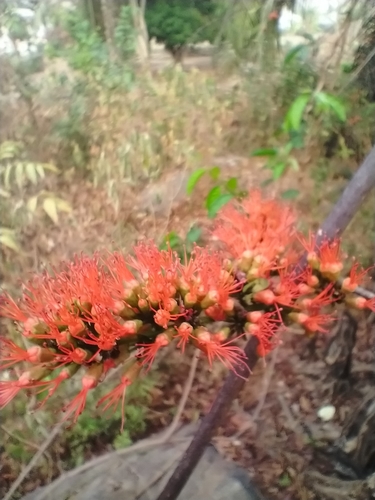
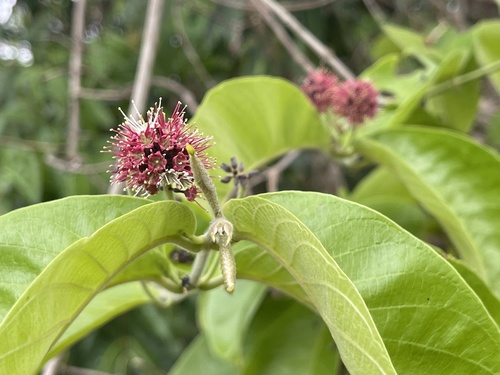
A small tree. It grows 8-10 m tall. It loses many leaves during the year. The crown can be rounded or flat. The bark is reddish brown or pale brown. The leaves can be opposite or alternate. The leaf blade is 20 cm long by 8 cm wide. It varies in shape. There are 6-14 pairs of side veins. The flower clusters are 10 cm long and usually in the axils on the current year's growth. The flowers are yellow. The fruit are brown to purple and 3-5 cm long by 3-5 cm wide. They vary in shape. There are several subspecies.
Edible Uses
Gum is edible.
Traditional Uses
Africa, Angola, Benin, Botswana, Burkina Faso, Cameroon, Central Africa, Congo, Côte d'Ivoire, East Africa, Eswatini, Ethiopia, Gabon, Gambia, Ghana, Guinea-Bissau, Ivory Coast, Kenya, Malawi, Mali, Mozambique, Namibia, Niger, Nigeria, Rwanda, Sahel, Senegal, South Africa, Southern Africa, Sudan, Swaziland, Tanzania, Uganda, West Africa, Zambia, Zimbabwe,
Medicinal Uses
The bark yields a gum, loosely called taramniya in N Nigeria. It is used to cure toothache or to plug a carious tooth. The leaves are used as a purgative. The roots are boiled and the decoction drunk warm as a treatment for dysentery and snakebites.
Distribution
It is a tropical plant. In Namibia it grows in deep sand. It grows in wooded savanna. It grows from sea level to 1,500 m above sea level. It grows in areas with an annual rainfall of 200 mm and above. It grows in sandy and rocky soils. It can tolerate drought. It can grow in arid places.
Where It Grows
Savannah. Open woodlands; forest margins; deciduous thickets; and Kalahari and Lake Basin chipya woodland; occasional on anthills, in miombo woodlands; and in dry, evergreen forests; at low to medium elevations.
Cultivation
A slow-growing tree. The tree responds well to coppicing, lopping and pollarding.
Propagation
Seed - The seed of most, if not all, species can be stored inside the fruit for several years without losing viability.
Other Uses
The bark yields a gum, loosely called taramniya in N Nigeria. The heartwood is light brown; it is not clearly demarcated from the whitish-brown sapwood. The wood has an interlocked grain and a course texture; it is fairly hard, not very durable. It is used for wagon building, canoes and tool handles. The branches can be cut and used to construct fences. The wood is used for fuel and makes a very good charcoal. The living tree is tolerant of grass fires and so is suitable for planting as a savannah firebreak.
Production
The gum is used in medicine.
Synonyms
Also Known As
Aitopongo, Chinabado, Ekuloin, Imbondvo, Kiguifouan, Lemhlophe, Mubutu, Mucubunda, Mufitikaranje, Mufuka, Muhwezha, Munondwe, Muramba, Muruka, Umkhosikazi, Umukoyokoyo
References (17)
- Achigan-Dako, E, et al (Eds), 2009, Catalogue of Traditional Vegetables in Benin. International Foundation for Science.
- Bonou, A., et al, 2013, Valeur economique des Produits Forestiers Non Ligneux (PFNL) au Benin. Editions Universitaires Europeennes p 89
- Dansi, A., et al, 2008, Traditional leafy vegetables and their use in the Benin Republic. Genet Resour Crop Evol (2008) 55:1239–1256
- Flora Zambesiaca. http://apps.kew.org/efloras
- Fowler, D. G., 2007, Zambian Plants: Their Vernacular Names and Uses. Kew. p 19
Show all 17 references Hide references
- Fox, F. W. & Young, M. E. N., 1982, Food from the Veld. Delta Books. p 157
- Leger, S., 1997, A Description of Today's Use of Plants in West Bushmanland (Namibia). German Development Service. PO Box 220035, 14061 Berlin, Germany. http://www.sigridleger.de/book/
- Long, C., 2005, Swaziland's Flora - siSwati names and Uses http://www.sntc.org.sz/flora/
- Maguire, 1978,
- Mannheimer, C. A. & Curtis. B.A. (eds), 2009, Le Roux and Muller's Field Guide to the Trees and Shrubs of Namibia. Windhoek: Macmillan Education Namibia. p 354
- Peters, C. R., O'Brien, E. M., and Drummond, R.B., 1992, Edible Wild plants of Sub-saharan Africa. Kew. p 85
- Roodt, V., 1998, Trees & Shrubs of the Okavango Delta. Medicinal Uses and Nutritional value. The Shell Field Guide Series: Part 1. Shell Botswana. p 194
- Royal Botanic Gardens, Kew (1999). Survey of Economic Plants for Arid and Semi-Arid Lands (SEPASAL) database. Published on the Internet; http://www.rbgkew.org.uk/ceb/sepasal/internet [Accessed 10th April 2011]
- Ruiters-Welcome, A. K., 2019, Food plants of southern Africa. Ph.D. thesis. Univ. of Johannesburg p 44
- Welcome, A. K. & Van Wyk, B.-E., 2019, An inventory and analysis of the food plants of southern Africa. South African Journal of Botany 122 (2019) 136–179
- World Checklist of Useful Plant Species 2020. Royal Botanic Gardens, Kew
- www.zimbabweflora.co.zw 2011