Salacia leptoclada
Tul.
Sand lemon rope
iNaturalist· cc-by-nc
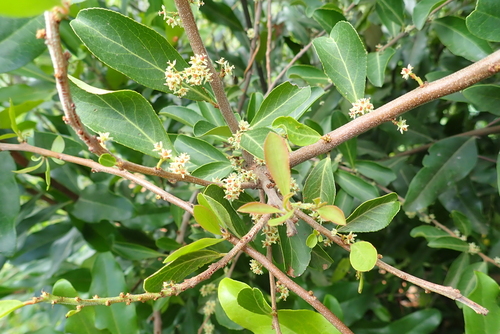
(c) Francois du Randt, some rights reserved (CC BY-NC), uploaded by Francois du Randt
iNaturalist· cc-by-nc
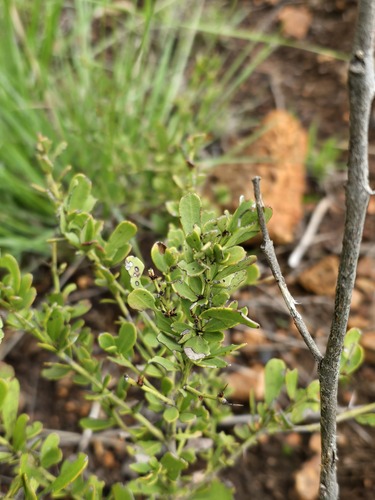
(c) magdastlucia, some rights reserved (CC BY-NC)
iNaturalist· cc-by-nc
(c) magdastlucia, some rights reserved (CC BY-NC)
Description
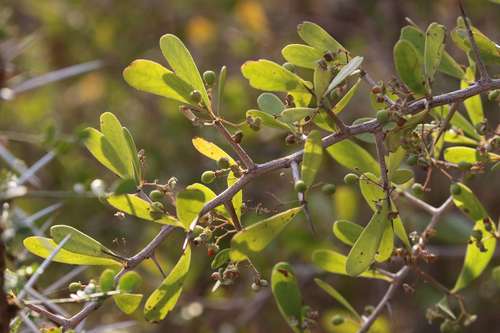
A creeper or liane. Although often only 4 m long it can grow 25 m long. The stem often has 2 raised lines. The leaves are opposite or alternate on climbing shoots. The fruit has a sweet edible pulp. The leaf is dark green but more pale underneath. They are 5-10 cm long by 3-4 cm wide. They are narrowly sword shaped and taper to the tip. The flowers are in groups of 1-5 in the axils of leaves. They are 5-7 mm across and contain both sexes. The sepals are green with red edges and the petals are yellowish. The fruit are orange to red. They are round and 1-2 cm across. There are 1-3 seeds.
Edible Uses
The ripe orange to red round fruits, measuring 1-2 cm across, have a sweet edible pulp and are eaten as a snack, particularly enjoyed by children.
Traditional Uses
The ripe fruit are eaten as a snack.
This uses section is brief — help expand it
Distribution
It is a tropical plant. It grows in coastal regions in West Africa. It grows between 200-915 m above sea level. It grows in the lowlands. In Tanzania it grows between 100-2,200 m above sea level.
Where It Grows
Africa, Comoros, Côte d'Ivoire, East Africa, Eswatini, Ghana, Ivory Coast, Kenya, Madagascar, Mozambique, South Africa, Southern Africa, Swaziland, Tanzania, Togo, West Africa, Zimbabwe,
Cultivation
Plants can be grown from seeds.
Production
Fruit are collected during the rainy season.
Other Information
The fruit are attractive. The fruit are etaen especially by children.
Notes
It has anti-inflammatory properties.
Synonyms
Also Known As
Mbungo mkavu
References (9)
- Burkill, H. M., 1985, The useful plants of west tropical Africa, Vol. 1. Kew.
- Cunningham, 1985,
- Grivetti, L. E., 1980, Agricultural development: present and potential role of edible wild plants. Part 2: Sub-Saharan Africa, Report to the Department of State Agency for International Development. p 48
- JSTOR Global Plants edible
- Mpasiwakomu, R. A., 2017, The Diversity and Utilization of Wild Edible and Medicinal Plant Species found in Uvinza Miombo Woodlands, Tanzania. M. Sc. thesis University of Tanzania.
Show all 9 references Hide references
- Peters, C. R., O'Brien, E. M., and Drummond, R.B., 1992, Edible Wild plants of Sub-saharan Africa. Kew. p 81
- Ruffo, C. K., Birnie, A. & Tengnas, B., 2002, Edible Wild Plants of Tanzania. RELMA p 582
- Swaziland's Flora Database http://www.sntc.org.sz/flora
- World Checklist of Useful Plant Species 2020. Royal Botanic Gardens, Kew