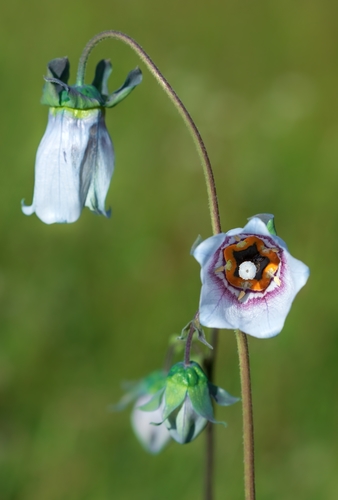
Cyphia glandulifera
Hochst.
iNaturalist· cc-by-nc
(c) GiraffeCentre, some rights reserved (CC BY-NC), uploaded by GiraffeCentre
iNaturalist· cc-by-nc
(c) Abigail Church, some rights reserved (CC BY-NC)
gbif· cc-by-sa
Jaka Razinger
Description
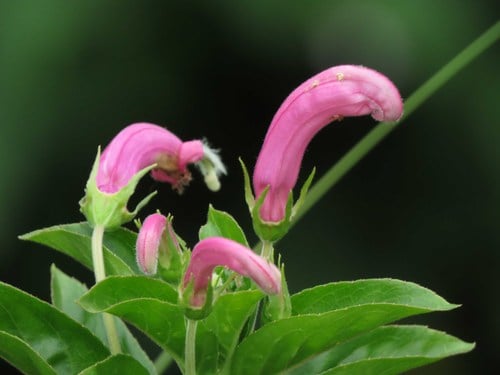
A herb. It usually has a single stem. It grows 25-40 cm high. The stem is purplish-green. It has a white scaly tuber. It is 5 cm across and is 6-12 cm below the surface. The leaves are in a ring around the stem just above the ground. They are almost round and 10 cm long. They have irregular teeth. The flowers are pink and have 5 petals.
Edible Uses
The leaves are used as a vegetable, and the tubers are peeled, cooked, and eaten. The shoots are also edible.
Traditional Uses
The leaves are used as a vegetable. The tubers are peeled and cooked and eaten.
This uses section is brief — help expand it
Distribution
It is a tropical plant. In Kenya it grows between 1,000-2,000 m altitude.
Where It Grows
Africa, East Africa, Ethiopia, Kenya, Somalia, Tanzania,
Cultivation
Plants can be grown by tubers or seeds.
Also Known As
Ikurjij, Kurte, Namsulubiani, Ngomo
References (10)
- Asfaw, Z. and Tadesse, M., 2001, Prospects for Sustainable Use and Development of Wild Food Plants in Ethiopia. Economic Botany, Vol. 55, No. 1, pp. 47-62
- Demise, S. & Asfaw, Z., 2020, Ethno Botanical Study of Wild Edible Plants in Adola District, Southern, Ethiopia. International Journal of Research and Analytical Reviews (IJRAR) 7(2).
- Grubben, G. J. H. and Denton, O. A. (eds), 2004, Plant Resources of Tropical Africa 2. Vegetables. PROTA, Wageningen, Netherlands. p 561
- Ichikawa, M., 1980, The Utilization of Wild Food Plants by the Suiei Dorobo in Northern Kenya. J. Anthrop. Soc. Nippon. 88(1): 25-48
- Johns, T., Mhoro, E. B. and Sanaya, P., 1996, Food Plants and Masticants of the Batemi of Ngorongoro District, Tanzania. Economic Botany, Vol. 50, No. 1, pp. 115-121
Show all 10 references Hide references
- Maundu, P. et al, 1999, Traditional Food Plants of Kenya. National Museum of Kenya. 288p
- Mutie, F. G., 2020, Conservation of Wild Food Plants and Their Potential for Combatting Food Insecurity in Kenya as Exemplified by the Drylands of Kitui County. Plants 2020, 9, 1017
- Mutie, F. M., et al, 2023, Important Medicinal and Food Taxa (Orders and Families) in Kenya, Based on Three Quantitative Approaches. Plants 2023, 12, 1145
- Peters, C. R., O'Brien, E. M., and Drummond, R.B., 1992, Edible Wild plants of Sub-saharan Africa. Kew. p 74
- World Checklist of Useful Plant Species 2020. Royal Botanic Gardens, Kew