Schizoglossum atropurpureum
E. Mey.
Red milkwort
iNaturalist· cc-by-nc
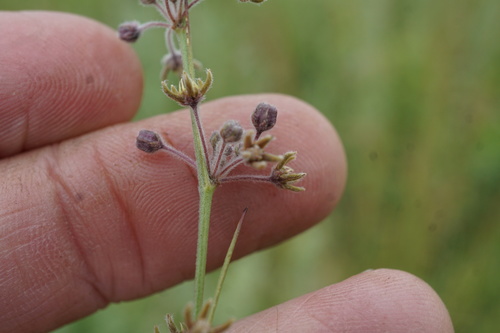
(c) Ansell Matcher, some rights reserved (CC BY-NC), uploaded by Ansell Matcher
iNaturalist· cc-by-nc
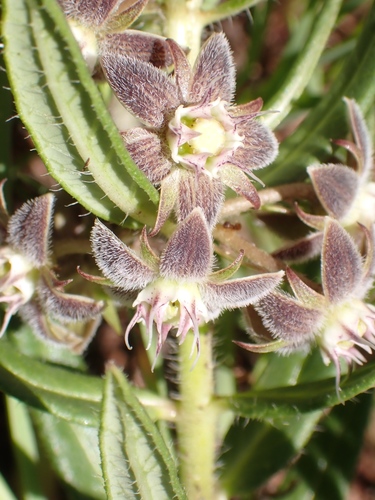
(c) Kathy, some rights reserved (CC BY-NC), uploaded by Kathy
iNaturalist· cc-by
(c) Alan Manson, some rights reserved (CC BY), uploaded by Alan Manson
Description
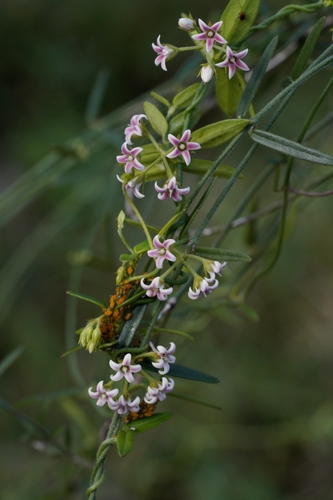
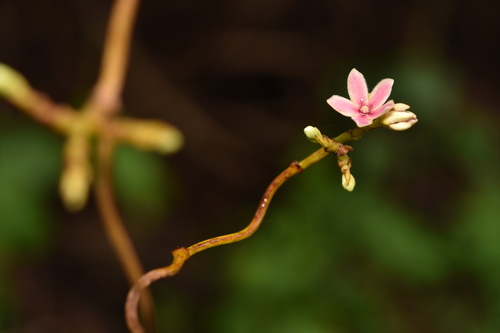
A tall herb. It keeps growing from year to year from a tuberous rootstock. It has few branches. The stems are slender and have white down. The leaves are simple and opposite. They are broad at the base and taper to a blunt point. The flowers occur in several groups at the top of the plant. The flowers are small and 5 mm long and dark purple. The fruit is a narrow follicle. The seeds are flat with tufts of hairs at the end.
Edible Uses
The tuberous roots are peeled and eaten raw.
Traditional Uses
The roots are peeled and eaten raw.
This uses section is brief — help expand it
Distribution
It is a subtropical plant.
Where It Grows
Africa, Eswatini, Lesotho, South Africa, Southern Africa, Swaziland,
Notes
Also put in the family Asclepiadaceae.
Synonyms
Also Known As
Ishongwe, Sehoete-moru
References (7)
- Fox, F. W. & Young, M. E. N., 1982, Food from the Veld. Delta Books. p 115
- Guillarmod, J., 1971,
- Long, C., 2005, Swaziland's Flora - siSwati names and Uses http://www.sntc.org.sz/flora/
- Peters, C. R., O'Brien, E. M., and Drummond, R.B., 1992, Edible Wild plants of Sub-saharan Africa. Kew. p 66
- Ruiters-Welcome, A. K., 2019, Food plants of southern Africa. Ph.D. thesis. Univ. of Johannesburg p 27
Show all 7 references Hide references
- Welcome, A. K. & Van Wyk, B.-E., 2019, An inventory and analysis of the food plants of southern Africa. South African Journal of Botany 122 (2019) 136–179
- Wehmeyer, A. S, 1986, Edible Wild Plants of Southern Africa. Data on the Nutrient Contents of over 300 species. (As Cynanchum atropurpureum)