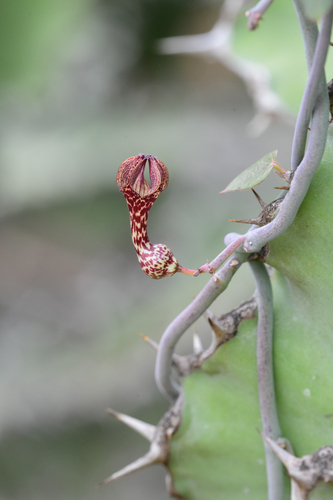
Orthanthera jasminiflora
(Decne.) Schinz
Jasmine creeper
iNaturalist· cc-by-nc
(c) Pieter, some rights reserved (CC BY-NC), uploaded by Pieter
iNaturalist· cc-by-nc
(c) juddkirkel, some rights reserved (CC BY-NC)
Description
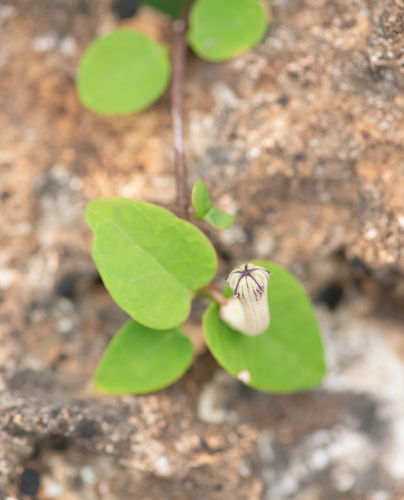
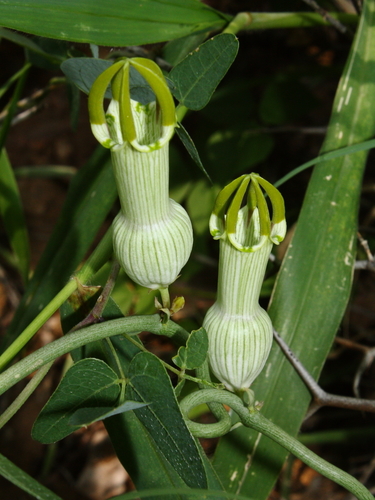
A herb that lies along the ground. It spreads 3-10 m wide. It has a taproot. The leaves are opposite and sword shaped. The flowers are in groups. There are 2-10 flowers in a group. They are cream or pale yellow and have 5 petals. The flowers have a strong scent. The fruit are a pair of follicles. They are spindle shaped and 10 cm long by 12 mm wide. They taper to a long beak.
Edible Uses
Young pods are eaten raw; mature fruit is a staple food eaten boiled, baked, or as a vegetable with a meat-like texture. Leaves and seeds are edible. Crushed roots are used to make beer.
Traditional Uses
The young pod is eaten raw. The fruit is used as a staple food. They are also boiled and baked. They are treated as a vegetable. It is eaten as a meat-like substance. The crushed roots are used to make beer.
Distribution
It is a tropical plant. It grows in sandy places. It grows in well-drained soils. It grows in dry savannah. In Southern Africa it grows between 800-1,500 m altitude. It is often along roadsides in the Kalahari. It can grow in arid places.
Where It Grows
Africa, Angola, Botswana, Central Africa, Congo, East Africa, Namibia, South Africa, Southern Africa, Zambia, Zimbabwe,
Cultivation
The cream-coloured flowers are strongly scented.
Other Information
It is a minor vegetable of local importance.
Notes
There are 5 Orthanthera species. It has also been put in the Asclepiadaceae family.
Synonyms
Also Known As
Ekoka, Kamungambe, Matangan, Moerwortel, N-lai, Sandmelktou, Shamukamba
References (11)
- Fox, F. W. & Young, M. E. N., 1982, Food from the Veld. Delta Books. p 110
- Grubben, G. J. H. and Denton, O. A. (eds), 2004, Plant Resources of Tropical Africa 2. Vegetables. PROTA, Wageningen, Netherlands. p 405
- Peters, C. R., O'Brien, E. M., and Drummond, R.B., 1992, Edible Wild plants of Sub-saharan Africa. Kew. p 65
- Pickering, H., & Roe, E., 2009, Wild Flowers of the Victoria Falls Area. Helen Pickering, London. p 28
- Rodin, 1985,
Show all 11 references Hide references
- Royal Botanic Gardens, Kew (1999). Survey of Economic Plants for Arid and Semi-Arid Lands (SEPASAL) database. Published on the Internet; http://www.rbgkew.org.uk/ceb/sepasal/internet [Accessed 4th April 2011]
- Ruiters-Welcome, A. K., 2019, Food plants of southern Africa. Ph.D. thesis. Univ. of Johannesburg p 26
- van Wyk, Be., & Gericke, N., 2007, People's plants. A Guide to Useful Plants of Southern Africa. Briza. p 72
- van Wyk, B-E., 2011, The potential of South African plants in the development of new food and beverage products. South African Journal of Botany 77 (2011) 857–868
- Welcome, A. K. & Van Wyk, B.-E., 2019, An inventory and analysis of the food plants of southern Africa. South African Journal of Botany 122 (2019) 136–179
- World Checklist of Useful Plant Species 2020. Royal Botanic Gardens, Kew