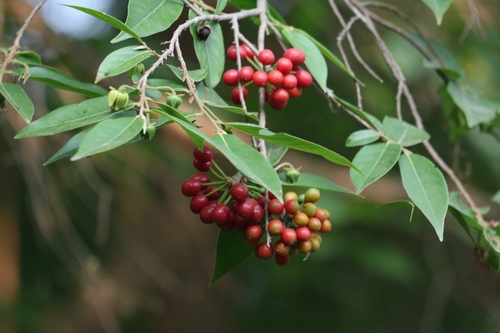
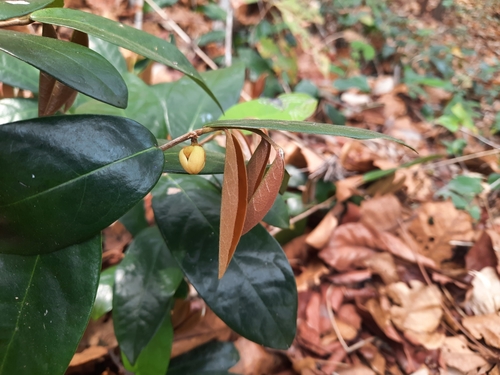
Uvaria acuminata
Oliv.
No photos yet for Uvaria acuminata
Sign in to contribute a photoDescription
A shrub or climber. It can grow 5 m high. The leaves are usually hairy underneath. The leaves are rounded or heart shaped at the base. It narrows to the tip. The flowers are yellow. They occur singly or in pairs. The fruit are as several warted sections. They are yellow when ripe.
Edible Uses
Fruit - raw. The pulp of ripe fruits is sweet and is eaten by sucking it out and discarding the seeds. A refreshing juice is prepared by squeezing ripe fruits in water and adding some sugar, then it is filtered and drunk before or after being cooled. The yellow or orange, round to ovoid fruits are 8 - 16mm in diameter. They are produced in clusters of 5 - 15 fruits.
Traditional Uses
The ripe fruit are eaten raw. The seeds are discarded. The fruit are squeezed into water to make a drink.
This uses section is brief — help expand it
Medicinal Uses
The roots are boiled and the decoction is used for the treatment of dysentery, snakebite, painful menstruation, stomach-ache and breast disorders.
Distribution
A tropical plant. In Kenya it grows from sea level to 1,400 m altitude.
Where It Grows
Africa, East Africa, Ethiopia, Kenya, Madagascar, Mozambique, Tanzania,
Cultivation
Plants can be grown from seeds.
Other Uses
The wood is used for withies, bows, tool handles and walking sticks. The wood is used for fuel.
Production
In Tanzania the fruit are collected from July to September.
Notes
There are about 100-150 Uvaria species. They grow in the tropics. All Uvaria are climbers.
Also Known As
Kadzala-doe, Mchofuo, Mshofu, Mudzala, Murori, Qormera, Tomur
References (12)
- Addis, G., Asfaw, Z & Woldu, Z., 2013, Ethnobotany of Wild and Semi-wild Edible Plants of Konso Ethnic Community, South Ethiopia. Ethnobotany Research and Applications. 11:121-141
- Herb., E. A., 1981,
- Glover et al, 1969,
- Maundu, P. et al, 1999, Traditional Food Plants of Kenya. National Museum of Kenya. 288p
- Msuya, T. S., et al, 2010, Availability, Preference and Consumption of Indigenous Foods in the Eastern Arc Mountains, Tanzania, Ecology of Food and Nutrition, 49:3, 208-227
Show all 12 references Hide references
- Mutie, F. G., 2020, Conservation of Wild Food Plants and Their Potential for Combatting Food Insecurity in Kenya as Exemplified by the Drylands of Kitui County. Plants 2020, 9, 1017
- Mutie, F. M., et al, 2023, Important Medicinal and Food Taxa (Orders and Families) in Kenya, Based on Three Quantitative Approaches. Plants 2023, 12, 1145
- Pakia, M., 2000, Plant Ecology and Ethnobotany of two sacred forests (Kayas) at the Kenya Coast. M. Sc. Thesis.
- Peters, C. R., O'Brien, E. M., and Drummond, R.B., 1992, Edible Wild plants of Sub-saharan Africa. Kew. p 55
- Reis, S. V. and Lipp, F. L., 1982, New Plant Sources for Drugs and Foods from the New York Botanical Garden herbarium. Harvard. p 72
- Ruffo, C. K., Birnie, A. & Tengnas, B., 2002, Edible Wild Plants of Tanzania. RELMA p 696
- Walsh, M., 2009, The Use of Wild and Cultivated Plants as famine Foods on Pemba Island, Zanzibar. Études océan Indien. 42-43