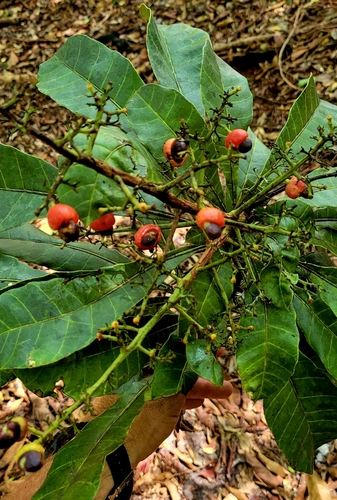
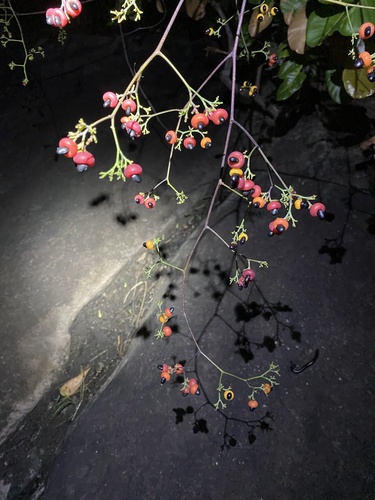
Searsia transvaalensis
(Engl.) Moffett
Transvaal currant
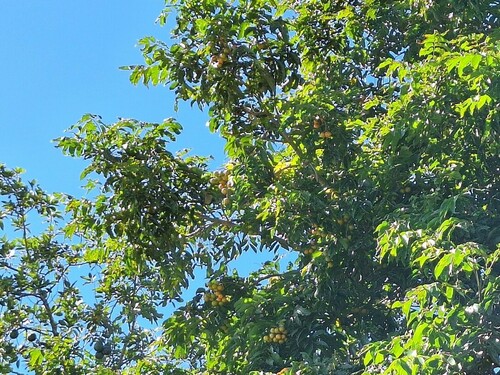
iNaturalist· cc-by-nc
(c) Troos van der Merwe, some rights reserved (CC BY-NC), uploaded by Troos van der Merwe
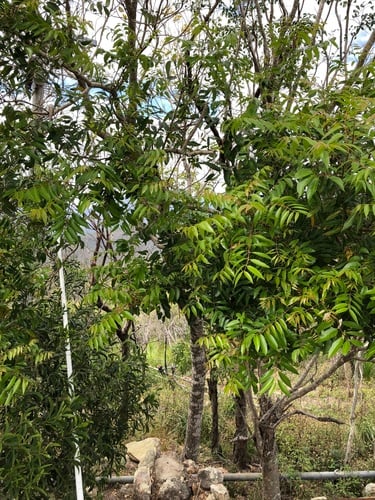
iNaturalist· cc-by-nc
(c) Troos van der Merwe, some rights reserved (CC BY-NC), uploaded by Troos van der Merwe
iNaturalist· cc-by-nc
(c) Troos van der Merwe, some rights reserved (CC BY-NC), uploaded by Troos van der Merwe
Description
A shrub. It grows 2 m tall. The leaflets are small and narrow. The leaflets are 4 cm long by 1 cm wide and taper to both ends. The fruit are fleshy, yellow and 5 mm across.
Edible Uses
The fruit are eaten raw as a snack.
Traditional Uses
The fruit are eaten raw as a snack.
This uses section is brief — help expand it
Distribution
It is a subtropical plant.
Where It Grows
Africa, Eswatini, South Africa, Southern Africa, Swaziland,
Synonyms
Rhus eburnea SchonlandRhus transvaalensis Engl.
References (7)
- Long, C., 2005, Swaziland's Flora - siSwati names and Uses http://www.sntc.org.sz/flora/ (As Rhus transvaalensis)
- Moffett, R. O., 2007, Name changes in the Old World Rhus and recognition of Searsia (Anacardiaceae). Bothalia 37,2: 165-175 (2007)
- Ogle & Grivetti, 1985, (As Rhus transvaalensis)
- Peters, C. R., O'Brien, E. M., and Drummond, R.B., 1992, Edible Wild plants of Sub-saharan Africa. Kew. p 52 (As Rhus transvaalensis)
- Ruiters-Welcome, A. K., 2019, Food plants of southern Africa. Ph.D. thesis. Univ. of Johannesburg p 17
Show all 7 references Hide references
- Swaziland's Flora Database http://www.sntc.org.sz/flora (As Rhus transvaalensis)
- Welcome, A. K. & Van Wyk, B.-E., 2019, An inventory and analysis of the food plants of southern Africa. South African Journal of Botany 122 (2019) 136–179