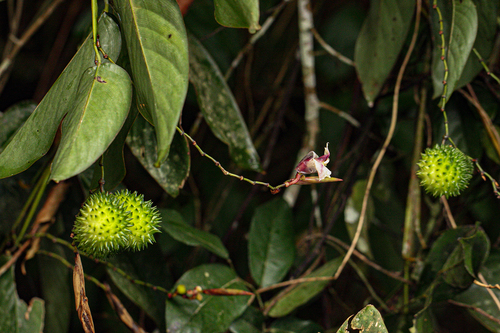
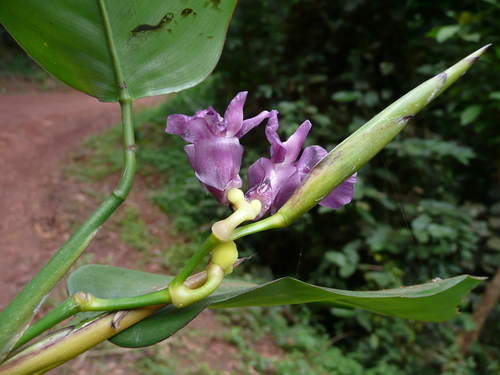
Megaphrynium macrostachyum
(K. Schum.) Milne-Redh.
Yoruba soft cane
iNaturalist· cc-by-nc
(c) Carel Jongkind, some rights reserved (CC BY-NC), uploaded by Carel Jongkind
iNaturalist· cc-by-nc
(c) Carel Jongkind, some rights reserved (CC BY-NC)
Summary
Source: WikipediaMegaphrynium macrostachyum is a species of large plant in the Marantaceae family native to tropical Africa. It grows in moist places and regenerates rapidly after ground disturbance or fire. The long stems have various uses in making cord, baskets and mats, and the large leaves are used for wrapping food, for making utensils and containers, and in herbal medicine.
Description
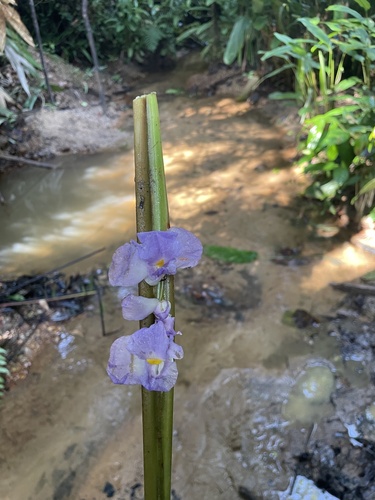
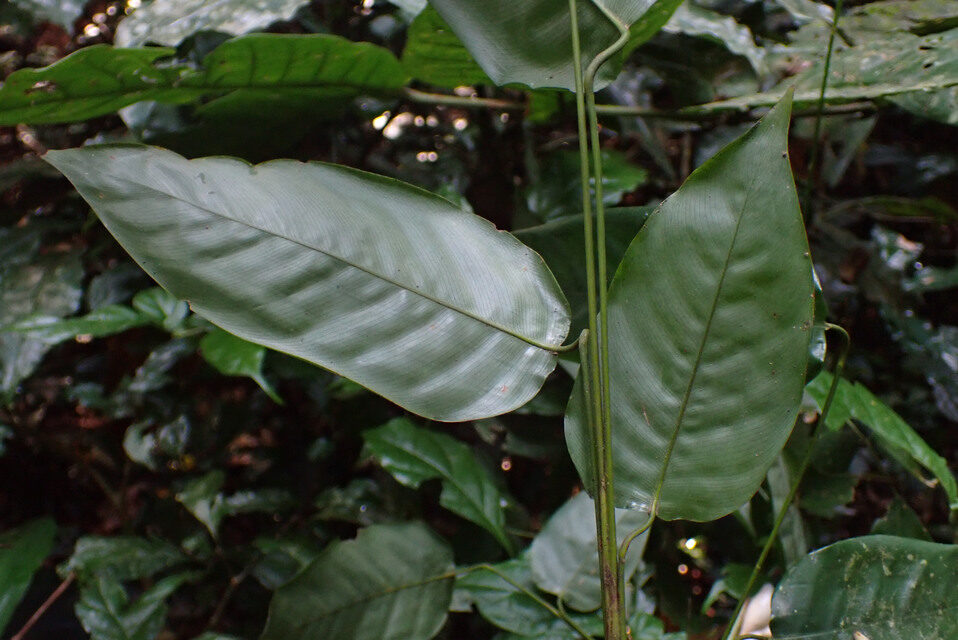
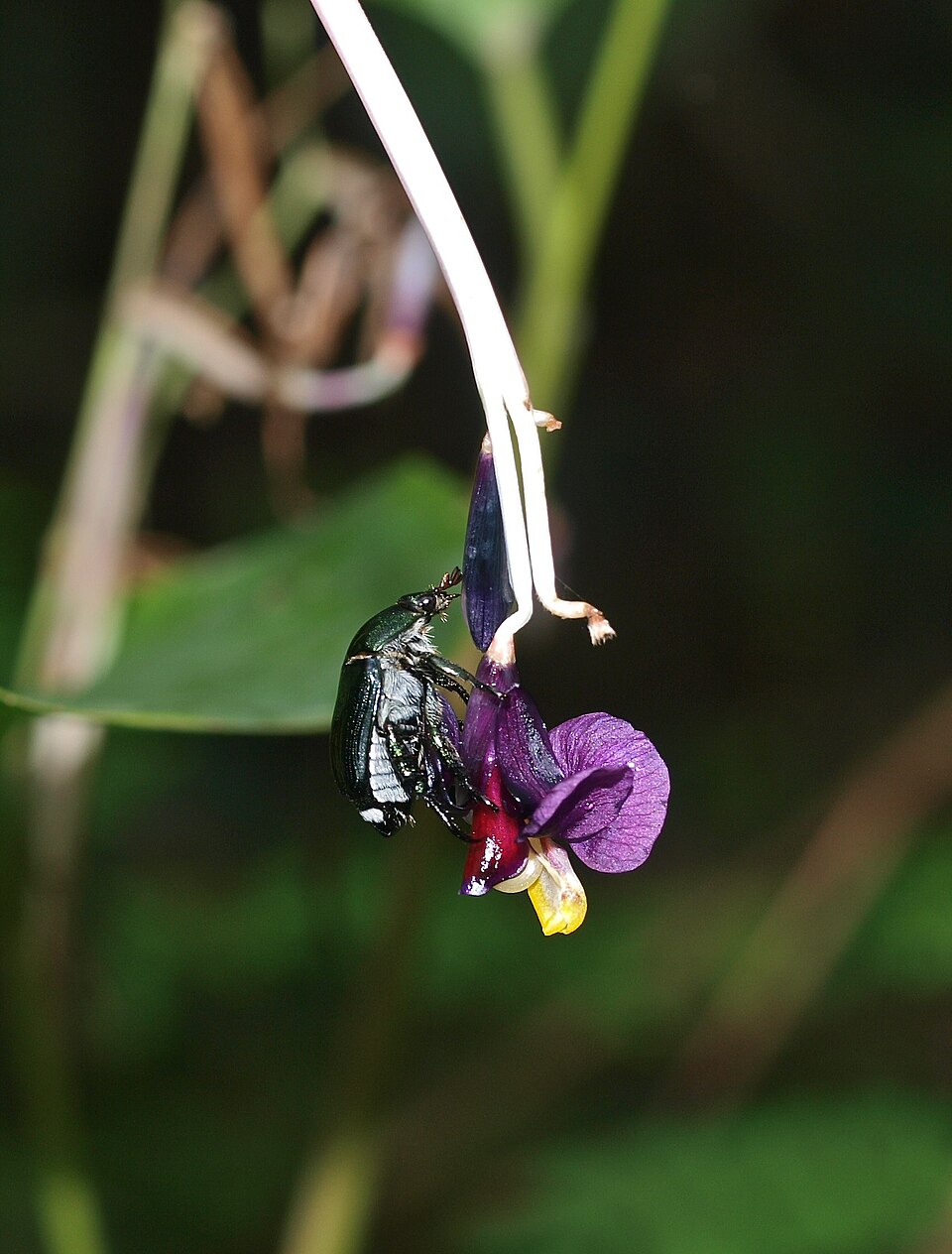
A semi-woody herb. It keeps growing from year to year. It forms clumps with stems 2-4 m high. There is one large leaf 30-60 cm long by 12-30 cm wide. The flowers are on the leaf stalk below the leaf. The flowers are white with purple. The fruit are round and red. The pulp is white. The seed is black.
Edible Uses
The young leaf button is cooked as a vegetable. The fruit pulp is eaten raw. The seeds are roasted and eaten.
Traditional Uses
The young leaf button is cooked as a vegetable. The fruit pulp is eaten raw. The seeds are roasted and eaten. The stem fibres are burnt as a salt.
This uses section is brief — help expand it
Medicinal Uses
The leaves of Megaphrynium macrostachyum are used to wrap food while it is cooking, imparting a characteristic aroma to the food. For example, it is the preferred wrapping for a staple dish of central Africa, chikwangue (cassava bread). The young leaves can be cooked and eaten as a vegetable and older leaves are used to make disposable table-wear, containers, funnels, pots, fans and parasols. The petioles, either whole or split, are used to make cord, baskets and mats. The leaves are also used in herbal medicine as a sedative and to treat epilepsy and mental problems, another use being as an antidote to snake venom and arthropod stings.
Distribution
It is a tropical plant. It grows in wet places in the forest in West Africa.
Where It Grows
Africa, Cameroon, Central Africa, Central African Republic, CAR, Congo DR, Congo R, Côte d'Ivoire, East Africa, Gabon, Ghana, Ivory Coast, Liberia, Sierra Leone, Uganda, West Africa,
Synonyms
Also Known As
Angule, Bakongo, Bale, Bindiondi, Bobokwe, Dingungu, Gilipi, Ilipi, Iungu, Kangkuruma, Kongo, Likongo, Likongo beye, Mangungu, Meye, Ngilipi, Ngongo, Oheye, Okongoto, Ungoli
References (14)
- Billong Fils, P. E., et al, 2020, Ethnobotanical survey of wild edible plants used by Baka people in southeastern Cameroon. Journal or Ethnobiology and Ethnomedicine. 16:64 p 9
- Burkill, H. M., 1985, The useful plants of west tropical Africa, Vol. 4. Kew.
- Grubben, G. J. H. and Denton, O. A. (eds), 2004, Plant Resources of Tropical Africa 2. Vegetables. PROTA, Wageningen, Netherlands. p 563
- Latham, P., 2004, Useful Plants of Bas-Congo province. Salvation Army & DFID p 183
- Liengola, I. B., 2001, A contribution to the study of native edible plants by the Turumbu and Lokele of the Tshopo District, Province Orientale, D. R. Congo. Syst. Geogr. Pl. 71:687-698
Show all 14 references Hide references
- Moutsambote, J., 1996, Vegetation forestiere et plantes alimentaires de la region de la Sangha. Chp. 11 of Bien Manger et Bien Vivre. ORSTOM p 119
- Nkeoua, G. & Boundzanga, G. C., 1999, Donnees sur les produits forestieres non ligneux en Republique du Congo. FAO. p 31
- Terashima, H., et al, 1992, Ethnobotany of the Lega in the Tropical Rainforest of Eastern Zaire (Congo): Part Two, Zone de Walikale, African Study Monographs, Suppl. 19:1-60
- Terashima, H., & Ichikawa, M., 2003, A comparative ethnobotany of the Mbuti and Efe hunter-gatherers in the Ituri Forest, Democratic Republic of Congo. African Study Monographs, 24 (1, 2): 1-168, March 2003
- Termote,C., Dheda Djailo, B., Everaert, G., Haesaert, S., Van Damme, P., 2007, Use and Socio-Economic Value of Wild Edible Plants by the Turumbu, TshopoDistrict, DRCongo
- Termote, C., et al, 2011, Eating from the wild: Turumbu, Mbole and Bali traditional knowledge of non-cultivated edible plants, District Tshopo, DRCongo, Gen Resourc Crop Evol. 58:585-618
- Terashima, H., et al, 1991, Ethnobotany of the Lega in the tropical rainforest of eastern Zaire: part 1, Zone de Mwenga. African Study Monographs. Suppl. 15:1-61
- von Katja Rembold, 2011, Conservation status of the vascular plants in East African rain forests. Dissertation Universitat Koblenz-Landau p 172
- World Checklist of Useful Plant Species 2020. Royal Botanic Gardens, Kew