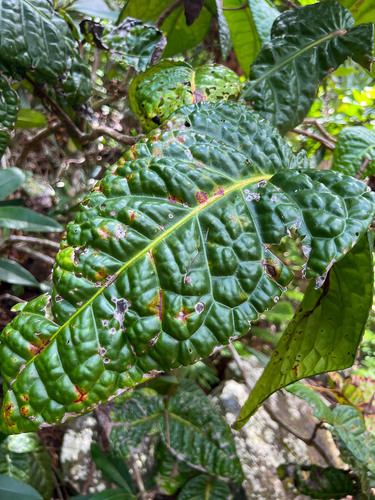
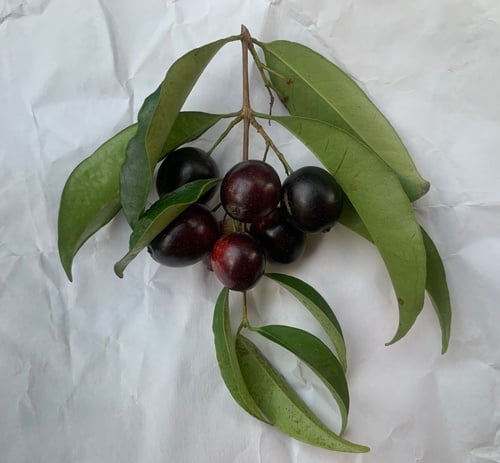
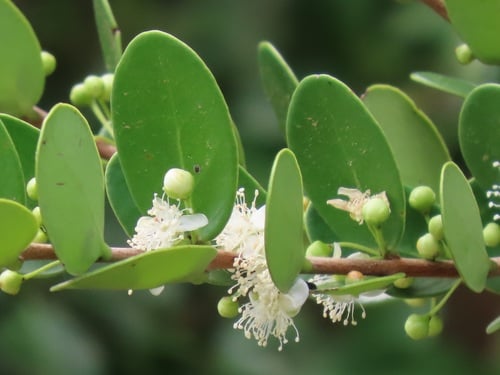
Metrosideros robusta
A. Cunn.
Northern rata
iNaturalist· cc-by-nc
(c) cbeem, some rights reserved (CC BY-NC), uploaded by cbeem
iNaturalist· cc-by
(c) Tim Park, some rights reserved (CC BY)
iNaturalist· cc-by
(c) Tim Park, some rights reserved (CC BY)
Summary
Source: WikipediaMetrosideros robusta, commonly known as the northern rātā, is a forest tree endemic to New Zealand. It grows up to 25 metres (82 ft) or taller, and usually begins its life as a hemiepiphyte high in the branches of a mature forest tree; over centuries the young tree sends descending and girdling roots down and around the trunk of its host, eventually forming a massive, frequently hollow pseudotrunk composed of fused roots. In disturbed ground, or where there are gaps in the forest cover, northern rātā will grow on the ground with a normal but short trunk.
Description
An evergreen tree reaching 6 m tall by 15 m wide, hardy to UK zone 9 but frost-tender. It remains evergreen and flowers in August. Bee-pollinated hermaphrodite flowers attract wildlife. The tree grows well in light, medium, or heavy well-drained soils across pH ranges, requires full sun, prefers moist soil, and tolerates maritime exposure.
Edible Uses
An edible nectar is obtained from the flowers.
Medicinal Uses
None known.
Distribution
It is a temperate plant.
Where It Grows
New Zealand*,
Cultivation
Prefers a well-drained but moisture-retentive lime-free soil in a sunny position. Plants are somewhat lime-tolerant but are unsuitable for shallow soils over chalk. Very resistant to maritime exposure. This species is not very hardy in Britain, succeeding outdoors only in the mildest areas of the country where it makes a small shrub. A very ornamental plant. Plants in this genus are notably resistant to honey fungus.
Propagation
Sow seed in spring in a warm greenhouse, barely covering it. Prick seedlings into individual pots once large enough to handle and grow on under glass for at least their first winter. Plant out in late spring or early summer after the last expected frosts, and provide frost protection for at least the first winter outdoors. Take cuttings of half-ripe wood, 7–10cm with a heel, and root in individual pots in a frame. Good success rate.
Other Uses
Plants can be used as a hedge, performing well in exposed maritime positions. The wood is dense, hard, heavy, and durable, and is used for bridges and carriages.
References (3)
- Ann. Nat. Hist. 3:112. 1839
- Crowe, A., 1997, A Field Guide to the Native Edible Plants of New Zealand. Penguin. p 45
- Lavelle, M., 2008, Wild Flowers of Australia and Oceania. Southwater. p 73