Bowenia spectabilis
Hook. ex J. D. Hook.
Byfield fern, Zamia fern
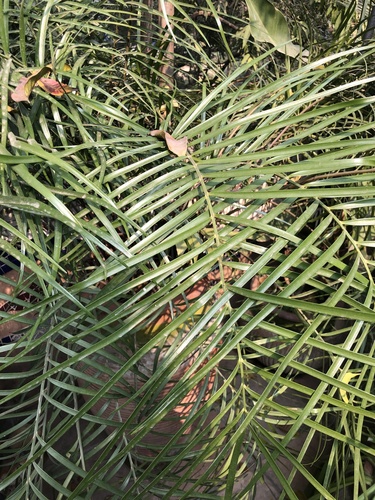
iNaturalist· cc-by-nc
(c) douglasnat, some rights reserved (CC BY-NC)
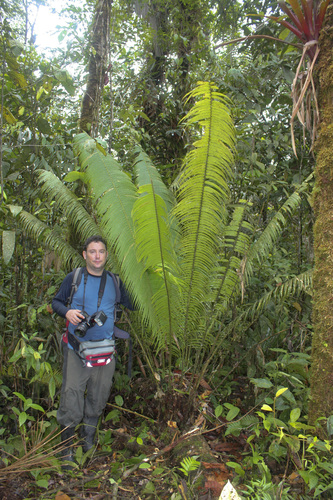
iNaturalist· cc-by-nc
(c) Suzanne Lennox, some rights reserved (CC BY-NC), uploaded by Suzanne Lennox
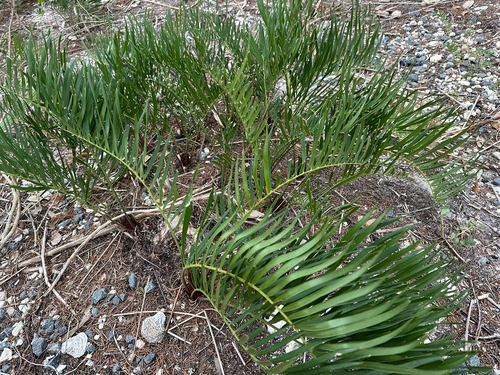
iNaturalist· cc-by
(c) Wairambar Rainforest, some rights reserved (CC BY), uploaded by Wairambar Rainforest
Summary
Source: WikipediaBowenia spectabilis is a species of cycad in the family Stangeriaceae. It is endemic to Queensland, Australia. Its natural habitat is subtropical or tropical moist lowland forests.
Description
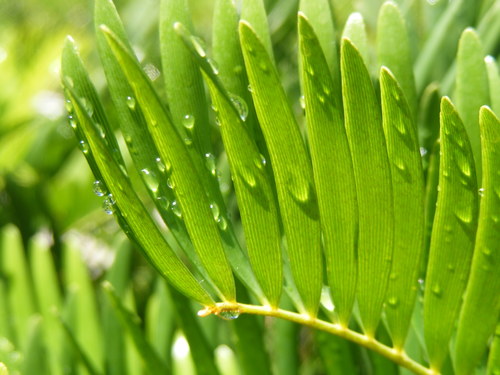
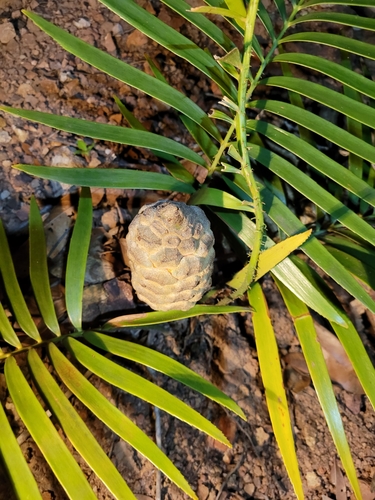
A small cycad. It is a palm like plant. It grows 1.5 m tall and spreads 1.5 m wide. It has an underground trunk. This is carrot shaped and 12 cm across. The tap root forms a tuber. The leaves are feather-like and arch over. They are 1 m long. The leaves are twice divided. The leaflets are leathery and oval. The edges of the leaves are smooth. Plants are separately male and female. Male cones are oblong and female cones are round. Male cones are 3-6 cm long by 2-3 cm wide. Female cones are 10-12 cm long by 7-10 cm wide. They are barrel shaped and brownish-green. They occur in groups at ground level. The seeds are 2.5-3.5 cm long by 1.5-2 cm wide. They are oblong and cream or pink or purple.
Edible Uses
The large, yam-like rhizomes are eaten by the Aborigines. Rich in starch, they are baked before eating. Cycads have often been used traditionally as a source of food starch, obtained either from the seeds or from the stems, and it is probable that the seed kernels and stem pith of all cyeads can be used as food after treatment to remove any toxic principle that may be present (See notes above on toxicity). The starch would appear to be of particular importance as a source of sustenance during hard times or in areas where the food supply is naturally limited.
Traditional Uses
The roots and seeds need treatment before eating.
This uses section is brief — help expand it
Known Hazards
The seeds are poisonous. The plant is toxic to livestock, the poison being cumulative and leading to weakness in the hindquarters.
Distribution
A tropical plant. It suits tropical and subtropical regions. It grows in the highland rainforests in Queensland in Australia. It requires some shade. It grows to 700 m altitude in tropical Queensland in Australia. It suits hardiness zone 11-12. In the Cairns Botanical Gardens. Melbourne Botanical gardens.
Where It Grows
Asia, Australia*, Indonesia, SE Asia,
Cultivation
It can be grown from seed. It can also be grown by dividing the tuberous stem. Large plants transplant easily.
Propagation
Seeds - best sown as soon as they are ripe, though the seeds of many species can take 12 months or more to finish maturing the embryo before they are ready to germinate. Sow the seeds in a tray in a freely-draining medium and place in moderate shade. Bottom heat at about 27°c will hasten seed germination dramatically. Young roots are quite brittle and once germination takes place, the root grows rapidly. It is important to pot up the seedlings at this time in order to give them enough root-space. Grow on the plants in pots until large enough to plant out. Division of off-sets or suckers is best carried out just before the plant comes in to new growth at the start of the growing season.
Notes
There are 3 Bowenia species. It has also been put in the family Strangeriaceae.
Nutrition
| Part | Moisture | kJ | kcal | Protein | Vit A | Vit C | Iron | Zinc |
|---|---|---|---|---|---|---|---|---|
| Root | 69 | 404 | 97 | 1.6 | — | — | 3 | 0.5 |
Also Known As
Chiroo, Gunyoo, Julbin, Sikas pakis zamia
References (26)
- Asmussen, B., 2011, Changing perspectives in Australian Archaeology, part 10. Australian Museum
- Beasley, J., 2011, Plants of Tropical North Queensland - the compact guide. Footloose publications. p 143
- Bircher, A. G. & Bircher, W. H., 2000, Encyclopedia of Fruit Trees and Edible Flowering Plants in Egypt and the Subtropics. AUC Press. p 63
- Bodkin, F., 1991, Encyclopedia Botanica. Cornstalk publishing, p 163
- Bot. Mag. 89: t. 5398. 1863
Show all 26 references Hide references
- Brickell, C. (Ed.), 1999, The Royal Horticultural Society A-Z Encyclopedia of Garden Plants. Convent Garden Books. p 186
- Cherikoff V. & Isaacs, J., The Bush Food Handbook. How to gather, grow, process and cook Australian Wild Foods. Ti Tree Press, Australia p 198
- Cooper, W. and Cooper, W., 2004, Fruits of the Australian Tropical Rainforest. Nokomis Editions, Victoria, Australia. p 2
- Cribb, A.B. & J.W., 1976, Wild Food in Australia, Fontana. p 137
- Cundall, P., (ed.), 2004, Gardening Australia: flora: the gardener's bible. ABC Books. p 248
- Elliot, W.R., & Jones, D.L., 1982, Encyclopedia of Australian Plants suitable for cultivation. Vol 2. Lothian. p 364
- Etherington, K., & Imwold, D., (Eds), 2001, Botanica's Trees & Shrubs. The illustrated A-Z of over 8500 trees and shrubs. Random House, Australia. p 138
- Hibbert, M., 2002, The Aussie Plant Finder 2002, Florilegium. p 45
- Hill, R. and Baird, A., 2003, Kuku-Yalanji Rainforest Aboriginal People and Carbohydrate Resource Management in the Wet Tropics of Queensland, Australia. Human Ecology, Vol. 31, No. 1. pp 27-52
- Jackes, B.R., 2001, Plants of the Tropics. Rainforest to Heath. An Identification Guide. James Cook University. p 83
- Jones D, L, 1986, Ornamental Rainforest Plants in Australia, Reed Books, p 330
- Jones, D.L., 2000, Cycads of the world. Reed New Holland. p 106
- Lazarides, M. & Hince, B., 1993, Handbook of Economic Plants of Australia, CSIRO. p 35
- Lim, T. K., 2015, Edible Medicinal and Non Medicinal Plants. Volume 9, Modified Stems, Roots, Bulbs. Springer p 17
- Low, T., 1991, Wild Food Plants of Australia. Australian Nature FieldGuide, Angus & Robertson. p 138
- Maiden, J. H., 1889, The Useful Native Plants of Australia (including Tasmania). The Technology Museum of NSW, Sydney. p 11
- Marinelli, J. (Ed), 2004, Plant. DK. p 361
- Nicholson, N & H., 1996, Australian Rainforest Plants 2, Terania Rainforest Publishing. NSW. p 12
- Ratcliffe D & P., 1987, Australian Native Plants for Indoors. Little Hills press. p 63
- Sukarya, D. G., (Ed.) 2013, 3,500 Plant Species of the Botanic Gardens of Indonesia. LIPI p 826
- Townsend, K., 1994, Across the Top. Gardening with Australian Plants in the tropics. Society for Growing Australian Plants, Townsville Branch Inc. p 103