Boscia oleoides
(Burch. ex DC.) Toelken
White-stem, Shepherd's tree, Coffee tree
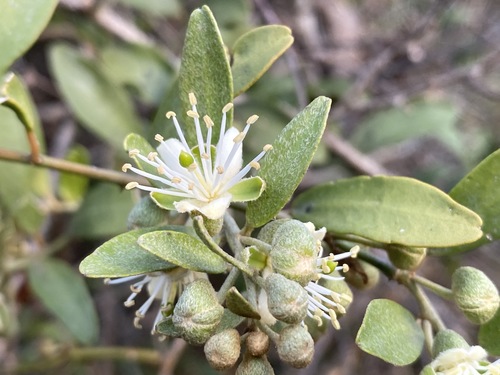
iNaturalist· cc-by-nc
(c) Craig Peter, some rights reserved (CC BY-NC), uploaded by Craig Peter
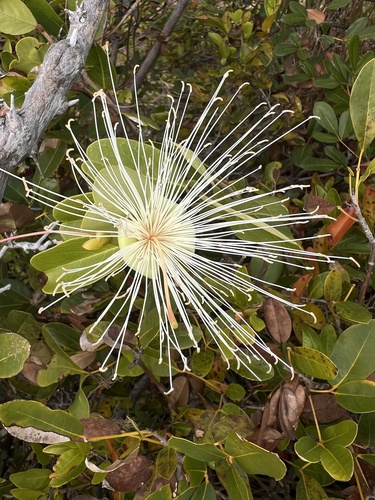
iNaturalist· cc-by-nc
(c) Craig Peter, some rights reserved (CC BY-NC), uploaded by Craig Peter
iNaturalist· cc-by-nc
(c) Craig Peter, some rights reserved (CC BY-NC), uploaded by Craig Peter
Description
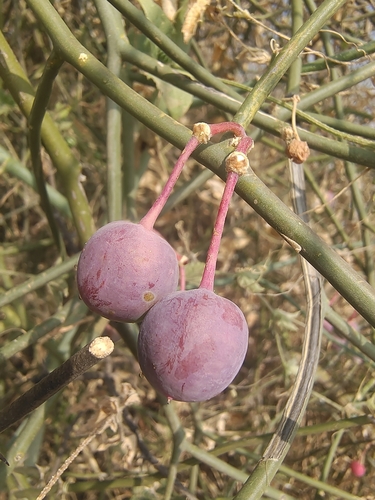
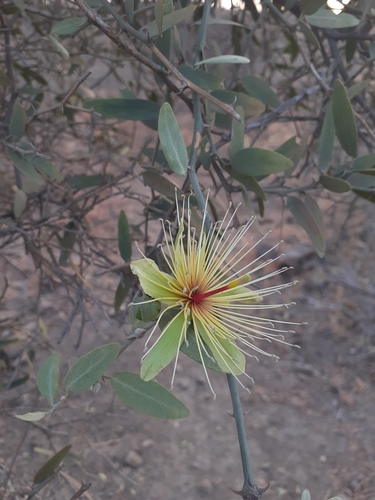
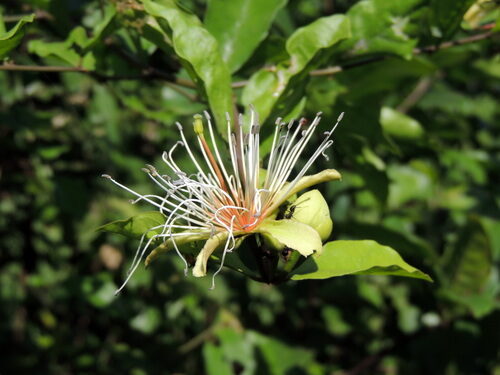
A shrub or tree. The flowers help distinguish this species from Boscia albitrunca. The leaves are hard and leathery. They are oblong and 2.5-5 cm long. They tend to be yellow-green. They have an easy to see midrib and are on short stalks. The leaves have small knobs near the base. The leaves are usually one after another along the branch. The flowers are small and star shaped. They have 2-4 petals. The flowers are usually at the ends of branches. They are yellow and have a strong sweet smell. The fruit is a smooth round berry. It can be 1.3 cm across.
Edible Uses
The roots are eaten as a famine food. The flower buds can be pickled in vinegar as capers. The bark from the roots is chopped and roasted as a coffee substitute. The fruit is also edible.
Traditional Uses
The bark from the roots is chopped and roasted for coffee. Roots are eaten as a famine food. The flower buds can be pickled in vinegar as capers.
This uses section is brief — help expand it
Distribution
It is a subtropical plant. It can grow in arid places.
Where It Grows
Africa, South Africa, Southern Africa,
Notes
There are 37 Boscia species.
Synonyms
Also Known As
Bastard shepherd's tree, Witgat
References (7)
- Palgrave, K.C., 1996, Trees of Southern Africa. Struik Publishers. p 189
- Peters, C. R., O'Brien, E. M., and Drummond, R.B., 1992, Edible Wild plants of Sub-saharan Africa. Kew. p 76
- Plowes, N. J. & Taylor, F. W., 1997, The Processing of Indigenous Fruits and other Wildfoods of Southern Africa. in Smartt, L. & Haq. (Eds) Domestication, Production and Utilization of New Crops. ICUC p 186
- Royal Botanic Gardens, Kew (1999). Survey of Economic Plants for Arid and Semi-Arid Lands (SEPASAL) database. Published on the Internet; http://www.rbgkew.org.uk/ceb/sepasal/internet [Accessed 7th April 2011]
- Ruiters-Welcome, A. K., 2019, Food plants of southern Africa. Ph.D. thesis. Univ. of Johannesburg p 42
Show all 7 references Hide references
- Welcome, A. K. & Van Wyk, B.-E., 2019, An inventory and analysis of the food plants of southern Africa. South African Journal of Botany 122 (2019) 136–179
- World Checklist of Useful Plant Species 2020. Royal Botanic Gardens, Kew